New undergraduates
Welcome to St Mary's College, the School of Divinity. You will find here information about Orientation Week and others ways we aim to help you get started with your studies.
-
 Welcome to St Mary’s College, the School of Divinity in the University of St Andrews. We are delighted that you have joined our community, and look forward to getting to know you, and to seeing how you contribute to our life in this ancient seat of learning. St Mary’s is one of the original colleges of the University, having been founded in 1538. Theology has been taught here continuously since 1579; so you are now part of a place with a long and distinguished history. We pride ourselves in being an open and inclusive college. There are student societies for undergraduates and postgraduates that organise various social events throughout the year in St Mary’s. We also have regular college chapel services, and you are most welcome to join in those during the semesters, whatever your religious affiliation. We are confident that you will find your place among us and will soon think of St Mary’s as your alma mater.
 With very best wishes for the new academic year,
Professor William Tooman,
Head of School and Principal of St Mary’s College -
 Welcome to your first year! My name is Ella Prieto, your President of the School of Divinity, and I absolutely cannot wait to meet you! I am a third year from Texas currently studying biblical and theological studies on the MTheol track—so no matter what you’re studying, we’ll have plenty to talk about. If you are nervous about this coming year, have no fear—you will feel at home here at St Mary’s! Our small size allows for a strong academic community, uniting undergraduates, postgraduates, and staff, leading to incredible opportunities for collaboration and friendship. Whether you’re in lecture, tutorial, the junior common room (or the JCR, as we lovingly call it), or at the pub with friends, you will find a supportive, intellectually challenging, and FUN community here. You will love it!
I can’t wait to get to know you and watch you settle in! If you have any questions at all (or would just like to meet for a coffee and a chat), you can reach me at divinitypresident@st-andrews.ac.uk. See you soon!
-

I'm John Perry, one of your lecturers, writing together with Natalie Mackie (who works in the Divinity office) and Beth Cook (4th year undergraduate). Here at the School of Divinity, we want everyone to feel challenged and be treated fairly. Natalie and I lead the team responsible for helping staff and students get better at honouring those commitments. At our University, we support equality and diversity in all aspects of our activities by listening to others, even when we disagree, providing an environment free from discrimination and harassment, regardless of race, religion, disability, ethnicity, or sexual identity or orientation. Feel free to email divedi@st-andrews.ac.uk with any suggestions and concerns, or to reach Beth, bc215@st-andrews.ac.uk.
-
These are the various academic activities the School is delivering for new undergraduates during Orientation Week. You should ensure that you use the Orientation app and MySaint (for your personalised timetable) as locations and times may be updated there.
Monday 7 September 2026
12.30-2.00pm Academic Fayre - Upper and Lower College Hall. You will be able to meet some Divinity staff and senior students to ask questions about your studies.
Wednesday 9 September 2026
2.30-3.00pm Tours of St Mary's College. Important for you finding your way around the College buildings. Meet in St Mary's Quad.
3.00-4.00pm Get to know academic members of staff. This gives you the opportunity to meet teaching staff and student representatives. Location: Senior Common Room (St Mary’s College).
Friday 11 September 2026
11.00am-12 noon Introduction to Teaching & Learning in Divinity. Mandatory session, led by Dr Doren Snoek, for all new undergraduate students. Location: St Mary’s College, Lecture Room 1.
4.00-6.00pm Opening Lecture of the School of Divinity, to be given by Professor Judith Wolfe, "Theology in the University". The lecture will be followed by refreshments. Location: Parliament Hall
-
St Mary's College Student Society Events
Wednesday 9 September 2026
2.00pm First Cake and Coffee hour of the semester. Location: Outside in St Mary's Quad (weather permitting); SCR (if bad weather).
(You can also meet members of the College Society at the Academic Fayre on 7 September.)
-
First year recommended reading list. * = Required textbook for the module
DI1001 - God and the World: Introducing Theology
- Woodhead, Linda. Christianity: A Very Short Introduction. OUP, 2014.
- Hart, Trevor. Confessing and Believing: The Apostles’ Creed as Script for the Christian Life. Minneapolis: Fortress Press, 2022.
(Both are available as paper copies and ebooks via the library.)
DI1003 - The Art of Biblical Literature: Introducing the Hebrew Bible/Old Testament
No preliminary reading is expected, but students will need a modern translation of the Bible. Many translations are freely available online. Most will be fine for this module except the translations called The Message, The American Bible, and The Amplified Bible. Excerpts from the NRSV (New Revised Standard Version) or the NJPS (New Jewish Publication Society) frequently will be used in lecture.
DI1004 - Hebrew I: Introduction to Hebrew Language
- *Weingreen, Jacob. A Practical Grammar for Classical Hebrew. 2nd ed. OUP, 1963. (Numerous copies are available in the library.)
DI1005 - New Testament Greek 1
- *Duff, Jeremy. The Elements of New Testament Greek. 3rd revised edition. Cambridge University Press, 2005. (Make sure to purchase this edition by Jeremy Duff and not the earlier editions of the same title by J. W. Wenham or H. P. V. Nunn.)
-
You each have an advisor of studies, each of your modules has its designated coordinator, and the Director of Teaching (divdot@st-andrews.ac.uk) is also available. Once the semester is fully underway it is usually the coordinator of one or other of your modules who will be your first port of call if you are unable to find the information you need from any of the sources below.
The University Student Handbook
The School of Divinity Undergraduate Handbook (this has information specific to this School and will be available nearer to the start of semester).
Module handbooks (these have information specific to each module and will be available in Moodle at the start of semester).
Key staff contacts for undergraduates
Full list of staff contacts, listed by role
Equality and diversity commitment and support
School of Divinity's Wellbeing Officer - Dr Dafydd Daniel (demd1@st-andrews.ac.uk)
Welcome to your first semester modules
-
 A very warm welcome to all students planning to take DI1001 God and the World: Introducing Theology. I am Prof Oliver Crisp, the module coordinator of this course. I will be teaching it alongside Prof Andrew Torrance and Prof Judith Wolfe. The course is delivered by in-person lectures with the professors and tutorials in which you can engage the materials and topics in a more informal setting with a course tutor.
Theology asks the most fundamental questions in life to which we all want answers. Is there a god? Is there life after death? Who was Jesus of Nazareth? What is salvation? These matters are vital to the lives of 2.5 billion Christians around the world—making Christianity the largest world religion. Given the importance of religious questions in the lives of so many people (Christian or otherwise), it is only natural to want to find out more. In this course, we begin to do that. In many ways, the module is a gateway to the other offerings in the School of Divinity that can be taken later in your academic careers. It addresses core claims made by the Christian faith. These include: the existence and nature of God; creation and our place in it; human failing and divine salvation; the person and work of Christ; and death and the afterlife. The emphasis is always on giving you a sense of the depth and vitality of these questions in engagement with the tradition while engaging contemporary theological challenges raised by the world in which we live today. Nothing is more vital than these matters. It is what gets me out of bed in the morning and has kept me pondering and writing for more than 30 years. I look forward to seeing you in class in the autumn of 2026 to begin thinking about and discussing these issues together.
-
Welcome to all students considering taking The Art of Biblical Literature: Introducing the Hebrew Bible/Old Testament (DI1003). I am Professor William Tooman, the module coordinator.
If you want to learn about the Bible, this is the place to start: at the beginning. DI1003 is open to anyone, the Bible enthusiast and the novice. We cover three substantial sections of the Bible: the Torah (five books of stories, laws, and poems attributed to Moses); the Deuteronomistic History (four books of stories from the conquest of the Holy Land to the Babylonians’ destruction of Jerusalem); and the books of the Prophets who brought God's message to Israel (four books of poems and stories about Israel’s life and future).
The Bible’s writers come from a world that is quite different from ours. Their views about the gods, the universe, humans, and destiny come from a particular time and culture. They speak with ancient voices, but they explore timeless human issues: the purpose of life, the place of humans in the universe, whether it’s worthwhile being ‘good,’ whether religion or politics really matter. All the emotions of human existence are here too: joy and grief, pleasure and pain, success and failure, love and hate. But ancient Israelites had their own ways of writing literature, which is unlike anything I know in the modern world.
So, while we explore what Israel has to say, we will also learn how biblical stories and poems were crafted. We will see that reading the Bible is as much an art as it is. We will experience dramatic stories and sublime poems. We will encounter countercultural ideas, poignant tragedies, and quirky comedies. Most of all, we will see that the Bible repays even small efforts to understand it. I look forward to seeing you in DI1003.
-
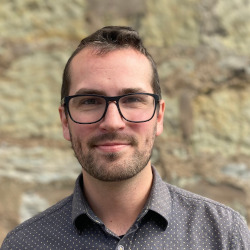 English speakers are spoiled for choice with translations of the Bible. However, there is nothing like reading the rich literature of the Hebrew Bible in its original language. I’m Dr Ethan Knudson, the module coordinator for DI1004 Hebrew 1. By learning to read the Bible in Hebrew, you can experience the Bible’s pervasive nuance, word play, and craft that is often lost in translation. For example, did you know that the “Manna” which the people of Israel eat in the wilderness could be translated as the “whatchamacallit”? Or that Jacob’s name is a pun that presents him as a trickster? In this module, we will start with the absolute basics of how to pronounce written Hebrew, and progressively build the necessary grammatical knowledge, vocabulary, and skills to read simple biblical texts. Learning Hebrew is a challenging undertaking, but we will be in it together and the rewards are well worth the effort!
 -
Maybe you’ve heard someone say “It’s all Greek to me!” and rolled your eyes. Come learn Greek, and you can say this ironically about things you know a lot about! I’m Dr Ethan Knudson, the module coordinator for DI1005 New Testament Greek 1. Something that is tremendously difficult to preserve in translation is an author's unique voice, but it is impossible to miss when you read in the original language. By learning Greek, you can encounter the rich and diverse voices in the the New Testament: the playful punning in the Gospel of John, the short and punchy story-telling of Mark, or the apostle Paul's endearing inability to end a sentence. Together we will start from the absolute basics of the Greek alphabet and pronunciation, and by the end of the module you will be reading extended texts from the Greek New Testament. Learning an ancient language is challenging, but the reward is tremendous—the ability to engage directly with books and authors that have captivated readers for millennia.
Miscellaneous
-
Students of the University of St Andrews wear the gown appropriate to their Faculty for attendance at special University functions. So far as Divinity is concerned, those students who are already graduates may wear the gown of their own University, but with the violet cross of St Andrew on the left facing. For undergraduates in the MTheol and BD programmes the description of the appropriate gown is:
Black stuff gown of knee length with short open sleeves and with violet cross of St Andrew (BCC 214 - Spectrum violet) on the left facing.
Undergraduates on MA programmes wear the scarlet Arts and Science gown.
-
The School of Divinity has an active presence on Instagram, Facebook, and X (formally Twitter). Please follow these accounts for important and timely information as well as student and staff highlights. @DivinityStA is the Divinity handle on all three platforms.