New undergraduates
Welcome to St Mary's College, the School of Divinity. You will find here information about Orientation Week and others ways we aim to help you get started with your studies.
-
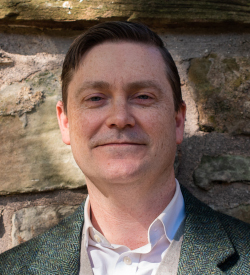 Welcome to St Mary’s College, the School of Divinity in the University of St Andrews. We are delighted that you have joined our community, and look forward to getting to know you, and to seeing how you contribute to our life in this ancient seat of learning. St Mary’s is one of the original colleges of the University, having been founded in 1538. Theology has been taught here continuously since 1579; so you are now part of a place with a long and distinguished history. We pride ourselves in being an open and inclusive college. There are student societies for undergraduates and postgraduates that organise various social events throughout the year in St Mary’s. We also have regular college chapel services, and you are most welcome to join in those during the semesters, whatever your religious affiliation. We are confident that you will find your place among us and will soon think of St Mary’s as your alma mater.
 With very best wishes for the new academic year,
Professor William Tooman,
Head of School and Principal of St Mary’s College. -
 Welcome to your first year! I’m Piper, your President of the School of Divinity, and I could not be more excited to meet you. I’m a third year currently working towards an MA in Biblical Studies, but no matter what your degree path is, trust me — St Mary’s is where you belong. If you are anxious about the year ahead right now, I want you to know that it is my personal duty and privilege to make certain throughout your journey that you feel like you are living your dream. It will be an extraordinary year – do not worry. Your time here will be full of laughter. You will find the kind of academic environment where your unique talents are valued, and where, by the reassurance of a supportive group of friends, you find space to be curious, creative, and take risks that could lead to the next breakthrough in the field. I cannot wait to hear what matters to you, to know your name. Each one of us makes up St Mary’s, and you are now one of us! Please contact me if you have any questions, or, if you’ve made it this far, send me a picture of your pet for a chance to be featured in the opening newsletter (divinitypresident@st-andrews.ac.uk).
 -
 I'm John Perry, one of your lecturers. Here at the School of Divinity, we want everyone to feel challenged and be treated fairly. I lead the team responsible for helping staff and students get better at honouring those commitments. At our University, we support equality and diversity in all aspects of our activities by listening to others, even when we disagree, providing an environment free from discrimination and harassment, regardless of race, religion, disability, ethnicity, or sexual identity or orientation. Please feel free to email divedi@st-andrews.ac.uk with any suggestions and concerns.
 -
These are the various academic activities the School is delivering for new undergraduates during Orientation Week. You should ensure that you use the Orientation app and MySaint (for your personalised timetable) as locations and times may be updated there.
Monday 8 September 2025
12.30-2.00pm Academic Fayre - Lower and Upper College Hall. You will be able to meet some Divinity staff and senior students to ask questions about your studies.
Wednesday 10 September 2025
2.30-3.00pm Tours of St Mary's College. Important for you finding your way around the College buildings. Meet in St Mary's Quad.
3.00-4.00pm Get to know academic members of staff. This gives you the opportunity to meet teaching staff and student representatives. Location: Senior Common Room (St Mary’s College).
Thursday 11 September 2025
Various times. Introductory Lectures, mandatory teaching sessions for participants in these modules
- DI1001 - God and the World: Introducing Theology - 10.00-11.00am in St Mary's College, Lecture Room 1
- DI1003 - Old Testament 1: Torah and Prophets - 12.00-1.00pm in St Mary's College, Lecture Room 1
- DI1004 - Hebrew 1: Introduction to Hebrew Language - 1.00-2.00pm in St Mary's College Lecture Room 2.
- DI1005 - New Testament Greek 1 - 4.00-5.00pm in St Mary's College, Seminar Room 2.
- DI2003/DI2013 - Paul & the Epistles - 11.00am-12.00pm in St Mary's College, Lecture Room 2.
- DI2010 - Philosophical Theology - online on Moodle.
Friday 12 September 2025
11.00am-12 noon Introduction to Teaching & Learning in Divinity. Mandatory session, led by Dr Lamb Varela, for all new undergraduate students. Location: St Mary’s College, Lecture Room 1.
4.00-6.00pm Opening Lecture of the School of Divinity, to be given by Dr T.J. Lang, "Christian Creeds, the Philosophy of Faith, and the Gospel of John". The lecture will be followed by refreshments. Location: Parliament Hall
-
St Mary's College Student Society Events
Wednesday 10 September 2025
2.00pm First Cake and Coffee hour of the semester. Location: Outside in St Mary's Quad (weather permitting); SCR (if bad weather)
Friday 12 September 2025
7.30pm sharp Opening Service of the College Society. Gowns encouraged! Followed by a pub social. Location: St Salvator's Chapel
(You can also meet members of the College Society at the Academic Fayre on 8 September 2025.)
-
First year recommended reading list. * = Required textbook for the module
DI1001 - God and the World: Introducing Theology
- Woodhead, Linda. Christianity: A Very Short Introduction. OUP, 2014.
- Hart, Trevor. Confessing and Believing: The Apostles’ Creed as Script for the Christian Life. Minneapolis: Fortress Press, 2022.
(Both are available as paper copies and ebooks via the library.)
DI1003 - The Art of Biblical Literature: Introducing the Hebrew Bible/Old Testament
No preliminary reading is expected, but students will need a modern translation of the Bible. Many translations are freely available online. Most will be fine for this module except the translations called The Message, The American Bible, and The Amplified Bible. Excerpts from the NRSV (New Revised Standard Version) or the NJPS (New Jewish Publication Society) frequently will be used in lecture
DI1004 - Hebrew I: Introduction to Hebrew Language
*Weingreen, Jacob. A Practical Grammar for Classical Hebrew. 2nd ed. OUP, 1963. (Numerous copies are available in the library.)
DI1005 - New Testament Greek 1
*Duff, Jeremy. The Elements of New Testament Greek. 3rd revised edition. Cambridge University Press, 2005. (Make sure to purchase this edition by Jeremy Duff and not the earlier editions of the same title by J. W. Wenham or H. P. V. Nunn.)
DI1201 - From Adam to Apocalypse: The Bible and Western Culture
- Strawn, Brent A. The Old Testament: A Concise Introduction. Routledge, 2019.
In addition to either of the following two options:
- Jones, Norman W. The Bible and Literature: The Basics. Routledge, 2016.
- Beal, Timothy. The Rise and Fall of the Bible: The Unexpected History of an Accidental Book. Houghton Mifflin, 2012.
-
You each have an advisor of studies, each of your modules has its designated coordinator, and the Director of Teaching (divdot@st-andrews.ac.uk) is also available. Once the semester is fully underway it is usually the coordinator of one or other of your modules who will be your first port of call if you are unable to find the information you need from any of the sources below.
The University Student Handbook
The School of Divinity Undergraduate Handbook (this has information specific to this School and will be available nearer to the start of semester).
Module handbooks (these have information specific to each module and will be available in Moodle at the start of semester).
Key staff contacts for undergraduates
Full list of staff contacts, listed by role
Equality and diversity commitment and support
School of Divinity's Wellbeing Officer - Dr Dafydd Daniel (demd1@st-andrews.ac.uk)
Welcome to your first semester modules
-
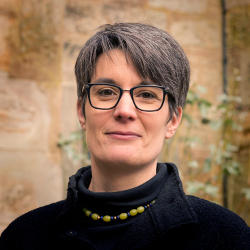 A very warm welcome to all students planning to take DI 1001 God and the World: Introducing Theology. I am Rev. Katrin Bosse, Associate Lecturer in Theology and the module coordinator of this course. The course will be co-taught by Prof Judith Wolfe.
The world we inhabit cannot be understood without understanding the impact of the religions on all areas of life. In this course we offer an introduction to Christian theology as an example case of a religious understanding of reality. Against the background of the situation of religious and philosophical pluralism, we will reflect on how Christian faith shapes human orientation in the world. We will explore the Christian doctrines of God, creation, the human destiny and sin, Jesus Christ, salvation, and the ultimate destiny of the world and learn about the impact of this understanding of reality for the life of the church. From this perspective it is possible to engage with other religious or non-religious world views by way of analogical and dialogical reasoning. We will see how, for 2000 years, Christian theology has been in constant interaction with philosophical thinking and has shaped all areas of culture: politics, economy, the sciences and humanities, personal formation and community organisation, art and architecture.
The three lectures per week are accompanied by weekly tutorials (from week 2-10), led by doctoral students and colleagues. These sessions give students lots of opportunity to discuss the topics of each week on the basis of readings assigned to each week. I hope that the course becomes an intellectually inspiring adventure for you. For me, one of the most exciting aspects of doing theology is that my own (often very basic) beliefs and certainties in life are clarified, reinforced or questioned by engaging with scholarly discourse. In other words, doing theology, in conversation with all of you, changes my outlook on life. I hope this will be true for you when taking part in this module, whether your basic beliefs and certainties are religious or not. Prof Wolfe and I look forward to meeting you in Martinmas 2025.
-
Welcome to all students considering taking The Art of Biblical Literature: Introducing the Hebrew Bible/Old Testament (DI1003). I am Professor William Tooman, the module coordinator.
If you want to learn about the Bible, this is the place to start: at the beginning. DI1003 is open to anyone, the Bible enthusiast and the novice. We cover three substantial sections of the Bible: the Torah (five books of stories, laws, and poems attributed to Moses); the Deuteronomistic History (four books of stories from the conquest of the Holy Land to the Babylonians’ destruction of Jerusalem); and the books of the Prophets who brought God's message to Israel (four books of poems and stories about Israel’s life and future).
The Bible’s writers come from a world that is quite different from ours. Their views about the gods, the universe, humans, and destiny come from a particular time and culture. They speak with ancient voices, but they explore timeless human issues: the purpose of life, the place of humans in the universe, whether it’s worthwhile being ‘good,’ whether religion or politics really matter. All the emotions of human existence are here too: joy and grief, pleasure and pain, success and failure, love and hate. But ancient Israelites had their own ways of writing literature, which is unlike anything I know in the modern world.
So, while we explore what Israel has to say, we will also learn how biblical stories and poems were crafted. We will see that reading the Bible is as much an art as it is. We will experience dramatic stories and sublime poems. We will encounter countercultural ideas, poignant tragedies, and quirky comedies. Most of all, we will see that the Bible repays even small efforts to understand it. I look forward to seeing you in DI1003.
-
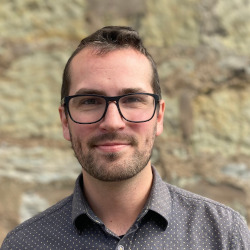 English speakers are spoiled for choice with translations of the Bible. However, there is nothing like reading the rich literature of the Hebrew Bible in its original language. I’m Dr Ethan Knudson, the module coordinator for DI1004 Hebrew 1. By learning to read the Bible in Hebrew, you can experience the Bible’s pervasive nuance, word play, and craft that is often lost in translation. For example, did you know that the “Manna” which the people of Israel eat in the wilderness could be translated the “whatchamacallit”? Or that Jacob’s name is a pun that presents him as a trickster? In this module, we will start with the absolute basics of how to pronounce written Hebrew, and progressively build the necessary grammatical knowledge, vocabulary, and skills to read simple biblical texts. Learning Hebrew is a challenging undertaking, but we will be in it together and the rewards are well worth the effort!
 -
Maybe you’ve heard someone say “It’s all Greek to me!” and rolled your eyes. Come learn Greek, and you can say this ironically about things you know a lot about! I’m Dr Ethan Knudson, the module coordinator for DI1005 New Testament Greek 1. Together we will start from the absolute basics of the Greek alphabet and steadily build a working understanding of the language. By the end of the module, you will be reading basic texts from the New Testament and other selections of Greek literature. Learning an ancient language is challenging, but the reward is tremendous—the ability to engage directly with books that have captivated and shaped readers for millennia.
-
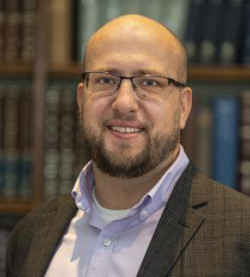
Welcome to St Andrews. I'm delighted that you've signed up for this module. My name is Dr Doren Snoek, and I'll be coordinating the module. I'm excited to explore with you the Bible and the truly fascinating ways it has been retold, adapted, and transformed in Western Culture. One goal of the module is to get you from one end of the Bible to the other, so please get your hands on one! (Yes, in print!) Try to find a "standard" version, like the New Revised Standard Version (NRSV) or a similar translation; you should find one with the Hebrew Bible (= Old Testament), New Testament, and the Apocrypha. The “standard” version for Catholics, Jews, and Eastern Orthodox are each a little different, and so if you have any questions, please let me know. If you want a "study" bible with notes, for the Old Testament / Hebrew Bible, consider the JPS Study Bible, and for the rest, consider the New Oxford Annotated Bible. If any of you are here to study English, you might even consider getting a King James Version, since this Bible translation has had such an enormous influence on the English language. I look forward to meeting you in class!
Miscellaneous
-
Students of the University of St Andrews wear the gown appropriate to their Faculty for attendance at special University functions. So far as Divinity is concerned, those students who are already graduates may wear the gown of their own University, but with the violet cross of St Andrew on the left facing. For undergraduates in the MTheol and BD programmes the description of the appropriate gown is:
Black stuff gown of knee length with short open sleeves and with violet cross of St Andrew (BCC 214 - Spectrum violet) on the left facing.
Undergraduates on MA programmes wear the scarlet Arts and Science gown.
-
The School of Divinity has an active presence on Instagram, Facebook, and X (formally Twitter). Please follow these accounts for important and timely information as well as student and staff highlights. @DivinityStA is the Divinity handle on all three platforms.