Why study this course?
Normally, for joint degree programmes, the subject with the higher entry requirements determines the grades you need. Chemistry with Mathematics MChem (Hons) joint degree programme has different entry requirements which are listed below.
All other aspects of the programme, including modules and teaching format, are the same as those listed on the Chemistry MChem and Mathematics MMath pages.
For more information on joint honours degrees, contact the Admissions team or the School of Chemistry at chemug@st-andrews.ac.uk.
Course details
The MChem (Hons) in Chemistry with Mathematics will teach you the fundamentals of the central science of chemistry, from the composition and properties of matter, to using reactions to create new molecules and materials. You will learn about the critical role of chemistry in industries and new technologies from pharmaceuticals to accessing drinkable water, and from efficient energy generation to sustainable food production.
You will develop a high level of mathematical ability to understand complex patterns and structures, and develop the tools with which to analyse them. Whether these patterns relate to physical or biological phenomena or the structure of mathematics itself, the primary aim is to describe, categorise, and understand the processes involved.
Chemistry with Mathematics at St Andrews interfaces with biology, physics, medicine and geology, making it a highly applicable degree.
The University of St Andrews operates on a flexible modular degree system by which degrees are obtained through the accumulation of credits.
Ask a student
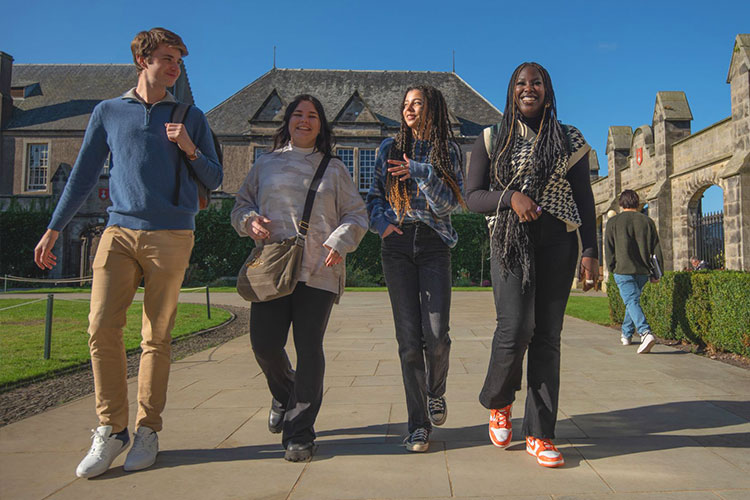
If you are interested in learning what it's like to be a student at St Andrews you can speak to one of our student ambassadors. They'll let you know about their top tips, best study spots, favourite traditions and more.

How it's taught
Teaching
The teaching format for this course is the same as for Chemistry MChem and Mathematics MMath. More information can be found on the Chemistry MChem and Mathematics MMath webpages.
-
The University's services and support teams can help students with additional needs resulting from disabilities, long-term medical conditions or learning disabilities, as well as many other difficulties and challenges students might face while studying.
Modules
Course information may change. Module information and course content, teaching and assessment may change each year and after you have accepted your offer to study at the University of St Andrews. We display the most up-to-date information possible, but this could be from a previous academic year. For the latest module information, see the module catalogue.
-
- Introductory Inorganic and Physical Chemistry: This module covers origin of the elements and the periodic table, atomic structure, shapes and properties of molecules, chemistry of the elements, properties of solutions, thermochemistry, thermodynamics and kinetics, and mathematical tools for chemistry.
- Inorganic and Physical Chemistry 1: covers bonding in simple molecules, inorganic solids, chemistry of the first-row transition metals, properties of solids, states of matter, and introductory spectroscopy.
- Organic and Biological Chemistry 1: This module covers the structure and nomenclature of simple organic compounds, basic stereochemistry, fundamental organic reaction mechanisms, organic functional groups and their reactions, introductory bioorganic chemistry, and organic spectroscopy
- Mathematics: introduces the ideas and techniques required for further study of mathematics or applications to other sciences.
-
- Introductory Chemistry for Second Year Direct Entry Students: CH1202 covers the core concepts from level 1000 chemistry across inorganic, organic, and physical chemistry aimed at students joining university directly into 2nd year.
- Inorganic Chemistry 2: This module develops via lectures, tutorials, a group presentation and laboratory classes, students’ knowledge and understanding of the fundamentals of Inorganic Chemistry across the breadth of the periodic table as preparation advanced studies.
- Organic Chemistry 2 (French): covers methods for carbon-carbon bond formation and interconversion of functional groups, aromatic and heteroaromatic reactivity, retrosynthetic analysis, mechanistic biological chemistry and organic spectroscopy
- Physical Chemistry 2: covers quantum mechanics, thermodynamics and electrochemistry, chemical kinetics, molecular spectroscopy and diffraction, and advanced mathematical tools for chemistry.
- Linear Mathematics: introduces the theory of vector spaces, linear independence, linear transformations and diagonalisation.
- Analysis: introduces key concepts of real analysis: limit, continuity and differentiation.
- Multivariate Calculus: extends the techniques of calculus in a single variable to the setting of real functions of several variables.
- Combinatorics and Probability: introduces counting techniques for finite structures and the behaviour of random variables.
- Abstract Algebra: explores the key concepts of modern abstract algebra: groups, rings and fields.
- Vector Calculus: introduces the theory of scalar and vector fields and associated techniques for the modelling of problems arising in the physical world.
- Mathematical Modelling: investigates the translation of physical problems into mathematics.
- Statistical Inference: introduces techniques for drawing inferences about population characteristics from observed data.
-
The knowledge and skills in research and analysis that you gain during the sub-honours years will prepare you to undertake more advanced and specialist modules during your final three (Honours) years combining Chemistry and Mathematics modules.
In years four and five students also undertake a substantial research project in Chemistry on a topic chosen in consultation with academic staff. The project aims to develop your skills in experimental design and problem-solving, the evaluation and interpretation of data, independent working and both oral and written communication.
Fees and funding
- Scotland: Tuition fees are yet to be confirmed by the Scottish Government.
- England, Wales, Northern Ireland and Republic of Ireland, Channel Islands, Isle of Man: £9,790 (yet to be confirmed by the UK Government)
- EU and overseas: £33,250
More information on tuition fees can be found on the undergraduate fees and funding page.
Accommodation fees
Find out about accommodation fees for University accommodation.
Funding and scholarships
The University of St Andrews offers a number of scholarships and support packages to undergraduate students each year.
Entry requirements
The University offers different entry requirements, depending on your background. Find out more about Standard and Minimum entry requirements using academic entry explained and see which entry requirements you need to look at using the entry requirements indicator.
For degrees combining more than one subject, the subject with the higher entry requirements determines the grades you need. You will also need to meet any further subject-specific entry requirements as outlined on their pages.
-
- Standard entry grades:
- AAAAB, including A in Chemistry and an A in Mathematics.
- Minimum entry grades:
- AABB, including A in Chemistry and an A in Mathematics.
-
- Standard entry grades:
- A*A*A, including A in Chemistry and A* in Mathematics.
- Minimum entry grades:
- A*AB, including an A in Chemistry and A* in Mathematics.
-
- Standard entry grades:
- 38 (HL 6,6,6), including HL6 in Chemistry and an HL6 in Mathematics.
- Minimum entry grades:
- 36 (HL 6,6,5), including HL6 in Chemistry and an HL6 in Mathematics.
General entry requirements
All applicants must have attained the following qualifications, or equivalent, in addition to the specific entry requirements for individual programmes.
-
SQA National 5 (B) in English and one SQA National 5 (B) from the following:
- Biology
- Chemistry
- Computing science
- Geography
- Applications of Mathematics
- Mathematics
- Physics
- Psychology.
-
GCSE (5) in English language or English literature, and one GCSE (5) from the following:
- Biology
- Chemistry
- Computing Science
- Geography
- Mathematics
- Physics
- Psychology.
Other qualifications
We accept a wide range of qualifications for entry on to our programmes. Please see our entry requirements for more information.
More information on how to apply via other entry routes or accreditation of prior learning and experience can be found on the University's entry requirements web page.
Do I need to have studied this subject before?
Yes, applicants are expected to have studied Chemistry and Mathematics at SQA Higher, GCE A-Level, IB Higher Level, or equivalent. Preference may be given to candidates offering strong science qualifications.
International applicants
If English is not your first language, you will need to provide an English language test score to evidence your English language ability.
Joint Honours degrees
You can also take Chemistry with Mathematics as part of a joint Honours degree in which you will take core modules of your chosen subjects.
| Course name | UCAS code |
|---|---|
| Arabic and Mathematics (With Integrated Year Abroad) | TV78 |
| Bachelor of Science (Honours) Biology and Chemistry | C761 |
| Bachelor of Science (Honours) Biology and Mathematics | CG11 |
| Bachelor of Science (Honours) Chemistry and Earth Sciences | FF16 |
| Bachelor of Science (Honours) Chemistry and Mathematics | FG11 |
| Bachelor of Science (Honours) Computer Science and Mathematics | GG14 |
| Bachelor of Science (Honours) Economics and Mathematics | GLC1 |
| Bachelor of Science (Honours) Financial Economics and Mathematics | L114 |
| Bachelor of Science (Honours) Geography and Mathematics | GF18 |
| Bachelor of Science (Honours) Mathematics and Philosophy | GV14 |
| Bachelor of Science (Honours) Mathematics and Physics | FG31 |
| Bachelor of Science (Honours) Mathematics and Psychology | GC18 |
| German and Mathematics (With Integrated Year Abroad) | GR21 |
| Italian and Mathematics (With Integrated Year Abroad) | RG31 |
| Master in Physics (Honours) Mathematics and Theoretical Physics | FGH1 |
| Master in Science (Honours) Chemistry and Physics | FF13 |
| Master of Arts (Honours) Ancient History and Mathematics | GVC1 |
| Master of Arts (Honours) Arabic and Mathematics | GT16 |
| Master of Arts (Honours) Art History and Mathematics | GV13 |
| Master of Arts (Honours) Biblical Studies and Mathematics | VG61 |
| Master of Arts (Honours) Classical Studies and Mathematics | QG81 |
| Master of Arts (Honours) Economics and Mathematics | GL11 |
| Master of Arts (Honours) English and Mathematics | Q3G1 |
| Master of Arts (Honours) Financial Economics and Mathematics | L113 |
| Master of Arts (Honours) German and Mathematics | R2G1 |
| Master of Arts (Honours) Hebrew and Mathematics | GQ14 |
| Master of Arts (Honours) International Relations and Mathematics | LG21 |
| Master of Arts (Honours) Italian and Mathematics | GR13 |
| Master of Arts (Honours) Latin and Mathematics | GQ16 |
| Master of Arts (Honours) Mathematics and Medieval History | GV11 |
| Master of Arts (Honours) Mathematics and Modern History | GVD1 |
| Master of Arts (Honours) Mathematics and Philosophy | GV15 |
| Master of Arts (Honours) Mathematics and Psychology | CG81 |
| Master of Arts (Honours) Mathematics and Russian | GR17 |
| Master of Arts (Honours) Mathematics and Scottish History | GV12 |
| Master of Arts (Honours) Mathematics and Spanish | GR14 |
| Master of Arts (Honours) Mathematics and Theological Studies | GV16 |
| Mathematics and Russian (With Integrated Year Abroad) | RG71 |
| Mathematics and Spanish (With Integrated Year Abroad) | GRC4 |
"With" degrees
You can take Chemistry with Mathematics as part of a "with" Honours degree in which the majority of the course deals with the first name subject. St Andrews offers the following "with" degrees in Chemistry with Mathematics:
- Bachelor of Science (Honours) Chemistry with French - UCAS code F1R1
- Bachelor of Science (Honours) Mathematics with Geography - UCAS code G1F8
- Chemistry with French (With External Placement) - UCAS code F1RA
- Chemistry with French (With Integrated Year Abroad) - UCAS code F1RC
- Master in Chemistry (Honours) Chemistry with French - UCAS code F1RD
- Master of Arts (Honours) Mathematics with Russian - UCAS code G1RT
- Master of Arts (Honours) Mathematics with Spanish - UCAS code G1RL
- Mathematics with Russian (With Integrated Year Abroad) - UCAS code G1R9
- Mathematics with Spanish (With Integrated Year Abroad) - UCAS code G1RX
"With" degrees taken with French, Russian, Spanish are also available 'With Integrated Year Abroad'.
Careers
St Andrews chemistry graduates have an employment rate of over 95% and are in demand by large multinational and grassroots companies alike. Chemistry degrees provide a range of highly desirable skills that are prized by employers across numerous sectors, including:
- problem-solving
- numeracy
- data handling
- teamwork
- oral and written communication.
St Andrews Chemistry with Mathematics graduates move into a wide range of employment both in the chemical and allied industries, as well as sectors outside physical science which rely on a high degree of mathematical ability. Many MChem Chemistry with Mathematics graduates continue on to PhD-level degrees both in the UK and overseas.
The Careers Centre offers one-to-one advice to all students as well as a programme of events to assist students to build their employability skills.
What to do next
Online information events
Join us for one of our information events where you can find out about different levels of study and specific courses we run. There are also sessions available for parents and college counsellors.
Undergraduate visiting days
We encourage all students who are thinking of applying to the University to attend one of our online or in-person visiting days.
Contact us
- Phone
- +44 (0)1334 46 3800
- chemistry@st-andrews.ac.uk
- Address
- School of Chemistry
Purdie Building
North Haugh
St Andrews
KY16 9ST
Discover Uni
Discover Uni provides official statistics about higher education courses taken from national surveys and data collected from universities and colleges about all their students. You can use this data to compare information for different degree programmes to help you make a decision about what and where to study.