Blue Carbon Science and Policy
Applications for this course are now open. The deadline to submit an application is Tuesday 31 March 2026 (23:59pm UK time).
6 June - 20 June 2026
Explore the science and policy of coastal carbon storage in this intensive two-week course, blending fieldwork, lab analysis, and insight from global experts. The course is suitable for undergraduate students seeking training in the theory, field and analytical methods of blue carbon research, as well as postgraduates and career professionals seeking to strengthen their overall understanding of blue carbon science and policy frameworks. Offered through the University’s Blue Carbon Academy, which is aligned with the United Nations Decade of Ocean Science for Sustainable Development, the course is supported by leading international blue carbon researchers and policymakers.
Blue carbon – the carbon stored in coastal habitats like mangroves, saltmarshes, and seagrasses – has quickly moved from a scientific concept to a crucial part of the fight against climate change and nature loss. These ecosystems not only lock away carbon but also protect communities from rising seas, provide homes for marine life, and support local economies.
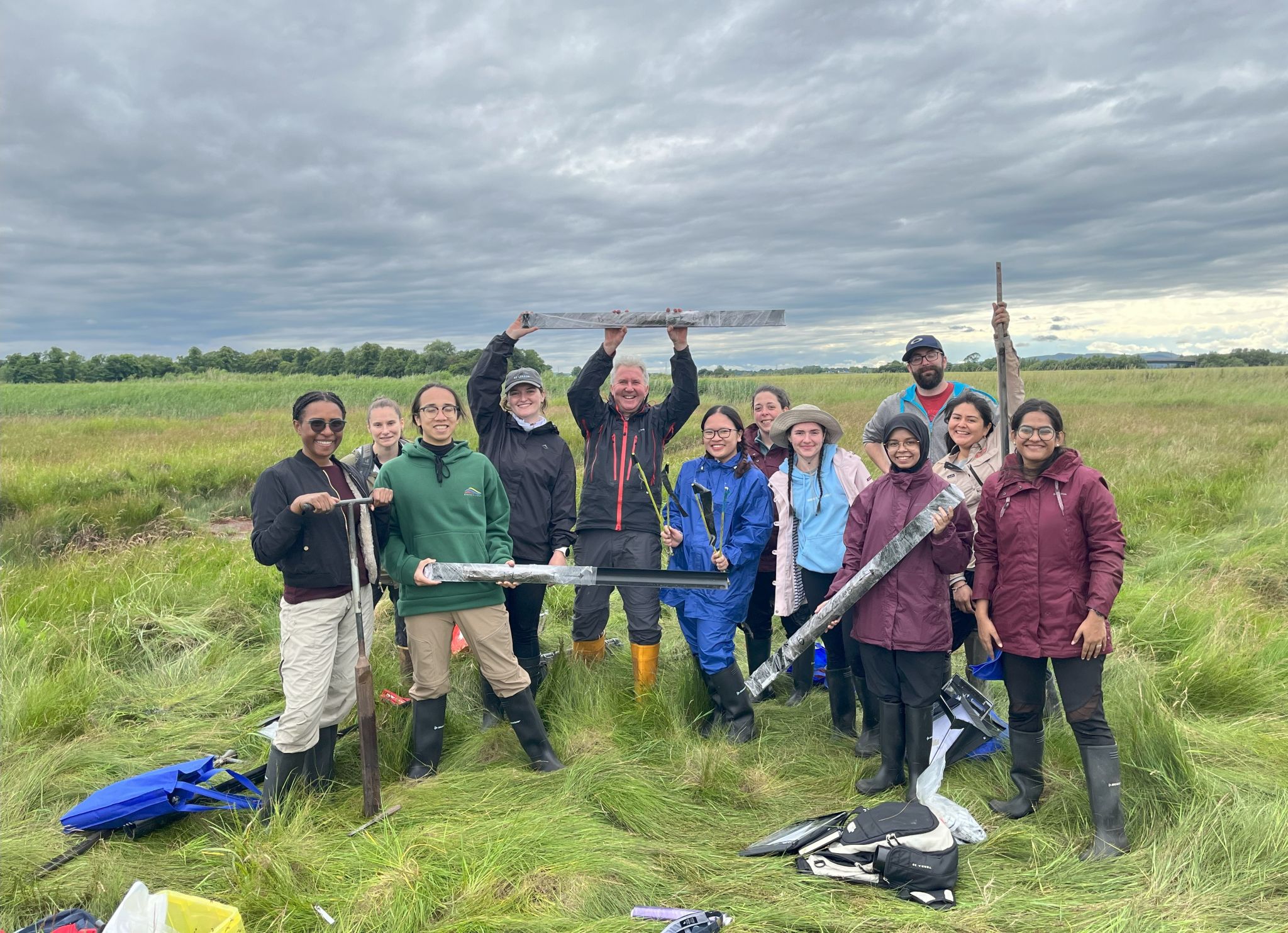
Students will follow a programme that builds a strong theoretical foundation in blue carbon science, with opportunities to design field sampling strategies, carry out fieldwork, and analyse their own samples in the laboratory. The course introduces core scientific tools and techniques, including QGIS, R, and sediment analysis, alongside workshops on science communication and policy engagement. Real-world case studies help participants connect theory to practice, equipping them to apply blue carbon knowledge in global conservation efforts.
By blending cutting-edge science, policy insight, and international collaboration, the course aims to be a stepping stone for those ready to make a meaningful difference for our oceans and coastal ecosystems while developing the confidence and skills needed to influence climate action and conservation efforts worldwide. Designed to inspire and equip the next generation of leaders in tackling marine climate (and linked biodiversity) challenges, the connections made here will continue to spark change long after students leave St Andrews.
"I had an incredible learning time, I hope to carry forward the learnings and share them with the same excitement, dedication and warmth you have shared with us."
Shrutee - Blue Carbon Science & Policy
-
The course fee for 2026: £3,050
St Andrews Summer Study course fees are inclusive of the following:
- Tuition fee
- Accommodation in our residences, en-suite in shared five-person apartments (sharing with other Summer School students).
- A programme of excursions, cultural and social activities
- A number of catered meals including:
- Breakfast 7 days a week (Monday – Sunday)
- Lunch 5 days a week (Monday – Friday)
- Dinner 5 days a week (Monday – Friday)
- Access to Sports Centre for the duration of the summer school
- Access to University services as a registered student of St Andrews, including the Library, IT Services, Student Services
The Fee does not include airfare or getting to St Andrews, personal expenditure (snacks and laundry) or access to St Andrews Academic Documents (academic transcript).
While course fees include university accommodation and a meal plan, we recognise that participants may have varying needs and preferences. If you do not require accommodation and meals, or have alternative arrangements, please contact us at shortcourses@st-andrews.ac.uk to discuss non-residential options.
-
Blue Carbon Science & Policy

The course will offer a mix of morning lectures and afternoon practical classes that cover the following topics.
Week 1
Day 1 – Introduction, sampling design
Introduction to the theories and concepts of Blue Carbon
Introduction to sampling design and sampling techniques
Day 2 – Fieldtrip (River Forth)
The students in groups will undertake their sampling plans and collect samples to be analysed during the week.Day 3 – Ecosystems, sediments and stratigraphy
Introduction to common sedimentological approaches and descriptive methods
Creation of stratigraphic understanding of the intertidal environment.Day 4 – Carbon in coastal environments
Introduction to the standard methodologies for the quantification of organic matter and carbon in coastal soils and sediments.
Tour of analytical laboratories.
Quantify organic matter and carbon in the sub-samples collected from the cores and vegetation in the field.
Sample processing and elemental analysis.Day 5 – Blue Carbon stocks
Students will be introduced to a range of approaches used to determine the quantity of carbon held within a natural environment.
Week 2
Day 6 – Blue Carbon and Data Methods
Advanced analytical approaches discussed including stable isotopes and radiocarbon.
Thermogravimetric and ramped thermal methodsDay 7 – Blue Carbon Stocks and Burial Calculators
Introduction to analytical methods used to date and a create age-depth models for sediments.
Radiometric dating approaches and radiocarbon
Organic carbon accumulation rates
Using age depth models.
Day 8 – Blue Carbon Policy I and Data Lab
Introduction to policy frameworks and levers
Introduction to best practices for presenting data
Day 9 – Blue Carbon Policy II and Data Visualization
Examples of blue carbon projects, policy interventions and introduction to blue carbon financing;
Work on final assessment
Day 10 – Final Preparation and Assessed Presentations
Work on their final assessment (group presentation and policy summary).
Presentation of approach, findings and results from the Blue Carbon assessment -
The University of St Andrews is fully accredited by the Scottish Qualifications Authority and recognised in the United States as a Title IV institution. Blue Carbon students earn credit under the Scottish Credit and Qualifications Framework (SCQF).
2-week courses are granted at 10 SCQF credits (equivalent to 2.5 US or 5 ECTS credits)
Each SCQF credit is rated 10 hours of work (roughly 1/3 contact hours and 2/3 self-directed study). You will complete work for graded assessment and receive a University of St Andrews transcript.
Please check with your home institution about credit transfer arrangements.
How to access your academic transcript
After St Andrews Summer Study has finished, you will be notified via email when your transcript is available to access via the University's new digital system: St Andrews Documents Online. Please note there is a one time fee to access your documents. For more details, see the University's guide on how to access your official documents.
-
Students will be assessed by submitting work during their course. Coursework will include an individual policy report and group presentation which will take place on the final day and be graded by University of St Andrews academics.
-
You must meet the following criteria for St Andrews Summer Study:
- must be aged 18 or over at the time of arrival in St Andrews.
- have completed your first year of university study (at least two semesters in full-time higher education) or equivalent at the point of arrival in St Andrews.
- a minimum average grade of 3.2 (on a USA 4.0 GPA scale) or equivalent.
English Language Requirements
f you are from a non-English speaking country or use English as an additional language, you must provide evidence that you can use English well enough to study effectively at St Andrews. You should include information about your English language proficiency with your application. The University accepts a wide range of language tests and qualifications as proof of English language proficiency.
For information on whether you are required to submit an English Language test score alongside the list of language tests and qualifications which the University accepts, see the following:
- undergraduate English Language requirements (select the Faculty of Science and Profile 7-D) and follow the information for undergraduate entry.
English Language test scores are only normally accepted if obtained within two years of the programme start date.
-
.jpg)
Blue Carbon WWF Scholarship
In partnership with the WWF (World Wide Fund for Nature) there are up to six fully funded scholarships for 2026 that are open to Blue Carbon applicants only. The Selection Committee seeks applicants who are gifted students with academic excellence. We particularly welcome and encourage applicants from the Global South for these scholarships. Successful scholars will be expected to fulfil an ambassadorial role and represent the University at a number of events and contribute to various University publications.
The scholarship covers the following:
- Course fee for Blue Carbon Science & Policy
- University-arranged travel to and from St Andrews (one return economy flight to Edinburgh Airport plus onward travel to and from St Andrews)
Applicants interested in applying for the scholarship can find more information on the Blue Carbon Scholarship page. We are fortunate to receive many strong scholarship applications, which makes the selection process highly competitive with a limited number of awards available. The scholarship application deadline is 23:59pm (UK time) on Wednesday 4 March 2026.
The outcome of your scholarship application will be available by mid/late March 2026.
How to apply
You must first submit an application to the Blue Carbon course, but you do not need to wait until you have received an offer of a place before applying for the scholarship. However, to be eligible for scholarship selection, you will need to ensure that you have provided all the necessary additional documents for your course application to Blue Carbon by 23:59pm (UK time) on Wednesday 4 March 2026.
If you are planning to apply for the WWF scholarship, please ensure that you complete the following steps:
1. Submit a Blue Carbon: Science & Policy course application.Fees and Funding: Where prompted, this section of the course application form allows you to add context about your intended funding arrangements. There is no expectation to provide detailed personal or financial information.
After you have applied to the Blue Carbon: Science & Policy course, you will be provided with login details for the My application portal.
You must allow at least 5-7 working days for processing and issue of your log in details before you can apply for this scholarship. Please consider this timeframe when submitting a course application to ensure you have enough time to also submit a Blue Carbon WWF scholarship application before the scholarship deadline.
Blue Carbon applicants should not expect to receive a decision on their course application until at least early/mid March though review may take longer depending on the volume of applications and any other extenuating circumstances.
2. Submit an application to the Blue Carbon WWF Scholarship before the scholarship deadline stated above.- Log in to My application portal
- Select 'My Scholarships and Funding' from the drop-down menu in My Pages, or in the Useful links section.
- Select View the scholarships and funding catalogue to apply and select Current in-year funding 2025/2026. Select Blue Carbon WWF Scholarship and click on Apply.
3. To be eligible for scholarship selection, ensure that you have provided all the necessary additional documents (via your My application portal) for your Blue Carbon course application by the scholarship deadline (23:59pm (UK time) on Wednesday 4 March 2026). Additional documents include:
- Official Academic University transcript(s)
- English Language Certificate (if applicable)
- Academic reference
Please submit original documents but where they are not in English, you will need to provide an official translated copy as well.
More information on additional documents can be found under the 'How to apply' section on this webpage.
Any questions should be directed to shortcourses@st-andrews.ac.uk.
-
You will be housed in one of our student residences, David Russell Apartments (DRA). They are located on the western edge of town, about a 20-minute walk to the centre of town and local amenities, and a ten-minute walk from the Sports Centre. There are regular bus routes between DRA and the town centre.
You will have a private bedroom with a double bed (four foot six inches wide), individual climate control and an en-suite shower room. There are five bedrooms per apartment, which includes a kitchen with a soft seating area, breakfast bar, oven, microwave, fridge freezer, tv and a dishwasher. There is basic cooking equipment and kitchenware, and an iron and ironing board. Wifi is free and available throughout the residence.
-
Alongside all courses, there are a range of excursions, cultural and social activities held throughout the programme. Excursions and activities differ each year but previous years have included but are not limited to:
- Welcome events
- Pub Quiz
- Day trip to Edinburgh
- Day trip to Glasgow's West End
- Edinburgh Castle
- Local whiskey distillery
- East Neuk of Fife
Full details will be announced in the lead up to the start of the programme.
N.B. Due to different course lengths, participants will not be able to attend all excursions and activities but can expect to attend welcome events and social activities held in the first two weeks including at least one weekend day trip.
-
Getting to St Andrews
The closest international airports to St Andrews are Edinburgh Airport and Glasgow Airport. If flying to London, you also have the option of taking the Caledonian Sleeper service, an overnight train (London Euston to Leuchars). Leuchars is the closest railway station to St Andrews, situated approx. 6 miles outside the town. From Leuchars, St Andrews is easily reached by bus or taxi.
See more details on how to get to St Andrews.
Visas
Electronic Travel Authorisations (ETAs) have now been introduced worldwide for visitors to the UK who do not currently need a visa for short stays, or who do not already have a UK immigration status (e.g. Student route visa) prior to travelling.
If you are coming to the UK for study for fewer than six months this means you are visiting the UK as a Standard Visitor. Check on the UK government visa pages whether you need an ETA or Standard Visitor Visa, and what you will need to show at the border. Please refer to the information provided about visas and travelling to the UK on the University webpages for international students.
Healthcare
Students are strongly advised to ensure they have the adequate medical and travel insurance for the duration of their stay in the UK to insulate themselves from costs that they may otherwise be responsible for paying. If students have health insurance coverage, they must check if their health insurance covers the costs beforehand.
For more information, please see our Healthcare webpage. Please be aware that the University does not provide travel insurance of any kind.
The National Health Service (NHS) is the primary medical service in the UK. Information about the NHS is available on the NHS inform website. Arrangements for international students are dependent on your visa status and any reciprocal health arrangements which the UK has in place with your country. Some NHS services are free of charge for everyone, these include:
- accident and emergency services
- family planning services
- diagnosis and treatment of sexually transmitted infections
- diagnosis and treatment of certain infectious diseases
- compulsory psychiatric treatment.
Using your phone abroad
All international students will need to change to a UK SIM card for their mobile phone while studying in St Andrews to access NHS services, including urgent medical care. Find out more about mobile phones.
-
Any queries prior to the summer school should be directed to shortcourses@st-andrews.ac.uk.
-
Depending on demand, certain courses may not be available in 2026. If this happens, we will clearly communicate this to offer holders by mid-May.
Students taking part in the Blue Carbon summer programme will be registered as “summer visiting students”. All students are obliged to adhere to the University’s code of conduct.
Please make sure that you have also read the St Andrews Summer Study Terms and Conditions.
Admission and registration is governed by the policy on the admission and registration of exchange and study abroad students.
-
We recommend that you first check the entry requirements and discuss your application with your home institution, in particular if you want to transfer back credit from this summer school. Please note the Terms and Conditions in the section above.
Apply now by completing the relevant online application form: 2-week application form
The application deadline for all courses is Tuesday 31 March 2026 (23:59pm UK time)
Note that for your application we will require the following documents:
Additional documents can be uploaded as part of your course application or afterwards via your My application portal.
Personal Statement
This should tell us why you wish to study on your selected course and at St Andrews, outlining your qualifications (including level of English language and IT competency) and what you hope to gain from attending the course.
Official Academic University Transcript
The transcript must be official and up-to-date, and you should include transcripts for time spent at other universities if relevant. Transcripts cannot be accepted that are marked as unofficial. Upload your official transcripts directly to your application, or ask your home institution to email it to shortcourses@st-andrews.ac.uk. Please submit original documents but where they are not in English, you will need to provide an official translated copy as well.
Academic reference
Your reference must be written by an academic member of staff at your current home institution. It must be signed and written on official headed letter paper and can be submitted by the referee after you submit your application and the deadline.
English Language Certificate - if applicable
If your first language is not English, you will need to provide an English language certificate showing you meet the university's proficiency standards. For information on whether you are required to submit an English Language test score alongside the list of language tests and qualifications which the University accepts, see the following:
- undergraduate English Language requirements (select the Faculty of Science and Profile 7-D) and follow the information for undergraduate entry.
English Language test scores are only normally accepted if obtained within two years of the programme start date.
After submitting your application
Blue Carbon applicants should not expect to receive a decision on their course application until at least early/mid March though review may take longer depending on the volume of applications and any other extenuating circumstances.
Blue Carbon WWF Scholarships
You do not need to have received a decision on your course application in order to apply for scholarships. Further information is provided in the 'Scholarship' section above. If you are planning to apply for the WWF scholarship, please ensure that you have done the following:
1. Submit a Blue Carbon: Science & Policy course application.After you have applied to the Blue Carbon: Science & Policy course, you will be provided with login details for the My application portal.
You must allow at least 5-7 working days for processing and issue of your log in details before you can apply for this scholarship. Please consider this timeframe when submitting a course application to ensure you have enough time to also submit a Blue Carbon WWF scholarship application before the scholarship deadline.
2. Submit an application to the Blue Carbon WWF Scholarship before the scholarship deadline (23:59pm (UK time) on Wednesday 4 March 2026).
- Log in to My application portal
- Select 'My Scholarships and Funding' from the drop-down menu in My Pages, or in the Useful links section.
- Select View the scholarships and funding catalogue to apply and select Current in-year funding 2025/6. Select Blue Carbon WWF Scholarship and click on Apply.
3. To be eligible for scholarship selection, ensure that you have provided all the necessary additional documents for your Blue Carbon course application by the scholarship deadline (23:59pm (UK time) on Wednesday 4 March 2026). Additional documents include:
- Official Academic University transcript(s)
- English Language Certificate (if applicable)
- Academic reference
Additional documents can be uploaded as part of your Blue Carbon course application or afterwards via your My application portal.
Any questions should be directed to shortcourses@st-andrews.ac.uk.