Please visit our training page to explore online options or contact mediation@st-andrews.ac.uk to register your interest in future in-person training opportunities.
The Mediation Servicehelps students, staff, and the wider community to address and resolve conflict constructively.
The service:
Facilitates confidential, informal conversations in which participants articulate the conflict and find mutually agreeable outcomes. Please email mediation@st-andrews.ac.uk if you want to talk about an issue, disagreement or conflict.
Provides a range of training to equip people to navigate challenging exchange.
What is mediation?
Mediation is a voluntary and confidential process that enables people to address differences and disagreements with the support of a trained, impartial mediator. Whether the issue relates to a working relationship, a decision, or a difference of opinion, mediation provides a constructive space for conversation.
The mediator does not:
take sides
make decisions
investigate complaints
determine who is right or wrong
Instead, the mediator helps participants explore issues, understand each other's perspectives and identify possible ways forward.
Rebecca: Hello, I am Rebecca Swarbrick, Project Officer of the Mediation Service and I’m going to introduce the Mediation Service and look at situations when it might be useful to you.
The Mediation Service provides space, time and support to people within the University community, to transform difficult relationships. The mediation process aims to help participants engage in conversations that could be too problematic to hold constructively without a trained, impartial mediator. It is confidential and quite separate from other university processes. We work with groups and with people experiencing one to one conflict.
There are 27 mediators throughout the University. They are a diverse group including 19 PG students. All have completed training accredited by Scottish Mediation and adhere to their code of practice.
Conflict is inevitable and disagreement is something everyone has to deal with. We all have experience of using negotiating skills in our lives., I expect we can think of times when we had to navigate opposing views, manage a limited number of resources, or communicate disappointing messages.
David Liddle, author of Managing Conflict, divides conflict into Dysfunctional conflict when differences become personalised and wellbeing and working together is negatively affected… and functional conflict, which is useful for uncovering new approaches and understanding (Liddle, 2017) Conflict can be destructive, but it can also be a driving force for finding solutions and positive change.
Mediation is a new service, launched in November 2020. It is an independent, impartial, informal service for everyone. You can be reassured that notes from mediation will not appear on student records. Within the limits of the law, everything discussed throughout the mediation is confidential. It is an additional option to existing formal processes which can still be invoked if a mutually agreeable outcome is not found, although the Mediators themselves do not participate in any subsequent formal processes. The beauty of Mediation is that it is the only process where those in conflict get to decide how to resolve the issues.
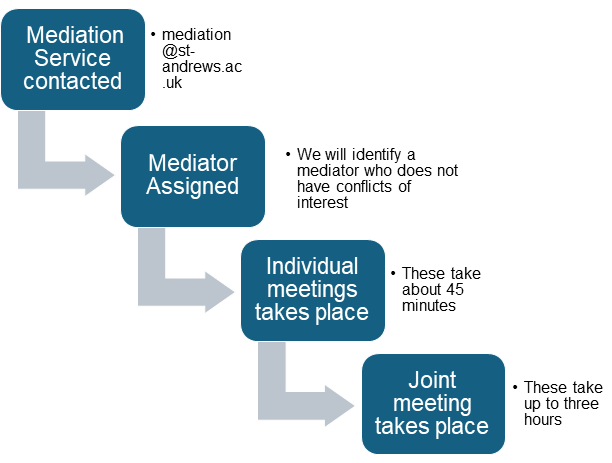
Mediation usually has 2 stages- we meet each participant separately, to listen to their individual perspectives and consider what might be gained from a joint meeting. The aims of the joint meeting are to open dialogue, for everyone to listen to understand the different perspectives, arrive at a joint understanding of the problem, explore all possible options and to seek a mutually agreeable outcome.
Mediation cannot succeed if it is used to try to silence a less powerful party or achieve a temporary peace by suppressing someone’s desire for justice. Mediation needs participants to leave their hierarchical status at the door so that we can have a sincere and honest conversation human to human.
The Mediation Service is available for a variety of disagreements and concerns, including those between peers or colleagues, disputes within or between teams, concerns about allocation or distribution of resources, and concerns about actions or inactions of the University.
Mediation is not appropriate for alleged criminal activities, such as gender-based violence, or for addressing breaches of Health and Safety when dangerous working practices are alleged.
It can be hard to talk about being trapped within a conflict, but it is forward thinking people, committed to building resilience that will chose to acknowledge the reality they are in and look to find constructive solutions so that they can learn more about themselves and others and seek positive win-win outcomes.
Please get in touch if you would like a confidential conversation about a situation, even if you’re unsure if mediation would be right at this time, we’d love to hear from you.
If you’d like to learn more about conflict resolution and the role of mediation, we provide a variety or workshops and courses across the university. Find out more and book your place by searching “conflict” on PDMS. Thanks for listening.
Benefits of mediation
Resolution can often be achieved in a relatively short time frame.
Mediation seeks to understand what people want and need and looks for any common ground and shared interests.
Options are explored and agreements are developed together.
Mediation builds dialogue between people to help to resolve disputes, conflicts and complaints.
Mediators do not impose a judgement or favour sides.
Feedback from participants
"It was a very human experience - which brought greater understanding of my own and the other colleague's feelings and thoughts."
"I felt it was so valuable to our team, I just wish we had done it earlier!"
"I would highly recommend Mediation to any student or staff member who is struggling to resolve a deeply rooted interpersonal or professional issue. It is an incredibly open, candid space and is managed in such a way that it is fair to all parties involved. I cannot endorse this service highly enough - my only regret is that we didn't go sooner!"
Principles of mediation
Voluntary
No-one is forced into mediation. This applies throughout the process, from first contact with the service until the last sentence has been uttered in the joint meeting.
Informal
Mediation is separate from formal university processes. Mediation notes are destroyed at the end of the joint meeting. Mediation is flexible and adaptable to a range of disputes and conflicts.
Confidential
Your issues and concerns will be treated with the utmost respect and privacy. All participants and mediators agree that the mediation is confidential within the limits of the law. If any part of the agreement or outcome needs to be communicated to others, this will be agreed by participants.
Self-determined
Self-determination is a key difference between mediation and other dispute resolution methods. In mediation, you, the participants, have an opportunity to express how you feel about the conflict. You are invited to listen to understand the different aspects of the conflict and to suggest options for a resolution. You, the participants are the decision makers in mediation.
Impartial
Mediators are trained to ensure a balanced and fair process, and not to take sides.
Without prejudice
The mediator does not participate in any subsequent formal processes.
Who can contact the mediation service?
The Mediation Service is available to all students and staff members of the University. You can contact the Mediation Service directly for a confidential conversation, whether you are in a conflict situation, or want to discuss a conflict situation that a friend or colleague is experiencing.
The Mediation Service also provides mediation to members of the community outwith the University.
When should I contact the Mediation Service?
Ideally at the earlier stage of a disagreement before issues escalate and become more entrenched. If you think that a disagreement might benefit from a constructive conversation, contact the Mediation Service for a confidential conversation.
What is the mediation process?
What is the Mediation Service not suitable for?
The Mediation Service does not get involved in academic appeals (including matters of academic judgement and academic progression), alleged criminal activities, such as gender-based violence, or for addressing breaches of Health and Safety, such as when dangerous working practices are alleged.
Who are the mediators?
The mediators are University students and staff who have completed formal mediation training that has been accredited by Scottish Mediation. The mediators:
Receive regular refresher training and reflective practice to enhance their mediation skills.
Act impartially and separately from University Schools and Services.
Are solely interested in helping you reach a mutually acceptable solution.
Create a safe and supportive environment so that you can talk about what has happened and how it has affected you and others involved.
Help you search for options and find agreeable outcomes, collaboratively.
Student mediators are part of the Centre for Peace and Conflict Studies and studying a Master of Letters (MLitt) or Master of Philosophy (MPhil) in Peacebuilding and Mediation.
The University's staff mediators are:
Ruth Unsworth is the Head of Mediation and Wellbeing and has worked at the University for over 14 years.
She is a Qualified Mediator, registered with Scottish Mediation, and accredited as a Therapist by the British Association for Behavioural and Cognitive Psychotherapies (BACBP), the lead organisation for cognitive behavioural therapy in the UK.
Ruth has used mediation in a range of settings. She has worked with homeless young people, public sector and third sector agencies, each with their own priorities, to develop services for young homeless people in and around Glasgow.
Ruth has many years’ experience of working with students, providing therapy, and helping to resolve disagreement or conflict situations.
As a minister of the Church of Scotland, she has used mediation skills to develop different support groups for people impacted by domestic violence and drug abuse. More recently, she has worked with congregations who had to decide whether to unite and whether to give up buildings they loved.
She also worked in Zambia with Non-Governmental Organisations (NGOs), Government educational officials, teachers, parents and children seeking to find a solution to different perspectives of conduct.
Ruth worked in Student Services as a therapist and as a manager.
Ruth also developed the Wellbeing, Counselling and Mental Health Matched Care framework. This received accreditation from the Accreditation Programme for Psychological Therapies Services (APPTS), a service development, quality improvement and accreditation network for services providing psychological therapy to adults in the UK. APPTS is a collaboration between the Royal College of Psychiatrists and the British Psychological Society.
Ruth is:
Chair of the University Mental Health Taskforce
Co-Chair of the Equally Safe Group
a member of the Universities Scotland Student Mental Health and Wellbeing Group
a member of the Research Advisory Board for the national research into Thriving Scottish Learners
Rebecca Swarbrick is Deputy Head of Mediation for Mediation and Wellbeing. She trains mediators and runs conflict resolution workshops.
She is a qualified and experienced mediator, registered with Scottish Mediation. Rebecca has a Master of Philosophy (MPhil) in Reconciliation and Conflict Resolution from Trinity College Dublin and has worked for small charities and schools.
Rebecca loves both the simplicity of the process and the rich complexity of conversation that arises in mediation and is forever in awe of the courage of participants.
She lives in the East Neuk, enjoying coastal walks, writing and mediating her children’s daily disputes.
Leon Watson joined the University in 2024 as a mediator and has since been supporting the development of mediation and conflict resolution services across the institution. In addition to facilitating mediations, he has been involved in the training and development of new mediators, designing and delivering practical skills sessions that equip participants with the confidence and techniques required to manage conflict constructively. Leon also delivers conflict resolution workshops to a range of audiences, drawing on his professional experience to provide engaging, interactive learning that promotes effective communication, problem-solving and collaborative approaches to dispute resolution.
A qualified and experienced mediator, Leon is registered with Scottish Mediation and graduated from the University of Strathclyde’s LLM in Conflict Resolution and Mediation in 2022. His mediation practice extends beyond the University, with extensive experience mediating Simple Procedure cases referred by Sheriff Courts across Scotland. Through this work, he has supported individuals in resolving disputes efficiently and amicably, helping them reach mutually acceptable outcomes without the need for formal processes.
Leon has also led mediations on behalf of Scottish Mediation and regularly co-mediates with fellow practitioners across Scotland on an ad hoc basis. His combined experience as both a mediator and trainer reflects a strong commitment to promoting mediation as an effective, accessible and empowering means of resolving conflict.
Denise is a qualified and experienced mediator, accredited with Scottish Mediation. She has over 30 years’ experience of working in Higher Education, both as a senior manager and as mediator.
As a trained formal grievance and complaints investigator, she has seen the negative effects on individuals involved in adversarial procedures - which may produce an outcome but do not repair the relationship. She is a strong advocate for future-focused informal dispute resolution processes such as Mediation which enable participants to work together to unpack the conflict and rebuild their relationship.
Outside of her work in the University sector, Denise is an accredited mediator for the Samaritans and works across the UK and Eire in this capacity. She also works for church organisations across Scotland - assisting with dispute resolution amongst paid staff and also helping congregations collectively to make hard and difficult decisions about their futures.
Originally a Lancashire Lass, she has lived in Scotland for over 30 years and loves the majesty of its landscape.
Ruth Woodfield is a Professor of Equalities and Organisation in the University of St Andrews Business School.
She has worked at the University for eight years. She is a qualified mediator and has completed mediation training at the University of St Andrews, accredited by Scottish Mediation.
Ruth was Co-Head of School in Management between 2017 and 2019 and was seconded to the Principal’s Office as Assistant Vice-Principal (Diversity) at the University between 2019 and 2021. In the latter role, she co-led on the development of the People Strategy consultation and development, which highlighted the need for the Mediation Service.
Ruth has research expertise in equality, diversity and inclusion in the workplace, and in higher education in particular. She has worked with staff and students in various roles that have required listening, facilitating, problem-solving and support skills.
Louise Nixon has worked at the University since 2006, first starting as a Human Resources (HR) Officer, moving roles over time, to her most recent position as the Deputy Director of HR.
She has experience of working in many private sector organisations and other public sector bodies, all within the HR profession, before joining the University.
Louise completed a National Certificate in Workplace Mediation in 2010 and refresher mediation training in 2021, and engages in continuing professional development.
She has led workplace mediations as an individual mediator as well as engaging in co-mediation and many facilitated meetings using the principles of mediation to help resolve conflict. More recently, Louise has been involved in student mediation.
Like with all other mediators, the role of mediation is independent and confidential from her role at the University.
With an undergraduate degree in Organisational Behaviour and a Masters in Human Resource Management, Louise is interested in people-centred initiatives. She likes to help people to take ownership and resolve conflict constructively.
Louise is a member of the Mental Health Task Force, Equally Safe working groups, and many other working groups that help drive change. She is keen to get involved in new initiatives and delighted to be part of the Mediation service as a qualified mediator.
Julie Brooks is Director of Postgraduate Programmes in the Business School, at the University of St Andrews.
She has worked at the University for 19 years. She is a qualified mediator and has completed mediation training at the University of St Andrews, accredited by Scottish Mediation.
Julie has worked in the public, private and voluntary sectors before taking up her role in the Business School. The common thread throughout her career has been working in roles that involve communication, empathy and listening skills, facilitating conversations between various people and across organisations.
She spent 7 years living in Russia and speaks fluent Russian. While living there, she was involved in negotiations between Russian and US government officials at the regional and national level.
During her time in Scotland and before starting her current role, she worked as the Community Planning Coordinator for Fife, a role that worked between Fife Council, National Health Service (NHS) Fife, Fife Police and CVS Fife.
Her current role requires listening, facilitating, problem-solving and support skills when working with students and colleagues. Becoming a qualified mediator has allowed her to bring these skills together more formally and put them into use to benefit the University and the wider community.
Boyka Bratanova is a Senior Lecturer in Management in the Department of Management at the University of St Andrews.
She has worked at the University for eight years. She has completed mediation training at the University of St Andrews, accredited by Scottish Mediation.
Boyka’s background is in Social Psychology. Her research examines social inequalities and the tensions arising from them. Through her research activities and life experience, Boyka has developed a keen interest in mediation as an alternative conflict resolution.
She firmly believes in the benefits that the mediation process can bring to participants, including finding optimal resolutions, strengthening relationships, and personal growth.
Jason McNulty is an Education Focused Lecturer and current Co-Director of Wellbeing in the School of Chemistry and has completed mediation training at the University of St Andrews, accredited by Scottish Mediation.
Jason’s roles in Chemistry focus on student and staff wellbeing and improving equality, diversity and inclusion in the workplace. Each of these roles requires good listening and communication skills, empathy and being supportive.
Jason’s experience in these roles influences his approach to mediation and facilitates honest and pragmatic discussion to achieve constructive conflict resolution. Undertaking accredited training has allowed Jason to build on these skills. He is keen to continue to develop them as an active member of the University Mediation service.
How to Disagree Successfully
What if the conversations we most want to avoid are the ones that contain the greatest opportunities?
Most of us would rather avoid disagreement. Yet when we care deeply about our work, our values, or the people around us, differences of opinion and conflict are often inevitable. At some point in our careers, we will all find ourselves disagreeing about something that matters.
Because many of us have experienced conflict that was uncomfortable or futile, we often try to avoid disagreement altogether. But avoiding disagreement doesn't reduce the risk of conflict. Avoiding these conversations can allow the disagreement to fester as well as missing opportunities to see the issue from a different perspective, strengthen relationships, and find mutually agreeable solutions. The key is not to avoid disagreement. It is to disagree well.
Listen first
If we want to disagree successfully, our first task is not to convince others that our perspective is right. It is to listen.
Listening well allows us tounderstand. Understanding is not the same as agreeing. It means taking the time to understand another person's perspective and the experiences that have shaped it.
As William Ury explains:
"Deep listening means leaving where our mind is and starting the conversation where their mind is. It means listening from within their frame of reference, not just ours." (Ury, 2024, p. 143)
If we want to influence someone's thinking, we first need to understand where they are coming from.
Explore why
Mediators encourage respectfully asking why, because the answer often reveals the underlying needs, wants or fears.
William Ury says: "It is often not enough to ask why? just once. To get to the deepest level of the iceberg, we may need to keep asking why? —two, three, four, even five times in succession." (Ury, 2024, p. 82)
Being curious about another person's reasoning can uncover shared interests that are not immediately obvious. It also helps if you are willing to explain why the issue matters to you. Mutual openness builds understanding.
Work towards solutions
When people feel heard and understood, they are more likely to engage constructively.
Respect, trust and goodwill create the conditions for exploring solutions that everyone can accept. Even when agreement is not possible, greater understanding often leads to easier conversations and better outcomes.
Act early
Disagreements rarely improve when they are ignored. If you notice the early signs of tension or misunderstanding, addressing them sooner rather than later can prevent conflict becoming entrenched.
Without exception, everyone at the University of St Andrews is welcome to have a confidential conversation with a mediator about a concern, an emerging disagreement or an existing conflict. You do not have to wait until a situation has escalated. If something feels wrong, contact us. Early conversations often make the biggest difference.
Reference Ury, W. (2024). Possible: How We Survive (and Thrive) in an Age of Conflict. Harper.
Frequently Asked Questions
Why should I contact the Mediation Service? Speaking with a mediator gives you the opportunity to reflect on your situation and explore your options. Mediators listen confidentially, help you think through possible approaches, allowing you to make an informed decision.
When should I contact the Mediation Service? At any stage. Whether you have a concern about an emerging issue or are already involved in a disagreement, it is never too early to get in touch.
How do I contact the Mediation Service? Email mediation@st-andrews.ac.uk to arrange a confidential conversation by Teams, telephone or in person.
Can mediation really help? Many people find it valuable to speak with someone who is independent of the situation. Mediators provide a confidential space (within the limits of the law) to help you think through your concerns and consider constructive ways forward.
Mediation? But it isn't my fault. Mediation is not about deciding who is right or wrong. It does not assign blame or pass judgement. Instead, mediation creates a safe environment for people to have a different kind of conversation—one focused on understanding and finding a better way forward. The people involved remain in control throughout the process.
If you would like to find out more, email mediation@st-andrews.ac.uk.