
- This event has passed.
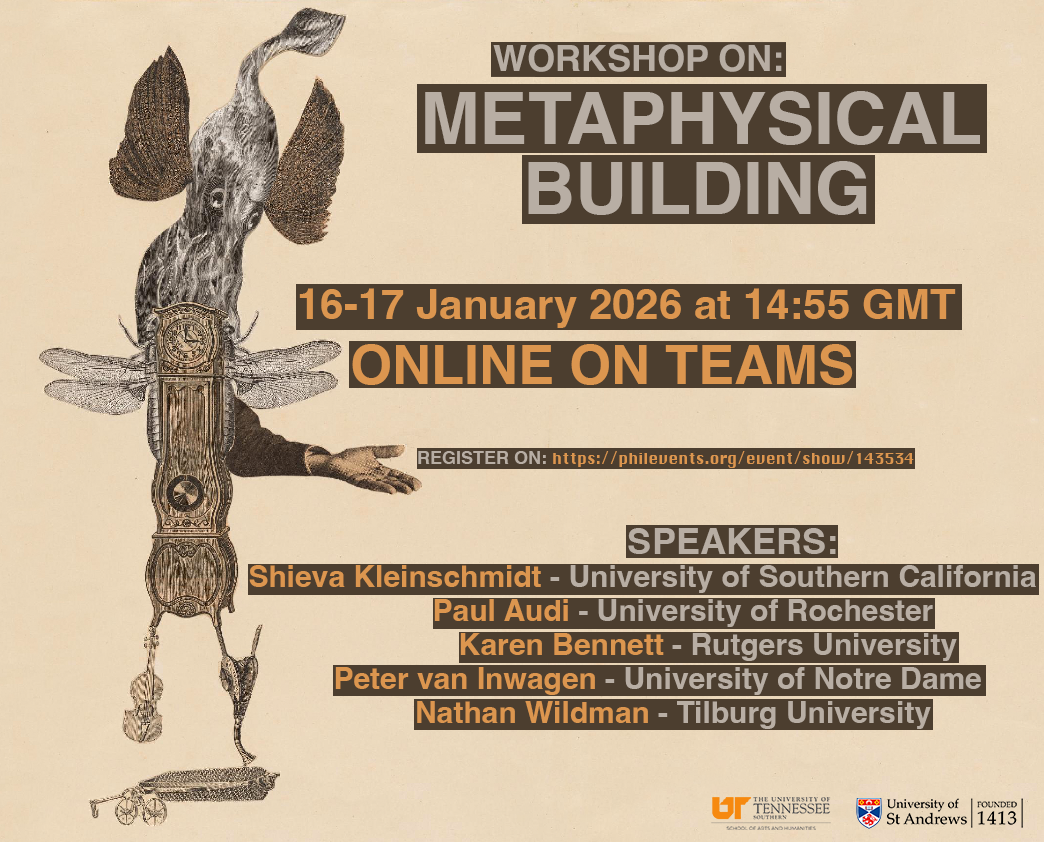
Workshop on Metaphysical Building
January 16 @ 3:00 pm - January 17 @ 6:00 pm
Event Navigation
The University of Tennessee Southern’s School of Arts and Humanities and the University of St. Andrews’ Arché Philosophical Research Centre for Logic, Language, Metaphysics, and Epistemology will be hosting a two-day online workshop on the Metaphysics of Building.
The aim of this workshop is to bring together scholars working on the metaphysics of building, broadly construed, to explore how building relations such as grounding, composition, constitution, and realization connect the more fundamental to the less fundamental. Talk of “building”—of one thing being based in, generated by, or constructed out of another—runs throughout contemporary metaphysics. This workshop focuses on the family of building relations, examining issues such as their nature, their possible unity or disunity, and their implications for how we conceive of what is fundamental and what is not.
DATES AND VENUE: 16 and 17 January 2026, online via Microsoft Teams
SPEAKERS: Paul Audi (University of Rochester), Karen Bennett (Rutgers University), Sheiva Kleinschmidt (University of Southern California), Peter van Inwagen (University of Notre Dame & Duke University), and Nathan Wildman (Tilburg University)
REGISTER HERE: https://forms.gle/hWmBG7h2JhVauTQ57
SCHEDULE (Note: All times are in GMT):
Every slot includes: The main talk (40 minutes), and Q&A (25 minutes).
Day 1: Friday, January 16
14:55–15:00 — Opening Remarks
15:00–15:40 — Shieva Kleinschmidt
15:40–16:05 — Audience Q&A
16:05–16:20 — Break
16:20–17:00 — Paul Audi
17:00–17:25 — Audience Q&A
Day 2: Saturday, January 17
14:00–14:40 — Nathan Wildman
14:40–15:05 — Audience Q&A
15:05–15:20 — Break
15:20–16:00 — Peter van Inwagen
16:00–16:25 — Audience Q&A
16:25–16:40 — Break
16:40–17:20 — Karen Bennett
17:20–17:45 — Audience Q&A
17:45 — Closing Remarks
This workshop is supported by Aaron J. Cotnoir’s EPSRC Funded Project Instruments of Unity: the Many Ways of Being One.
TITLES & ABSTRACTS: In Progress
Paul Audi: Indeterministic Grounding Via Indeterministic Causation
It’s easy to think that grounding must be deterministic. Grounding relations derive from essences, essences yield necessities, and where there’s necessity, there’s no indeterminism. But this is too quick. I will show how you could be led to grounding indeterminism by indeterminism about causation. The crucial links are the idea of causation as power-manifestation, and an understanding of power-manifestation as a special case of grounding. I will present an argument that clarifies the route from indeterministic causation to indeterministic grounding, and discuss some views that lend support to the premises. These include a novel account of dispositions, which in turn gives us occasion to discuss the ideas of reduction and elimination—both of which I regard as alternatives to, rather than cases of, grounding or building.
Nathan Wildman: Necessary fundamentals?
This talk focuses on two distinct but inter-related questions at the intersection of modality and fundamentality: (1) Do the entities that are metaphysically fundamental necessarily or contingently exist?, and (2) Is the property of being fundamental a necessary or contingent property? Here, I argue for contingentist answers to both questions. Specifically, after articulating and distinguishing the two questions, I raise a general argument against the idea that fundamental entities are necessary existents, derived from a traditional objection to the Principle of Sufficient Reason. I then present three cases designed to show that being fundamental is, for some entities, a contingent property. This leads to a brief aside where I discuss and ultimately dismiss a potential objection to this contingentism. Finally, I conclude by discussing the general plausibility of the thorough-going contingentism on offer.
Shieva Kleinschmidt: Weak Supplementation of Pluralities and Constitution
Weak Supplementation is commonly used to rule out two kinds of cases. (i) What I call “inadequate crowd” cases, where some part is not enough to make up the whole object but there’s no disjoint supplementing part, and (ii) constitution cases, where one thing does seem to constitute the whole of something distinct, and there’s no disjoint supplementing object. The impossibility of inadequate crowd cases is motivated by the intuition that, if you have just some of something, there must be some more of it beyond what you’ve already got. I’ve argued that this intuition also supports Weak Supplementation of Pluralities, which says that if some xs are parts of y but y is not a fusion of the xs, then there’s some z that is part of y and disjoint from the xs. Interestingly, one can accept WSP while rejecting WS. This allows for ruling out inadequate crowd cases, while allowing for distinct 1-1 constitution. And it allows us to do this without taking proper parthood to be asymmetric parthood.
Peter van Inwagen: Buildings
These are the building relations: composition, constitution, grounding, and realization. Composition and constitution are mereological relations, and pose no problems beyond those—if there are any—posed by parthood. (Proponents of constitution have generally supposed that constitution is not a mereological relation, but there is a plausible definition of constitution in terms of parthood.) Grounding is of two sorts, phenomenal grounding and ontological grounding. Phenomenal grounding is the grounding of phenomena in phenomena, and ontological grounding is the grounding of objects of one sort in objects of another sort. If the mental is grounded in the physical, that is a case of phenomenal grounding. If a unit set is grounded in its member, that is a case of ontological grounding. Phenomenal grounding is very much like supervenience—if it is not simply identical with supervenience. It will be argued that whether ontological grounding in fact occurs depends on the answers to certain fundamental meta-ontological questions. And, finally, there is realization. Like phenomenal grounding, realization may simply be supervenience, but it is difficult to say what realization is, owing to the use by its proponents of technical terms that, to my mind, have not got satisfactory definitions. I will explain why it seems to me that some of these terms—‘higher-level property’ and ‘property instance’, for example—have not been adequately defined.
Karen Bennett: Finding Dry Ground
I articulate two mistakes in standard ways of thinking about the apparent need for grounding, and restructure the discussion in a way that both reclassifies the teams and reveals new possible positions for those who prefer desert landscapes. While I will mostly be talking about grounding rather than building relations generally, I will also clarify, in big-picture ways, how this project relates to what I was doing in Making Things Up. (Hint: pages 58-9.)