Sustainability report 2024-2025
Net zero by 2035
Download PDFPrincipal's introduction
"I am very pleased to introduce the University of St Andrews 2024-2025 Annual Sustainability Report. 2024 was officially reported to be the hottest year on record; the twin emergencies of climate change and biodiversity loss demand a profound re-evaluation of how we live, learn and shape our societies.
At the University of St Andrews, we embrace this responsibility with both ambition and humility, and this report is a testament to what we can offer when vision, creativity and collective endeavour converge. It reflects the embedding of the United Nations Sustainable Development Goals across research, teaching, operations, community engagement and strengthened governance.
Of the many projects undertaken during the past year, a key highlight is our historic 100-year partnership with Corrour in the Highlands, which exemplifies the power of long-term collaboration for nature-based climate mitigation, research and teaching. Together, we are creating a living laboratory that advances the shared missions of both institutions.
Initiatives at the Eden Campus, including the Power-to-X facility producing green hydrogen, the Innovation Yard supporting low-carbon entrepreneurship, and Eden Mill distillery demonstrating circular resource use, showcase how sustainability can be both forward-thinking and practical.
Equally, the St Andrews Botanic Garden serves as a living laboratory, blending research, conservation and education to illuminate the interdependence of ecosystems, climate and resilience. This ethos extends beyond the local area through the St Andrews Nature Networks project where our Transition group has coordinated the restoration of parts of the Fife coastline, reconnecting habitats and communities in ways that are tangible, enduring and deeply inspiring.
Among many examples of our commitment to embedding sustainability in curricula, contributions by Dr James Rae to the National Climate Education Action Plan Curriculum Mapping Report and publication of Practices of Education for Sustainable Development: A Critical Guide for Higher Education by Dr Rehema White demonstrate the impact our research is making beyond St Andrews.
Students themselves are central to our collective effort. Initiatives such as the Sustainability Summit, Climate Cafés and Green Week are some of the many ways students are applying their learning to address critical issues. And the St Andrews Prize for the Environment, most recently awarded to the Kham River Restoration Project in India, illustrates how local engagement, global awareness and interdisciplinary curiosity come together to drive meaningful action.
This report reflects not only the challenges we all face, but also the remarkable opportunities that arise when knowledge, creativity and commitment come together to address them. It is a record of achievement, a call to further action, and a reminder that the University of St Andrews seeks to lead with both courage and conscience – shaping a sustainable, resilient and just future for generations to come."
Principal and Vice-Chancellor

Professor Dame Sally Mapstone FRSE
Reporting and accountability
Strategic governance
During the 2024-2025 academic year, the governance structure for the sustainability strategic theme was restructured with the introduction of a Director of Sustainability Transformation to oversee the operationalisation of the University’s Sustainability Strategy.
The strategic direction of the sustainable governance theme is advised by the Environmental Sustainability Board (ESB) and is embedded across all areas of the institution.
Led by Master of the United College, Professor Ineke De Moortel, the Senior Sustainable Leadership group meets six times a year to identify priority actions and strategies for progression across all key areas of the University.
The Master also oversees the Academic Sustainability Network, co-chaired by Assistant Vice-Principal Dean of Arts and Divinity, Professor Catherine O’Leary and Assistant Vice-Principal Dean of Science, Professor Gareth Miles. This network brings together sustainability representatives from each academic school for quarterly meetings to explore and progress school specific academic initiatives.
In parallel, the Sustainable Delivery Group, chaired by the Director of Sustainability Transformation Karen Laing, also meets monthly to drive forward operational priorities. Members of this group include representatives from planning, estates, procurement, business transformation, the biodiversity working group, communications and the student community.
Strategic response
Under this leadership, our strategic response focuses on:
- Research: Advancing knowledge and translating findings into policy and practice.
- Education: Equipping students with the skills and understanding to address global sustainability challenges.
- Students and Community Engagement: Fostering awareness, action and collaboration within the University and beyond.
- Estate, Energy, and Environment: Integrating sustainable practices across the campus and using it as a living laboratory.
- Operational Adaptation: Embedding sustainability into procurement, travel, digital systems and institutional processes.
Together, these priorities provide a structured framework for action, accountability and continuous improvement, ensuring that the University not only mitigates environmental impacts, but also actively contributes to a sustainability positive future. All actions are reported internally to the Planning And Resources Committee (PARC) who oversee all University work.
In addition to internal reporting, we submit data to the Public Bodies Climate Change Duties (PBCCD) report, cataloguing our corporate emissions, projects, renewables, emission targets, climate risk assessment and adaptation action.

Carbon reporting
During the development of the Public Bodies Climate Change Duty report, various teams across the University, including Estates, Procurement and Planning, were consulted to provide comments and data. Each year, the Scottish Government requires all public sector organisations to complete this report, ensuring transparency and accountability in relation to carbon emissions and climate action, to oversee the operationalisation of the University’s Sustainability Strategy.
2024-2025 emissions overview
The University’s total carbon emissions for the 2024-2025 reporting year amount to 82,946.5 tonnes, representing a reduction from 84,968.98 tonnes in 2023-2024. This decrease of just over 2,000 tonnes reflects continued progress in reducing our overall carbon footprint, even as our operations evolve and the demands on our estate change.
Scope 1 emissions, which cover direct emissions from activities owned or controlled by the University, such as heating, University-owned vehicles and refrigerant gases, have risen this year. The increase is primarily the result of greater gas consumption during periods when the biomass system was offline, requiring increased reliance on more carbon-intensive heating methods.
Scope 2 emissions, associated with purchased electricity, have decreased. This is due in part to reduced electricity use in halls of residence. Although non-residential electricity use increased, the overall carbon impact was mitigated by a lower national carbon conversion factor for electricity, contributing to an overall reduction in Scope 2 emissions.
Scope 3 emissions, which encompass a wide range of indirect activities including purchasing, expenses, business travel, commuting, homeworking, student travel, waste, water, and transmission and distribution losses, also decreased this year. While emissions from purchasing increased slightly, reductions in expenses, departmental business travel and student travel helped to bring total Scope 3 emissions down.
Flight emissions and global context
Flight-related emissions remain a notable component of the University’s carbon footprint. In 2024-2025, 341 tonnes of CO₂e were generated from first, business and premium economy flights, compared with 122.75 tonnes from UK domestic flights. These figures represent a decrease from 2023-2024, when higher-class flights accounted for 853 tonnes and domestic flights for 160 tonnes. This reduction was influenced by the travel restrictions introduced last year to reduce expenses. However, as international travel activity resumes, these figures may increase again unless measures are taken to discourage the purchase of higher-emitting ticket classes.
It is important to interpret flight emissions within the broader context of the University’s global role. As an institution that attracts scholars, researchers and students from around the world, international travel is an inherent and often necessary aspect of our academic mission. The educational and research outcomes enabled by this global mobility extend far beyond what emission statistics can capture.
The University plays a vital role in educating future leaders who go on to shape sustainability policy, scientific advancement and climate solutions across academia, government and industry. Their contributions help address the twin crises of climate change and biodiversity collapse in ways that are profound yet currently immeasurable. While our reporting offers a transparent reflection of our operational carbon footprint, the long-term positive impact of the University’s teaching, research, and international engagement is significant.
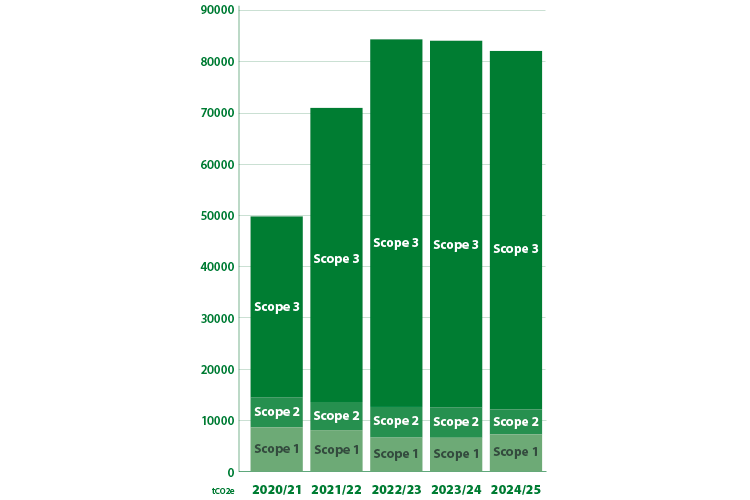
Measured carbon performance at St Andrews
Research
Research strategy priorities
Our research strategy continues to emphasise three priorities: advancing world-leading research on sustainability across disciplines, fostering sustainable research cultures that minimise environmental impact, and ensuring that research translates into practical, scalable solutions with real-world impact.
Delivering on these ambitions requires not only intellectual innovation, but also leadership in how research itself is conducted. Laboratories are among the most resource-intensive parts of a university, and embedding sustainability in their operation is vital to reducing emissions, improving efficiency, and demonstrating best practice.
To support this, we are adopting the Laboratory Efficiency Assessment Framework (LEAF), an internationally recognised standard for sustainable laboratories that helps reduce energy use, cut waste and promote sustainable practices across our research environments.

Education
Transforming education for sustainability
The University is committed not only to embedding sustainability within our own teaching and research, but also to contributing to the wider transformation of education in the UK and internationally. By integrating sustainability across the curriculum and leading sector-wide initiatives, we are helping to shape a future in which sustainability is a core principle of higher education.
Through partnerships, collaborative projects and knowledge sharing, St Andrews contributes to the growing network of universities working together to build a more sustainable future. Our students and staff participate in global dialogues, exchange best practices and advance innovative approaches to sustainability in education that extend well beyond our own institution.
In doing so, the University is strengthening its role as a leader in sustainability education, preparing graduates to meet global challenges and ensuring that higher education plays its part in building a just and resilient world.
Our teaching methods are also evolving to reflect this commitment. Flexible and digitally supported learning opportunities are expanding, reducing the environmental footprint of teaching and fieldwork while making education more inclusive and accessible. By rethinking how and where learning takes place, we are lowering our carbon impact and preparing students to thrive in a future shaped by sustainability.

Students and community engagement
Embedding sustainability in student life
Engagement with sustainability is deeply embedded in student life at St Andrews and extends into our local and global communities. We are working to increase awareness among students of their personal and collective environmental impact, encouraging behaviour that reduces carbon footprints and promotes more sustainable choices.
These projects collectively illustrate the University’s commitment to sustainability, inclusion, and practical support for communities. Across Fife, residents, volunteers, and local organisations have benefited from tangible environmental, social, and economic outcomes, helping create a greener and more resilient region.

Estate, energy and environment
Transforming the estate
The University estate is being transformed into a living laboratory for sustainability, where innovative solutions are tested and implemented at scale. At the heart of this transformation is the Eden Campus, which is developing as a net-zero operational hub and a model for how universities can integrate research, teaching and practice to accelerate climate action.
Nature-based solutions are central to this vision. Projects such as the St Andrews Forest are creating long-term carbon sinks while enhancing biodiversity, supporting climate resilience, and connecting the University to local and global efforts to restore ecosystems. These initiatives demonstrate how the estate itself can contribute to carbon sequestration, waste reduction and ecological enrichment, while also offering opportunities for student engagement and research.
By integrating nature-based solutions with cutting-edge building design and operational excellence, the University is demonstrating how a diverse estate can act as both a platform for sustainability research and a practical driver of progress towards a net-zero future.

Operational adaptation
Procurement strategy
Our colleagues in procurement are based at Walter Bower House, the centre for the University’s professional services. Our procurement strategy includes identifying contractors’ carbon footprint as we are required to report that in our own Scope 3 emissions, and also where we can support our partners in providing social benefits to the University as many companies have an option for their staff to participate in these activities.
![Planting eden estuary [750 x 500px]](/assets/university/sustainability/images/report/operational-adaptation-750x500.jpg)
United Nations Sustainable Development Goals
Established in 2015, the United Nations Sustainable Development Goals (UN SDG) constitute a comprehensive and ambitious framework designed to tackle global challenges and promote sustainable development. Comprising 17 interconnected goals with 169 targets, they address pressing issues such as poverty, inequality, climate change, environmental degradation, peace and justice.
Building upon the earlier Millennium Development Goals (MDGs), the UN SDG embrace a more holistic and inclusive approach, spanning economic, social and environmental dimensions. Guided by the principles of universality, leaving no one behind and partnership, they underscore the importance of collaborative efforts among governments, the private sector, civil society and the international community.
The successful implementation of the UN SDG demands collective commitment, transformative action and a dedication to leaving a positive legacy for future generations. By aligning the University Annual Sustainability Report with the UN SDG, the University aims to exemplify its commitment to addressing global challenges by contributing to the wellbeing of local and global communities through strategic operations and research outputs.
As the international community approaches the end of the initial 15-year SDG timeframe, the renewal process offers an opportunity for reflection, assessment and recalibration of strategies. The renewal is expected to involve a comprehensive review of progress made towards achieving the 17 interconnected goals and 169 targets, identifying areas of success and acknowledging persistent challenges. A renewed commitment to the principles of the 2030 Agenda holds the promise of fostering a more equitable, sustainable and resilient world.