Why study this course?
Normally, for joint degree programmes, the subject with the higher entry requirements determines the grades you need. However, the Biology and Chemistry BSc (Hons) joint degree programme has different entry requirements which are listed below.
Similarly, modules available for joint degree programmes are usually the same as for the single honours degree. However, the Biology and Chemistry BSc (Hons) degree has a specifically tailored set of available modules which is described below.
All other aspects of the programme, including teaching format, are the same as those listed on the Biology BSc and Chemistry BSc pages.
For more information on joint honours degrees, contact the Admissions team.
Ask a student
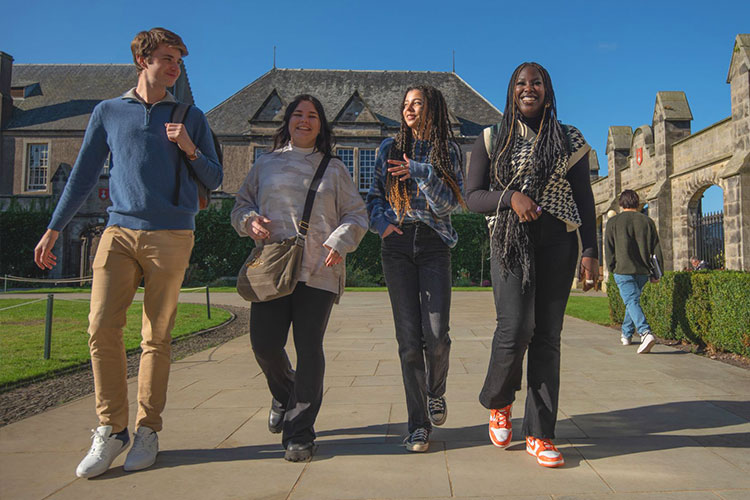
If you are interested in learning what it's like to be a student at St Andrews you can speak to one of our student ambassadors. They'll let you know about their top tips, best study spots, favourite traditions and more.

How it's taught
Teaching
-
The University's services and support teams can help students with additional needs resulting from disabilities, long-term medical conditions or learning disabilities, as well as many other difficulties and challenges students might face while studying.
Modules
Course information may change. Module information and course content, teaching and assessment may change each year and after you have accepted your offer to study at the University of St Andrews. We display the most up-to-date information possible, but this could be from a previous academic year. For the latest module information, see the module catalogue.
-
In first year, modules introduce you to core subject material relevant to your degree. Students will take the following compulsory first-year modules:
- Introductory Inorganic and Physical Chemistry: This module covers origin of the elements and the periodic table, atomic structure, shapes and properties of molecules, chemistry of the elements, properties of solutions, thermochemistry, thermodynamics and kinetics, and mathematical tools for chemistry.
- Biology 1: This module provides an introduction to molecular and cellular biology. It covers cell diversity and the origins of life, evolution, cellular structures and fundamental processes.
- Biology 2: This module provides an introduction to the diversity of life on Earth and addresses key elements of organismal, behavioural and ecological aspects of life.
- Organic and Biological Chemistry 1: This module covers the structure and nomenclature of simple organic compounds, basic stereochemistry, fundamental organic reaction mechanisms, organic functional groups and their reactions, introductory bioorganic chemistry, and organic spectroscopy
-
In second year, you will continue to study modules tailored to your degree combination. Students will take the following compulsory second-year modules:
- Applied Molecular Biology: examines case studies to provide examples of how molecular biology techniques are applied in research to address real-life questions and problems.
- Biochemistry: a number of central metabolic pathways and their control are studied in detail, alongside examples of their importance in disease and recent metabolomic studies.
- Cell Biology: This module will introduce cell biology and the diversity of cells across a range of Kingdoms, and how they form tissues and organisms, with a theme of structure and function and emphasis on practical experimental analysis.
- Molecular Biology: provides an introduction to modern molecular biology, covering fundamental biological processes such as transcription, translation, and DNA replication and repair.
- Inorganic Chemistry 2: This module develops via lectures, tutorials, a group presentation and laboratory classes, students’ knowledge and understanding of the fundamentals of Inorganic Chemistry across the breadth of the periodic table as preparation advanced studies.
- Organic Chemistry 2: covers methods for carbon-carbon bond formation and interconversion of functional groups, aromatic and heteroaromatic reactivity, retrosynthetic analysis, mechanistic biological chemistry and organic spectroscopy.
-
In your third and fourth years, you will continue to specialise in your joint subjects via a wide range of modules covering core topics. Modules that have been offered in previous years include:
- Protein Structure and Function
- Membranes and Cell Communication
- Metabolic and Clinical Biochemistry
- Biomolecular Sciences Public Engagement
- Carbohydrate and Nucleic Acid Chemistry
- Mechanism in Organic Chemistry
- Blockbuster Pharmaceuticals
- Natural Products, Biosynthesis and Enzyme Co-factors.
In fourth year, students also undertake a substantial final-year research project. This research project is designed to develop skills in experimental design and problem-solving, the evaluation and interpretation of data, and communication skills. The project occupies half of the year and is selected and supervised by a member of academic staff.
Fees and funding
- Scotland: Tuition fees are yet to be confirmed by the Scottish Government.
- England, Wales, Northern Ireland and Republic of Ireland, Channel Islands, Isle of Man: £9,790 (yet to be confirmed by the UK Government)
- EU and overseas: £33,250
More information on tuition fees can be found on the undergraduate fees and funding page.
Accommodation fees
Find out about accommodation fees for University accommodation.
Funding and scholarships
The University of St Andrews offers a number of scholarships and support packages to undergraduate students each year.
Entry requirements
The University offers different entry requirements, depending on your background. Find out more about Standard, Minimum and Gateway entry requirements using academic entry explained and see which entry requirements you need to look at using the entry requirements indicator.
-
- Standard entry grades:
- AAAAB, including A in Chemistry, and an A or B in Biology (or Human Biology) If you have a B in Biology, you will need to have an A in one other subject from the following: Computing Science, Economics, Geography, Mathematics and Physics.
- Minimum entry grades:
- AABB, including A in Chemistry, and an A or B in Biology (or Human Biology) If you have a B in Biology, you will need to have an A in one other subject from the following: Computing Science, Economics, Geography, Mathematics and Physics.
- Gateway entry grades:
- Applicants who have narrowly missed the minimum entry grades, but meet the University's contextual criteria, may be interested in one of the University’s Gateway programmes.
-
- Standard entry grades:
- AAA, Including Biology and A in Chemistry.
- Minimum entry grades:
- ABB, Including Biology and A in Chemistry.
-
- Standard entry grades:
- 38 (HL 6,6,6), Including HL6 in Biology and HL6 in Chemistry.
- Minimum entry grades:
- 36 (HL 6,5,5), Including HL6 in Biology and HL6 in Chemistry.
General entry requirements
All applicants must have attained the following qualifications, or equivalent, in addition to the specific entry requirements for individual programmes.
-
SQA National 5 (B) in English and one SQA National 5 (B) from the following:
- Biology
- Chemistry
- Computing science
- Geography
- Applications of Mathematics
- Mathematics
- Physics
- Psychology.
-
GCSE (5) in English language or English literature, and one GCSE (5) from the following:
- Biology
- Chemistry
- Computing Science
- Geography
- Mathematics
- Physics
- Psychology.
Other qualifications
We accept a wide range of qualifications for entry on to our programmes. Please see our entry requirements for more information.
More information on how to apply via other entry routes or accreditation of prior learning and experience can be found on the University's entry requirements web page.
Do I need to have studied this subject before?
Applicants must have studied Biology and Chemistry at SQA Higher, GCE A-Level, or equivalent. Preference may be given to candidates offering strong science qualifications.
International applicants
If English is not your first language, you will need to provide an English language test score to evidence your English language ability.
What to do next
Online information events
Join us for one of our information events where you can find out about different levels of study and specific courses we run. There are also sessions available for parents and college counsellors.
Undergraduate visiting days
We encourage all students who are thinking of applying to the University to attend one of our online or in-person visiting days.
Contact us
- Phone
- +44 (0)1334 46 3602
- bioadmissions@st-andrews.ac.uk
- Address
- School of Biology
Biomedical Sciences Research Complex
North Haugh
St Andrews
KY16 9ST
Discover Uni
Discover Uni provides official statistics about higher education courses taken from national surveys and data collected from universities and colleges about all their students. You can use this data to compare information for different degree programmes to help you make a decision about what and where to study.