Gender pay gap report 2021
This is the fifth report on the gender pay gap at the University of St Andrews, utilising a framework provided by the UK Government.
Introduction
Gender pay gap is a measure of the difference between the average hourly pay of men and women across the whole organisation. It is not a measure of unequal pay, which is the difference in pay between men and women doing the same job. Unequal pay is against the law, as set out in the Equality Act 2010.
The Equality Act (Scottish Specific Duties) 2012 regulations requires the University of St Andrews to publish gender pay gap data. The 2017 UK regulations, which stipulate more extensive analysis, do not apply to Universities in Scotland, however the University decided to produce a gender pay analysis to allow direct and meaningful comparison with other organisations, including almost 200 universities. By openly participating in this submission, it provides the opportunity for the University to map trends in its own gender pay and those of others.
The information in this report provides the mean and median gender pay gaps for the organisation as a whole and is broken down by grade. Figures have been calculated using the technical guidance set out by the UK Government Equalities Office.
Measures
The mean hourly rate is calculated by adding all of the hourly rates together and dividing by the number of individuals in the data set. The pay gap is the average difference between the mean hourly pay rate of men and women.
The median hourly rate is calculated by arranging the hourly rates of all individuals in the data set in numerical order to identify the middle (or median) hourly rate. This means that 50% of individuals will earn more than this hourly rate and 50% will earn less. The median gender pay gap is the difference between the mid-point hourly pay rate of men and women. Since 2019 the gender pay gap calculations have considered subtractions of pension contributions via salary sacrifice.
Key findings on gender pay gap
The Gender Pay Gap data presented here was correct as of the 31st March 2021. Calculations in this report include all permanent, fixed term and flexible contract staff.
Total workforce breakdown

Figure 1: Total Workforce Breakdown
Scale graph showing the split in staff between men and women in 2021.
In 2021, there were 1,697 men employed at St Andrews who made up 47% of the staff population. There were 1,935 women employed at St Andrews who made up 53% of the population.
Mean gender pay gap

Figure 2: Mean Gender Pay Gap
An illustration showing the mean gender pay gap values.
On average, men earned £20.92 per hour and women earned £16.70 per hour, therefore the mean gender pay gap at the University was 20.2% in favour of men, a 0.5 percentage point improvement since 2020.
Median gender pay gap
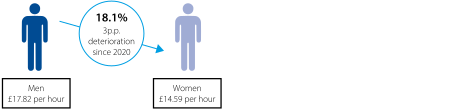
Figure 3: Median Gender Pay Gap
An illustration showing the median gender pay gap values.
On average, men earned £17.82 per hour and women earned £14.59 per hour, therefore the median gender pay gap at the University was 18.1% in favour of men, a 3 percentage point deterioration since 2020.
Mean and median gender pay gap
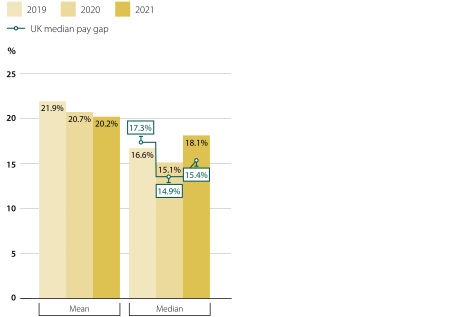
Figure 4: Mean and Median Gender Pay Gap
A bar graph which provides a comparative analysis of the mean and median gender pay gap at St Andrews between 2019 and 2021.
- The mean gender pay gap was 21.9% in 2019, 20.7% in 2020 and 20.2% in 2021. This is a consistent annual improvement.
- The median gender pay gap was 16.6% in 2019, 15.1% in 2020 and 18.1% in 2021.
- According to the 2021 Office for National Statistics Annual Survey of Hours and Earnings, the median gender pay gap for the UK economy stood at 15.4%, this is an increase from 14.9% in 2020.
- In 2019 the University’s median gender pay gap of 16.6% was 0.7 percentage points lower than the UK median.
- In 2020 the University’s median gender pay gap of 15.1% was 0.2% percentage points higher than the UK median.
- In 2021 the University’s median gender pay gap of 18.1% was 2.7 percentage points higher than the UK median.
Mean and median hourly rates by gender

Figure 5: Mean and Median Hourly Rates by Gender
A bar graph which provides a comparative analysis of the mean and median gender pay gap by hourly rate between 2019 and 2021.
- Men earned a mean average of £19.72 per hour in 2019, £20.02 in 2020 and £20.92 in 2021, whereas women earned an hourly mean average of £15.40 in 2019, £15.87 in 2020 and £16.70 in 2021.
- The median average hourly wage at St Andrews was lower. Men earned a median average of £16.86 in 2019, £17.19 in 2020 and £17.82 in 2021. Whereas women earned an hourly median average of £14.06 in 2019, £14.59 in 2020 and £14.59 in 2021.
Proportion of women in each pay quartile
Quartile pay bands are calculated by dividing the overall staff population into four equal segments from lowest to highest hourly pay. This figure shows the percentage of men and women in each quartile.
Pay quartiles 2021

Figure 6: Proportion of Women in each Pay Quartile
A scale graph, which details the proportion of men and women in each of the four pay quartiles.
- The lower quartile was made up of 35% men and 65% women.
- The lower middle quartile was made up of 42% men and 58% women.
- The Upper middle quartile was made up of 49% men and 51% women.
- The Upper quartile had 62% men and 38% women.
What the findings tell us
We have analysed the gender pay gap by contract type and grade to provide a more granular overview of the data. These figures are shown in Appendix 1.
The figures identify a mean gender pay gap of 20.2% (as compared to the 20.7% reported in March 2020) and median gender pay gap of 18.1% (as compared to 15.1% reported in March 2020). The mean average pay gap is therefore slightly reduced from the previous year. The median average pay gap however has deteriorated by three percentage points.
Understanding the median gender pay gap
Over the course of 2021, the global Covid-19 pandemic resulted in significant changes in our staffing requirements, with substantial reductions in the quantity of staff employed on flexible contracts, particularly in front line positions where facilities were closed as a result of the pandemic or when re-opened the service, due to limitation on numbers, could be serviced fully by salaried staff. While the overall University staff headcount dropped by 150, the headcount of our workers on flexible contracts dropped by 302. As a result, the percentage of the total University workforce on flexible contracts has dropped from 23.5% in 2020 to 16.1% in 2021.
Flexible contracts typically represent the lowest paid members of our workforce, particularly those with a flexible professional services contract. The number of female staff on flexible professional service contracts dropped 27.9% while the number of male staff on flexible professional service contracts dropped 33.3% over the same period. This change has resulted in significant changes to the average hourly wage of staff on flexible contracts. The removal of a greater proportion of the lowest paid male workers compared to female workers has contributed to the greater increases to male mean and median hourly rates, resulting in a widening of the median pay gap.
The median has fluctuated over the last few years, largely because there is polarisation in the male population. Female grades cluster (broadly) across the mid-range of grades, whereas males are either at the lower end of the grading structure, or at the high end. That volatility impacts the median more so than the mean. The last couple of years have been particularly impacted by a decrease in casual contract usage during the pandemic (i.e. less male staff being brought on casual contracts for facilities and trades work).
Gender pay gap comparators
Due to methodological differences and time discrepancies in calculating the gender pay gap, it is difficult to provide a direct like-for-like calculation against which to benchmark our gender pay gap.
Advance HE’s staff statistical report (2021), on the basis of the 2019-2020 year, reported that in UK higher education, the median gender pay gap was 11.1 percentage points and the mean gender pay gap was 15.7 percentage points. In Scottish HE the median gender pay gap was 16.2 percentage points and mean gender pay gap was 16.6 percentage points. According to the October 2021 Office for National Statistics (ONS) Annual Survey of Hours and Earnings (ASHE) figures, the median gender pay gap for the UK economy stood at 15.4%.
Pay quartiles
The pay gaps identified derive, in part, from a disproportionately small number of women in more senior University roles and the disproportionately large number of women in less senior roles. The majority of our staff in the lower pay quartiles are women (65% in the lower and 58% in the lower middle), while only 38% of staff in the upper quartile are women. The Upper middle quartile has more equal gender distribution, as was the case in 2019 and 2020.
There has been little significant movement in the quartiles. In the lower quartile men saw a one percentage point decrease (from 36% in 2020 to 35% in 2021). In the upper middle quartile women gained a one percentage point increase (from 50% in 2020 to 51% in 2021). In the upper quartile women lost one percentage point from 39% in 2020 to 38% in 2021. The lower middle quartile saw no movement.
Gender pay gap at senior levels
There is however, still a significant gender pay gap at the most senior levels, and in the case of Grade 9 professional services, the gender pay gap is very significant. The analysis of the gender pay gap by employment grade indicates a widening of the gender pay gap at grade 9 (10.9%). However, there is an important diversion between academic and professional services: the gender pay gap for grade 9 academics was 8.6, whilst the gender pay gap for grade 9 professional service staff was 23%.
When aggregated, the Grade 9 gender pay gap becomes distorted due to the diverse range of roles in this cohort. However, to address this and provide a more nuanced analysis, the University introduced a sub-grade pay banding structure within Grade 9, consisting of three sub-bands (9A, 9B and 9C). Whilst some colleagues remain on legacy Grade 9 contracts, and therefore remain outside of the sub-grade banding structure, the structure provides a better like for like comparison across similar sized roles and removes the distortion created with the current length of the band. This undertaking has not eliminated the pay gap but provides clarity on the areas where action needs to be taken.
We have developed our understanding of the underlying reasons for the gender pay gap and have introduced measures to reduce it. We are now considering a range of further interventions to more actively address the gender pay gap in our institution.
Actions to address the gender pay gap
We continue to strengthen our activities to address gender imbalance and eliminate the gender pay gap. A commitment to ensuring progress in this area is laid out in the University’s Strategy 2018-2023, and in its key enabler, the People Strategy.
Gender Pay Gap Working Group
As we emerge from the pandemic, a revitalised Gender Pay Gap Working Group will initially work with our Planning Office to model the data and identify a variety of direct interventions that will help close the residual and overall pay gap. This will consider the polarisation of the male population and the clustering of women at the mid-range to ascertain where the most impact can be made to reduce the pay gap. This will be undertaken in parallel with ensuring that we continue to run events to support the progression of women, such as demystifying promotions and regrading events for both applicants and managers, monitoring applications for gender balance and publishing outcomes. In addition, we are currently undertaking a review of our pay points and starting salary to take account of, where possible, the impact of the voluntary living wage.
A further action of the group will be to review the impact of programmes such as the Elizabeth Garett Mentoring Programme/ Aurora to ascertain if we can monitor the trajectory of staff, as a result of participating in these initiatives.
We remain resolutely committed to improving our understanding of other pay gaps, and to understand the impact of intersectionality when addressing the gender pay gap. In 2020, we published St Andrews’ ethnicity pay gap for the first time. The aim over the next period is to look at the actions that can be taken to reduce under/over representation in the upper and lower quartiles.
Equality, diversity and inclusion staff appointments
In March 2019, the University’s first Assistant Vice Principal (AVP) for Diversity was appointed. This senior-level role is a visible and high profile demonstration of the University’s determination to place equality, diversity and inclusion (EDI) at the heart of the St Andrews experience. AVP Diversity has since demitted office, and the University is currently in the process of appointing a Vice-Principal People and Diversity in recognition of the importance we place on this role in supporting and driving forward the EDI agenda.
Our VP People and Diversity will work closely with the other dedicated EDI appointments, who have continued to work across the University to broaden engagement with the EDI agenda. This has included supporting bystander training, and holding the St Andrews’ first ever Inclusion Week, in collaboration with 5 other HEIs, an event open to colleagues in all HEIs and other sectors. In addition, we are seeking to attain an institutional Race Equality Charter award. To work towards this, we have appointed an academic Race Equality Charter institutional Chair to oversee the application process and work stream. These roles build on the existing EDI staff complement, which include the Head of EDI, two Awards Advisers and an EDI Assistant.
Athena Swan
We continue to engage fully with Athena Swan: the University’s Bronze institutional award was renewed in May 2018; all Academic Schools have received an Athena Swan award. 17 of our Academic Schools have received the Bronze Athena Swan award and 2 schools have received Silver. In April 2021 the School of Biology received a Gold Athena Swan award, a level held by less than 3% of departmental award holders in UK and Ireland HEIs. This award is recognition of the hard work the School has been doing for many years to champion gender equality, address other inequalities, and foster an inclusive environment for all staff and students. Through a wide variety of actions, including building leadership experience, the School has achieved gender parity across management roles and in staff recruitment. It has also seen substantial increases in grant income and successful promotion applications for female academic staff. The School has established an annual ‘away day’ for Professional Services and Support (PSS) staff, future plans for which include dedicated sessions on career development and recognition of the skills and contributions of PSS staff to the School.
Additionally, our School of Physics and Astronomy continues to hold the Juno Champion status (the highest level) from the Institute of Physics. We are seeking to attain an institutional Silver Athena Swan award in the academic year 2023-2024. To work towards this, we have appointed a senior academic Athena Swan institutional Chair to oversee the application process and work stream.
Since the last Athena Swan submission, we have taken a series of actions to enhance gender equality. These include:
- restricting single-sex recruitment shortlists for academic posts
- developing and implementing Academic Review and Development Scheme (ARDS) guidance for Heads of School
- enhancing recruitment processes to promote the proportion of women joining the University, especially in senior academic roles (all recruitment panel members are required to complete the ‘Unconscious Bias’ online training module); and developing recommendations to improve recruitment information available to potential applicants
- established an EDI representatives’ network for staff working in Units to mirror the network in Academic Schools
- revision of the promotions procedure to give a clear pathway for staff in education-focused roles. Three staff in these roles have since been promoted to Professor.
- The University is reviewing the Head of School and Deputy Head of School roles and considering the supports that are put in place
Academic promotions
We continue to develop our promotion criteria to recognise excellence. The promotions exercise resumed in 2021, after being paused in in 2020 due to the pandemic, following an Equality Impact Assessment (EIA). To help increase awareness and transparency around the academic promotion process, ‘demystifying promotion sessions’ are held on an annual basis. These have been well attended and provide potential applicants with: an overview of the process, how applications are marked, what the panel is looking for and an overview of success rates. Since 2017, female applications have increased by 50%, with a success rate of 73% versus 64% for male applicants. The restarting of promotions will hopefully have a positive impact on the gender pay gap across many areas and grades.
Professorial and Senior Salary Review
In 2022, we will resume our biennial Professorial and Senior Salary Review process, which will provide a further opportunity to review and rebalance the gender pay gap at Grade 9.
Mentoring and development schemes for women
The Elizabeth Garret Mentoring Programme, which was launched in November 2017, continues to support the development of senior academic women in, or aspiring to, leading academic research, teaching, and leadership roles. To date, the scheme has supported 88 mentees.
In the academic years 2020-2021 and 2021-2022, the University has sponsored a further 52 professional and academic women to take part in the Advance HE Leadership Foundation in Higher Education (LFHE) Aurora programme. This is an external women-only leadership development programme, designed to take positive action to address the under-representation of women in leadership positions in the higher education (HE) sector.
Support for carers
We continue to hold the Carer Positive Employer Award at ‘Exemplary’ level (the highest level), which was renewed in June 2021. We launched a Staff Parents and Carers Network in March 2019 to support the working lives of staff who have parental and caring responsibilities. This provides a networking forum to share knowledge and experiences and raises awareness of the needs of working parents and carers through events and initiatives. In the context of Covid-19, in March 2020, a virtual network was launched to support staff working remotely.
Hybrid working
We have developed an interim hybrid working guide to support staff transitioning back into the workplace post pandemic, but accepting and realising that for many, the ability to flex working hours and days is an essential part of their lives and the University will continue to provide and enhance this flexibility.
Recruitment and promotion
We are embarking on a review of our recruitment strategy to ensure that it is inclusive and relevant following the pandemic, and clearly articulates the benefits of employment by St Andrews. We continue to ensure that in relation to recruitment the following is in place:
- all adverts encourage applications from women and other underrepresented groups
- disallowing single-sex shortlists for advertised academic posts
- require mandatory unconscious bias and diversity training for recruitment and promotion board members
- ensuring panels are representative and that all posts have both female and male contacts.
In order to further diversify the pool of staff sitting on appointment committees, we now invite all staff to express an interest in this role and offer training in preparation for it.