Gender pay gap report 2019
This is the third report on the gender pay gap at the University of St Andrews, utilising a framework provided by the UK Government.
Introduction
Gender pay gap is a measure of the difference between the average hourly pay of men and women across the whole organisation. It is not a measure of unequal pay, which is the difference in pay between men and women doing the same job. Unequal pay is against the law, as set out in the Equality Act 2010.
The Equality Act (Scottish Specific Duties) 2012 regulations requires the University of St Andrews to publish gender pay gap data. The 2017 UK regulations, which stipulate more extensive analysis, do not apply to Universities in Scotland, however the University decided to produce a gender pay analysis to allow direct and meaningful comparison with other organisations, including almost 200 universities. By openly participating in this submission, it provides the opportunity for the University to map trends in its own gender pay and those of others.
The information in this report provides the mean and median gender pay gaps for the organisation as a whole and is broken down by grade. Figures have been calculated using the technical guidance set out by the UK Government Equalities Office.
Measures
The mean hourly rate is calculated by adding all of the hourly rates together and dividing by the number of individuals in the data set. The pay gap is the average difference between the mean hourly pay rate of men and women.
The median hourly rate is calculated by arranging the hourly rates of all individuals in the data set in numerical order to identify the middle (or median) hourly rate. This means that 50% of individuals will earn more than this hourly rate and 50% will earn less. The median gender pay gap is the difference between the mid-point hourly pay rate of men and women. The 2019 gender pay gap calculations have considered subtractions of pension contributions via salary sacrifice; this has led to lower hourly rates in comparison to those reported in 2018.
Key findings on gender pay gap
The gender pay gap data presented here was correct as of the 31st March 2019. Calculations in this report include all permanent, fixed term and flexible contract staff.
Total workforce breakdown

In 2019, there were 1,788 men employed at St Andrews who made up 48% of the staff population, while 1,920 women were employed at St Andrews, who made up 52% of the population.
Mean gender pay gap
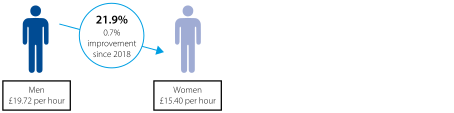
On average, men earnt £19.72 per hour and women earnt £15.40 per hour, therefore the mean gender pay gap at the University was 21.9% in favour of men, a 0.7% percentage point improvement since 2018.
Median gender pay gap
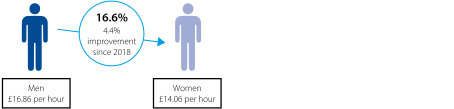
On average, men earnt £16.86 per hour and women earnt £14.06 per hour, therefore the median gender pay gap at the University was 16.6% in favour of men, a 4.4% percentage point improvement since 2018.
Mean and median gender pay gap
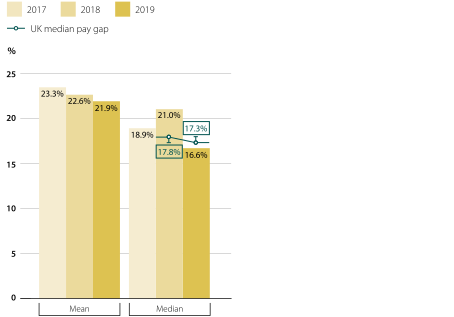
- The mean gender pay gap was 23.3% in 2017, 22.6% in 2018 and 21.9% in 2019. This is a consistent annual improvement.
- The median gender pay gap was 18.9% in 2017, 21% in 2018 and 16.6% in 2019. The median gender pay gap therefore spiked in 2018.
- According to the 2019 Office for National Statistics Annual Survey of Hours and Earnings, the median gender pay gap for the UK Economy stood at 17.3%, this is down from 17.8% in 2018.
- In 2018 the University’s median gender pay gap of 21% was 3.2% higher than the UK median.
- In 2019 the University’s median gender pay gap of 16.6% was 0.7% lower than the UK median.
Mean and median hourly rates by gender
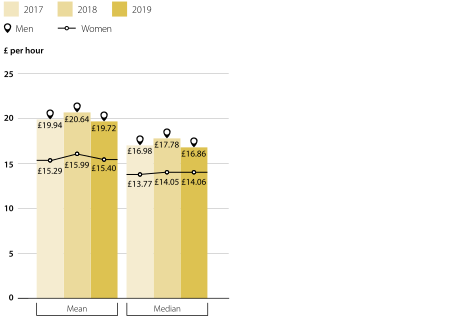
- Men earnt a mean average of £19.94 per hour in 2017, £20.64 in 2018 and £19.72 in 2019, whereas women earnt an hourly mean average of £15.29 in 2017, £15.99 in 2018 and £15.40 in 2019.
- The median average hourly wage at St Andrews was lower. Men earnt a median average of £16.98 in 2017, £17.78 in 2018 and £16.86 in 2019. Whereas women earnt an hourly median average of £13.77 in 2017, £14.04 in 2018 and £14.06 in 2019.
Proportion of women in each pay quartile
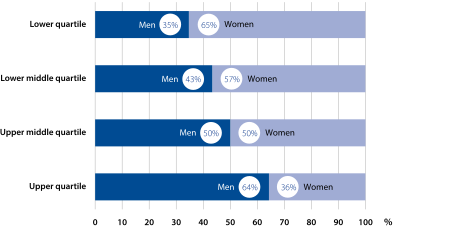
- The lower quartile was made up of 35% men and 65% women.
- The lower middle quartile was made up of 43% men and 57% women.
- The upper middle quartile had an even gender split.
- The upper quartile had 64% men and 36% women.
Bonus payments
The University has no contractual bonus arrangements.
What the findings tell us
The University has analysed the gender pay gap by contract type and grade to provide a more granular overview of the data. These figures are shown in Gender pay gap report 2019 appendix 1 (PDF).
The figures identify a mean gender pay gap of 21.9% (as compared to 22.6% reported in March 2018) and median gender pay gap of 16.6% (as compared to 21.0% reported in March 2018). The mean and median average pay gap for men and women is therefore reduced from the previous year.
Due to methodological differences and time discrepancies in calculating the gender pay gap, it is difficult to provide a direct like-for-like calculation against which to benchmark our gender pay gap. Advance HE’s staff statistical report (2019), on the basis of the 2017-2018 year, reported that in UK higher education, the median gender pay gap was 13.7% and the mean gender pay gap was 16.7%. According to the October 2019 Office for National Statistics (ONS) Annual Survey of Hours and Earnings (ASHE) figures, the median gender pay gap for the UK Economy stood at 17.3%.
The pay gaps identified derive, in part, from a disproportionately small number of women in more senior University roles and the disproportionately large number of women in less senior roles.
The majority of staff in the lower pay quartiles are women (57% in the lower and 65% in the lower middle), while only 36% of staff in the upper quartile are women. The upper middle quartile has more equal gender distribution, as was the case in 2018.
There has been no significant movement in the upper quartile figures since 2018, with men still dominating the highest paid quartile (64%). There has been little significant movement in the lower quartiles. Women gained a one percentage point increase in the lower quartile (up from 64% in 2018 to 65% in 2019) and there was no change in the lower middle pay quartile.
The analysis of the gender pay gap by employment grade indicates a widening of the gender pay gap at grade 9 (11.8%). However, there is an important diversion between academic and professional services: the gender pay gap for grade 9 academics was 9.9%, whilst the gender pay gap for grade 9 professional service staff was 22.3%.
We will work over the next year to understand better why these patterns persist.
Actions to address the gender pay gap
The University continues to strengthen its activities to address gender imbalance and eliminate the gender pay gap. A commitment to ensuring progress in this area is laid out in the University’s Strategy 2018- 2023, and in its key enabler, the People Strategy.
Equality, diversity and inclusion staff appointments
In March 2019, the University’s first Assistant Vice Principal (AVP) for Diversity was appointed. This senior-level role is a visible and high-profile demonstration of the University’s determination to place equality, diversity and inclusion (EDI) at the heart of the St Andrews experience.
In March 2020, the University appointed a Research Fellow and Project Manager in Equalities to work with the AVP Diversity to implement EDI initiatives across the University. The University also appointed an EDI Project Officer. In addition, the University has appointed two Equality, Diversity and Inclusion Area Leads (one for Arts and Divinity and one for Science) to further the EDI agenda within their respective faculties. These new roles build on the existing EDI staff complement of our Head of EDI, two Awards Advisers and an EDI Assistant.
Athena SWAN
The University has continued to engage with Athena SWAN: the University’s Bronze institutional award was renewed in May 2018; 13 of our Academic Schools have received a Bronze Athena SWAN award and 3 Schools have received Silver. Additionally, the University’s School of Physics and Astronomy continues to hold the Juno Champion Status from the Institute of Physics.
Consultation exercise
In 2019, the University undertook a large consultation exercise to collect the views of 1,000 staff and students through focus groups and anonymised surveys. The dataset was analysed to identify key themes and, where possible, ‘group specific’ trends, including gender. This research underpinned the development of the University’s People Strategy and its Action Plan.
Mentoring and development schemes for women
The Elizabeth Garret mentoring programme, which started in January 2018, continues to support women in, or aspiring to, academic leadership roles. To date, the scheme has supported 58 mentees.
In the academic years 2018-2019 and 2019-2020, the University has sponsored a further 47 members of staff to take part in the Leadership Foundation in Higher Education (LFHE) Aurora programme. This is an external women-only leadership development programme, designed to take positive action to address the under-representation of women in leadership positions in the higher education (HE) sector.
Support for carers
The University continues to hold the Carer Positive Employer Award and has progressed from the ‘Established’ level, to ‘Exemplary’, the highest level. The University launched a Staff Parents and Carers Network in March 2019 to support the working lives of staff who have parental and caring responsibilities. This provides a networking forum to share knowledge and experiences and raises awareness of the needs of working parents and carers through events and initiatives. In the context of Covid-19, in March 2020, a virtual network was launched to support staff working remotely.
Recruitment and promotion
Recruitment and promotion procedures have been revised to:
- encourage applications from women and other underrepresented groups
- disallow single-sex shortlists for advertised academic posts without a pause in the process and Principal’s Office discussion
- require mandatory unconscious bias and diversity training for recruitment and promotion board members.
Gender Pay Gap Working Group
Since September 2018, a new Gender Pay Gap Working Group has been working to support and enhance the University’s ongoing activities in tackling the gender pay gap and related issues. A gender-mixed membership includes:
- Assistant Vice-Principal for Diversity
- Director of Human Resources
- Head of Equality and Diversity
- a representative from Planning
- Trades union representatives from UCU, Unison and Unite
- academic and professional services staff representatives.
In addition to analysing data, the group examines external guidance for good practice, such as the EHRC ‘Closing the Gender Pay Gap’ publication (December 2018), as part of a review of evidence-based actions for removing the gender pay gap, within higher education as well as more widely.
The group has also commissioned work from the University Planning Office, from HR and the EDI team. This work includes analysing the impact of job titles and advertisements on the gender of applicants and appointees.
The University remains committed to improving our understanding of other pay gaps, and to understand the impact of intersectionality when addressing the gender pay gap. This year, the University will be publishing its ethnicity pay gap for the first time.
The EDI Research Fund continues to support projects to generate further evidence to support good practice; this year, a specific call was made for projects related to the gender pay gap.