Undergraduate project prize winners 2025

Many congratulations to graduating students winning project prizes, class medals, and other prizes
----------------------------------

Congratulations to Niya Petkova who was awarded for the best final year Theoretical Physics Project Prize
Project title: Training a cavity-QED associative memory
Supervisor: Jonathan Keeling
Niya's project sought to find out how we may train an 'associative memory' made of cold atoms in a confocal optical cavity. Associative memories, of which the Hopfield model is the most well known, allow one to input a partial or corrupted image and have the memory recover the original version. Building on several years of theoretical and experimental work our collaborators, the Lev group in Stanford, have recently produced a realisation of such a memory using the dynamics of ultracold atoms in a confocal cavity. While the experimental realisation allows the concept of remembering existing memories, the way the memory is encoded appeared to make the process of training new memories difficult. Surprisingly however, the experiments showed some form of training was possible, of reinforcing existing memories by allowing small movements of the clumps of atoms. Niya started from this, and worked out what is and is not possible in terms of training of such a memory by moving of the atoms. This revealed a lot of interesting results about how the complex relation between position and connectivity of nodes in this system behaved. Throughout the project, Niya showed great initiative and imagination in suggesting new approaches to try, and ways to understand the numerical results she was finding. Congratulations to Niya on winning the theoretical physics project prize.
--------------------

Congratulations to Farah (Tori) Wallauer who was awarded for the best final year Astrophysics BSc Project Prize.
Project title: Untwisting the Light Curves of Fairall 9
Superviser: Juan Hernandez Santisteban
Farah completed her BSc project on a nearby supermassive black in the active galaxy Fairall 9. She used seven years of daily monitoring from Las Cumbres Observatory, to understand the geometry of the flow of material that is actively feeding the black hole. Farah was able to disentangle multiple signals twisted in the light curves (light intensity as a function of time) by searching for echoes between the light variations at different energies. She concluded that there are two distinct components in the time-dependent variations arising from the accretion disc that feeds the supermassive black hole and gas orbiting much further away. Her results provide evidence for a mixed signal imbedded in the observed data which imposes stringent constrains on the geometry of the “accretion flow”. I want to congratulate Farah on this very much deserved award, as it demonstrates her expertise to handle a very large dataset and provide state-of-the-art results in our understanding of actively growing supermassive black holes.
----------------------------------------------

Congratulations to Lauren Stewart who was awarded for the best final year Physics BSc Project Prize
Project title: Exploring the Use of Shaped Pulses for DEER
Supervisors Janet (Eleanor) Lovett and Hassane EL Mkami.
Ren’s BSc project was to explore the use of shaped pulses for the EPR spectroscopy experiment of double electron-electron resonance (DEER). The experiment measures the dipolar coupling between pairs of paramagnetic centres, enabling the determination of nanometre distances. Such measurements are important for gaining deeper insights into the conformational and structural properties of soft matter, including biomolecules.
Shaped pulses should allow for uniform excitation of a lot more spins than the prior limitation of yesterday’s method of rectangular pulses of microwave radiation. Although the EPR spectrometer in Physics has been upgraded to allow the use of pulse shaping, the benefits of this feature had not been fully explored for DEER.
Ren learned the experimental aspects (computational, practical and theoretical) and explored many facets of the problem including, but not limited to, shape pulse characteristics, bandwidth, phase and amplitude. It was quite the Magical Mystery Tour!
Coming up, the results from this work will improve experimental settings and enable more accurate and sensitive DEER measurements. Ren’s attitude that “we can work it out” was vital in exploring so many aspects: she took ideas and flew with them like a blackbird but was also able to ask for help. Ren then took the results and concepts and made them come together in a compelling and clear report.
Congratulations on winning the BSc project prize Ren.
(* In case you’re wondering, Ren is a big Beatles and especially Paul McCartney fan).
----------------------------------------

Congratulations to Mairi Nonhebel who was awarded for the best final year Astrophysics MPhys Project Prize
Project title: Zooming-in to Star Formation
Supervisors: Rowan Smith
Mairi’s project investigated how turbulence shaped the density structure within the gas clouds where stars form. Previous investigations of this used idealised models where the turbulence was driven in a periodic box. However, Mairi investigated the effects of turbulence using our group's more realistic initial conditions where the clouds are part of a larger galaxy. Her work has shown that the density distribution in the clouds is narrower than that predicted by previous studies, and that this will affect how efficiently dense gas can be transformed into stars within these clouds. This is an important quantity as the formation of stars in galaxies regulates the galaxy baryon cycle and affects how they evolve over cosmological time. We are now planning to convert Mairi's thesis into a full research paper.
----------------------------
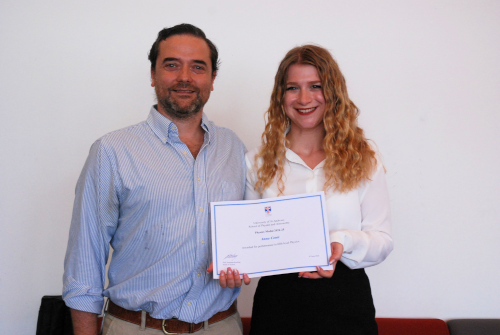
Congratulations to Anna Conti who was awarded Physics 5th Level Medal
Supervisor: Juan Varela
The project Anna did in Dr. Varela’s lab tackled a fundamental challenge in deep tissue imaging, studying how light scattering caused by mismatched refractive indices in biological tissues. Traditional methods like multiphoton microscopy or chemical clearing can help, but they are either complex or incompatible with live systems. Inspired by a new approach recently developed by scientists in Stanford, Anna tested whether tartrazine (a common, biocompatible food dye found in Doritos) could reduce scattering by increasing the refractive index of water surrounding cells. Using 3D confocal microscopy, Anna could measure clear improvements in gel models, with better visualization of fluorescent nanoparticles dispersed in the gel. The dye's effectiveness dropped off in real tissues like brain and bone, likely due to limited penetration and instability at room temperature. Still, the project opened up exciting possibilities for using absorbing dyes in optical clearing, showing what needs to be improved in future iterations of this imaging strategy.
---------------------------------

David Reid was awarded for the best final year MPhys Physics project.
Project title: The Stability of Triple-Cation Perovskite Solar Cells in a Simulated Low Earth Orbit Environment
Supervisor: Dr Lethy Krishnan Jagadamma
This project focused on investigating the thermal cycling stability of halide perovskite solar cells for space applications in low Earth orbit (LEO). Halide perovskites are an emerging family of highly promising photovoltaic materials, with power conversion efficiencies of up to 27% demonstrated under terrestrial conditions. These materials have also shown excellent radiation tolerance, making them a key focus for research into their suitability for 'space-grade' applications.
While the radiation tolerance of halide perovskites has been extensively studied, their behavior under thermal cycling—particularly relevant for the extreme temperature fluctuations in LEO—remains less understood. Gaining insights into their thermal stability under these conditions is crucial for evaluating their potential in space-grade solar panels.
In addition to thermal cycling stability, David’s project examined the impact of substrate selection—comparing fused silica and soda lime glass—on device performance. The study found that triple cation perovskite compositions are particularly suitable for LEO space-grade applications. However, a higher coefficient of thermal expansion mismatch between the perovskite active layer and fused silica substrate can lead to device degradation during thermal cycling. This highlights the importance of substrate choice in achieving long-term stability.
We are currently preparing these findings for formal publication with David Reid. We warmly congratulate David Reid on this significant achievement.