A New Order of Things
Social and Cultural Transition in the Epistolary and Journalistic Networks of Heinrich von Kleist
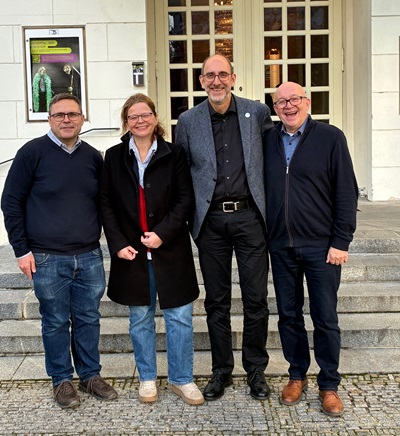 Our project, 'A New Order of Things': Social and Cultural Transition in the Epistolary and Journalistic Networks of Heinrich von Kleist', will be funded by the AHRC and DFG for three years from February 2026, to a combined total of 980k €. It will be co-delivered by Seán Allan (St Andrews/Bonn), Elke Dubbels (Osnabrück), Elystan Griffiths (Birmingham) and Christian Moser (Bonn/St Andrews).
A year before Prussia’s defeat at the hands of Napoleon Bonaparte in 1806, the German writer Heinrich von Kleist (1777-1811) expressed his sense of the emergence of a ‘new order of things’ catalysed by Napoleonic expansionism in Europe. Over the following years, Kleist would respond to these political and cultural changes by assembling a series of networks as the journalist and editor responsible for the artistic journal Phöbus (1808), the planned nationalist journal Germania (1809), and Berlin’s first daily newspaper, the Berliner Abendblätter (1810-11). He also maintained extensive correspondence with key cultural and political figures both in Germany and beyond.
Our project will map out Kleist’s epistolary and journalistic networks across five key areas: (1) Politics; (2) the Military; (3) Economics; (4) Means of Communication and Travel; and (5) Visual Arts. We will uncover in more detail how Kleist drew upon existing networks and created new ones of his own, by focusing on the interplay between public communication in his journals, private communication in his letters and semi-public fora such as salons. This is a particularly propitious time for our investigations, in the light of Hermann Weiss’s recent discovery of five hitherto unknown letters from Kleist to the Austrian chargé d’affaires in Dresden, Joseph von Buol-Berenberg as well as a wealth of new archival sources held at the Tiroler Landesmuseum Ferdinandeum in Innsbruck.
To understand fully the social and political implications of Kleist’s journalism and letter-writing, a new methodological approach—one less individual-centred and more oriented towards creative networks—is required. By positioning Kleist’s work within broader creative and intellectual networks, we will provide an analytical and interpretative model for the future study of ‘networked’ nineteenth-century cultures and move away from paradigms of creativity typically focused on the lone (male) genius. Our hypothesis is that by contextualising Kleist’s letters and journalism within his networks, we can refine scholarly understandings of authorship around 1800.
As a British-German cooperation, our project will transform the international understanding of an author who has remained under-appreciated in the Anglophone world. We plan to capitalise on the global celebrations of the 250th anniversary of Kleist’s birth in 2027 by producing open access translations of selected journalism and correspondence by Kleist and his network across our five focal areas.

