« back to Biography
Dickens's Favourite Blacking Factory
Neil Price, BSc 1974
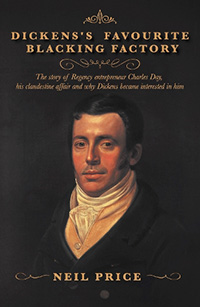
DICKENS’S FAVOURITE BLACKING FACTORY
The story of Regency entrepreneur Charles Day, his clandestine affair and why Charles Dickens became interested in him.
Neil Price knew his great-great-grandparents were John and Sarah Price. He had discovered plenty about Sarah, but nothing about John – not even a marriage record, just a family rumour that he was a merchant of London and that he died around 1831. Neil, and his father before him, had spent their whole lives in a fruitless search for clues. He was about to give up. Then a fluke discovery. He found that Sarah, under her maiden name of Peake, was mentioned in the Will of Charles Day (1784-1836), one of the most successful entrepreneurs in Regency London. From humble beginnings, Charles made a huge fortune (over £45m in today’s money) as the first person to mass-produce and successfully market boot-blacking, the forerunner of shoe polish, trading under the name of ‘Day and Martin’. He was also philanthropic, and could be described as the ‘Bill Gates’ of his time.
But what was the connection (if any) between Charles Day and Sarah’s husband, John Price? Could they even be the same person? Could Charles Day be the father of Sarah’s three sons, the middle of whom was Neil Price’s great-grandfather, Alfred Price?
In this remarkable and highly imaginative telling of a true story, following a decades-long search for information on his ancestor, the author reveals a sweeping narrative of Regency and early-Victorian London. An actual 170,000-word document uncovered in the National Archives at Kew exposes the tragic last two months of the life of Charles Day. This includes his deteriorating mental faculties resulting from tertiary syphilis, his remarkable philanthropy, blackmail by a dodgy solicitor, the inertia of the contemporary legal system and the shame of illegitimacy, particularly in the wealthy classes. The culture of counterfeiting and the birth of the concept of intellectual property is also explored as well as the kindness that can lie behind seemingly ruthless businessmen. He even discovers that Charles Dickens used the protracted Will case of Charles Day in the Court of Chancery as justification for the case of ‘Jarndyce and Jarndyce’ in Bleak House.
The most formative experience of Dickens’s early life was working as a boy in the squalid conditions of the Warrens’ blacking factory, the main competitor of ‘Day and Martin’. Dickens even makes a favourable comparison of ‘Day and Martin’ over Warrens in The Pickwick Papers. Perhaps the plot of Bleak House even reflects aspects of Charles Day’s own life? Using the central device of the diary of Day’s doctor, neighbour and friend, William Foote of Edgware, and also narrative to set the story of Day’s life, death and its aftermath in its historical context, an extraordinary family history is uncovered, having been a well-kept secret for nearly 200 years.
ISBN: 978-1-915494-68-9