Report and Support second report
This is the second Report and Support report, covering the period from September 2021 to August 2022.
Introduction
Report and Support makes an important contribution to the refreshed University Strategy key objectives; to foster an inclusive and compassionate culture where all feel able to be their authentic selves and to build greater diversity across our student and staff communities and make real progress in addressing inequalities.
In co-ordinating Report and Support, we acknowledge the reality that members of our community have been subjected to harassment, discrimination, sexual violence, and bullying behaviours. Whilst these behaviours are evident in all facets of society, and our University is no exception, this report is one outcome of a range of work detailed in the first report.
The University of St Andrews launched Report and Support in November 2020. The first report covered the period from November 2020 to May 2021. This second report provides an overview of the reports made during the full academic year of September 2021 to end of August 2022 and a comparison with the available data from the previous academic year. In this report, we share data insights, describe the creation of additional categories, review the first action plan and document the second action plan. The authors are grateful to students and staff who have shared their experiences and expectations of using the Report and Support tool.
Key findings
Key findings from this report are that:
- More people are reporting; 217 reports were made from September 2021 to end of August 2022 whilst 138 reports were made in the 10 months between November 2020 and end of August 2021.
- More are using their contact details; 59% (129) of reports included contact details, whilst 41% (88) of reports were made anonymously in 2021-2.
- Most reporters identify as women. 70% (121) of those who provided a gender identity in 2021-2 selected ‘woman’. This is an increase from 56.6% in 2020-1.
- Most reporters are students, with 82% of total reports in 2021-2. Staff made 6.5% of reports in the same period.
- More people are reporting mental health difficulties. A ‘mental health difficulty such as depression, schizophrenia or anxiety disorder’ was the most frequently selected disability at 25.6% (51) in 2021-2, up from 19.1% (27) in 2020-1.
What is Report and Support?
Report and Support provides an online and integrated option for students, staff and members of our wider community to report negative behaviour and to report concerns about wellbeing. Report and Support also contains comprehensive support pages.
Staff working in Student Services, Student Conduct and Human Resources receive and review all reports impartially and non-judgementally. For those reports that include contact details, staff seek to help and respond. This involves listening to understand more fully the experiences reported and use the range of support and investigative processes available. The data insights and action plan provide more information about how staff responded to these reports.
Delivery of action plan from the previous report
We established two Report and Support Fora in spring 2021, comprising a range of student representation, staff from Human Resources, Conduct, and Student Services. Each forum provided an opportunity for people to speak about their reporting experiences and to consider the best ways to address issues. The previous year’s Fora provided the basis for the initial action plan which has subsequently been implemented.
In the first action plan we committed to raise awareness of the Report and Support tool seeking to build confidence in using it. We have done this by:
- Supplementing the Report and Support Webpages with student-led social media posts that explain how to make a report and what happens to reports after they have been submitted.
- Embedding information about Report and Support in student orientation and staff inductions.
- Adding Report and Support to other webpages and events to highlight the tool.
- Speaking about Report and Support in information sessions to different groups within the community, for example, managers and students.
We are grateful to:
- Got Consent Students and Student Services colleagues who included Report and Support in the Consent and Bystander Intervention Training, which is undertaken by entrant students, in the Orientation web pages and as part of the Safety and Security information linked from the University’s Orientation App.
- The wardennial team for participating in LISTEN training, led by Student Services and designed to support those who disclose GBV.
- The Principal Professor Dame Sally Mapstone, Corporate Communications, the Rector’s Assessor and representatives from the student community for the production of the ‘Identifying and Challenging Racism’ video.
- The Student Association Director of Wellbeing for 2021-2, who produced flowcharts to illustrate the process for both anonymous and named reporting.
- The Students' Association Wellbeing and Equality Co-ordinator and Director of Wellbeing for 2021-2, who helped produce supporting documents, in relation to Drink Spiking.
- The Students’ Association, who hosted events with Student Services to talk about reporting with the BAME student network and to discuss intersectionality.
- OSDS (Organisational & Staff Development Services) and HR (Human Resources) colleagues who included Report and Support into the staff onboarding process and highlighted the Report and Support tool in the staff essential training.
- Students, HR, and IT colleagues, who helped produce a video explaining how to make a report and added links to the tool to Administration A-Z, Staff Wellbeing pages, MySaint and staff self-service.
Updates to the Report and Support System
Updates to the Report and Support System from September 2021 to end of August 2022
In response to suggestions and conversations with students and staff at the Fora, colleagues have updated and developed the following features, at times utilising support from Culture Shift, the organisation that developed and maintains Report and Support:
- To make the process more understanding and sensitive to the likelihood that reporters are sharing distressing information, we reordered the questions so that ‘Tell us what happened’ is now the first question.
- We included additional text within the report process to provide or signpost support. For example, “we understand this may be difficult to think about, so please only recount whatever details you feel comfortable to share.”
- We added reporting outcomes to reflect the work of Student Services, Conduct and HR more accurately. Outcomes now include ‘Support received,’ ‘Support offered – no reply’ and ‘Information passed to relevant staff.’
- We gave each report a reference number, visible on screen when the report is submitted, so that reporters can maintain their anonymity and check on progress by quoting the reference number when calling Student Services, Conduct or Human Resources to discuss their report.
- Students or staff reporting anonymously can now switch to named reporting without losing the information already shared.
- To gain a more comprehensive understanding of the experiences being reported, from end of May 2022, reporters can choose as many categories as necessary, previously they were limited to one specific category.
- There is now an option to simplify the process by submitting reports without answering questions related to data collection.
- Street Harassment and Hate Crime support documents are in development and will be available in spring 2023.
In response to ‘Other’ being the most frequently selected category for describing the situation the report relates to, we added four new categories:
Racism
We introduced the racism category at end of May 2022. This category enables reporters to voice their experiences and to help the University to understand more of the lived experiences of students and staff, to investigate and provide support.
A video was produced by students and staff with an introduction by The Principal, Professor Dame Sally Mapstone. This video explores the ways that racism manifests and provides examples of how it can be experienced, challenged and reported.
A Listening Guide is located in the section on Racism Support. It is designed for those wanting to support people who have experienced racism. We produced the guide with input from student representatives and staff. It includes advice on how to listen to those who have experienced racism. We are adapting this guide to make it relevant for all categories in 2023.
Drink spiking
In response to feedback from students, to learn more about the frequency and impact of drink spiking behaviour and to facilitate bringing this behaviour to light, we developed the Spiking category. The support pages provide a comprehensive resource for accessing support around Spiking.
In collaboration with the Student Association, guidance offers descriptions about drink spiking, symptoms one might experience, what to do if you think you may have been spiked and what to do if the Spiking involved being assaulted.
Anti-social behaviour and Safeguarding concerns
We added categories for Anti-social behaviour and Safeguarding concerns at end of June 2022.
Report and Support key statistics for 2021-2022
- 217 reports were made during the 12 months from September 2021 to end of August 2022. 138 reports were made in the 10 months between November 2020 and end of August 2021.
- Students made most reports, with 82% of total reports in 2021-2. Staff made 6.5% of reports in the same period. In 2020-1 students made 82.6% of reports and staff made 6.5%.
- ‘Other’ was the most reported category for describing the situation the report relates to, at 18.6% (45) in 2021-2, decreasing from 36.6% (56) in 2020-1. The next most reported category in 2021-2 was ‘Sexual assault and rape’ at 15.7% (38), as in 2020-1, when it was selected by 18.3% (23) of reporters.
- 59% (129) of reports included contact details, whilst 41% (88) of reports were made anonymously in 2021-2. This is an increase in named reports from 50.7% (70) in 2020-1.
- The most common response in 2021-2 to reasons for reporting anonymously was to inform the University: ‘I want the University to have this information’, with 14.5% of total options (44), this was also the most common response in 2020-1.
- University Accommodation was the most frequently selected category for location of incident, in both reporting years, with 30.7% of total options selected (66) in 2021-2, increasing from 25.6% (42) in 2020-1.
- ‘Closed as anonymous’ is the most frequent report outcome. However, this decreased from 48.4% (77) of reports in 2020-1 to 25.6% (57) in 2021-2.
- 70% (121) of reporters who provided a gender identity in 2021-2 selected ‘woman’. This is an increase from 56.6% in 2020-1.
- The highest reported category in 2021-2 for those identifying as ‘man’ was ‘discrimination and/or hate incidents’ with 16.7% of selections (7), followed by ‘Harassment’ with 14.3% of category selections (6).
- ‘Another Mixed or Multiple background,’ was the largest proportional increase for Ethnicity, with 19.1% (36) of reports in 2021-2, up from 5.1% (8) in 2020-1.
- ‘A mental health difficulty such as depression, schizophrenia or anxiety disorder’ was the most frequently selected disability at 25.6% (51) in 2021-2, up from 19.1% (27) in 2020-1.
- ‘No religion or belief’ was the most frequently selected category for religion and belief in both reporting years with 46% (80) of reports in 2021-2, up from 42.6% (60) in 2020-1.
Understanding the numbers
The increase in the number of reports may be understood in part because we are comparing 12 months of data (September 2021-end of August 2022) against 10 (November 2020-end of August 2021) when the tool was first launched. The efforts of students and staff detailed in the Delivery of Action Plan section to enhance awareness of Report and Support has also contributed. Thirdly, the increase may be a result of people becoming more familiar with reporting. The pandemic restrictions which required students and staff to stay at home, and restricted socialising opportunities, may have reduced the number of reports in 2020-1.
The data only includes reports from anonymous and named sources that were made through Report and Support. It does not include disclosures or reports made directly to Student Services, Conduct or Human Resources. Work to understand the complexities of centralising such reports is being undertaken as part of the University’s work on the Emily Test.
More detailed data insights
Who used Report and Support?
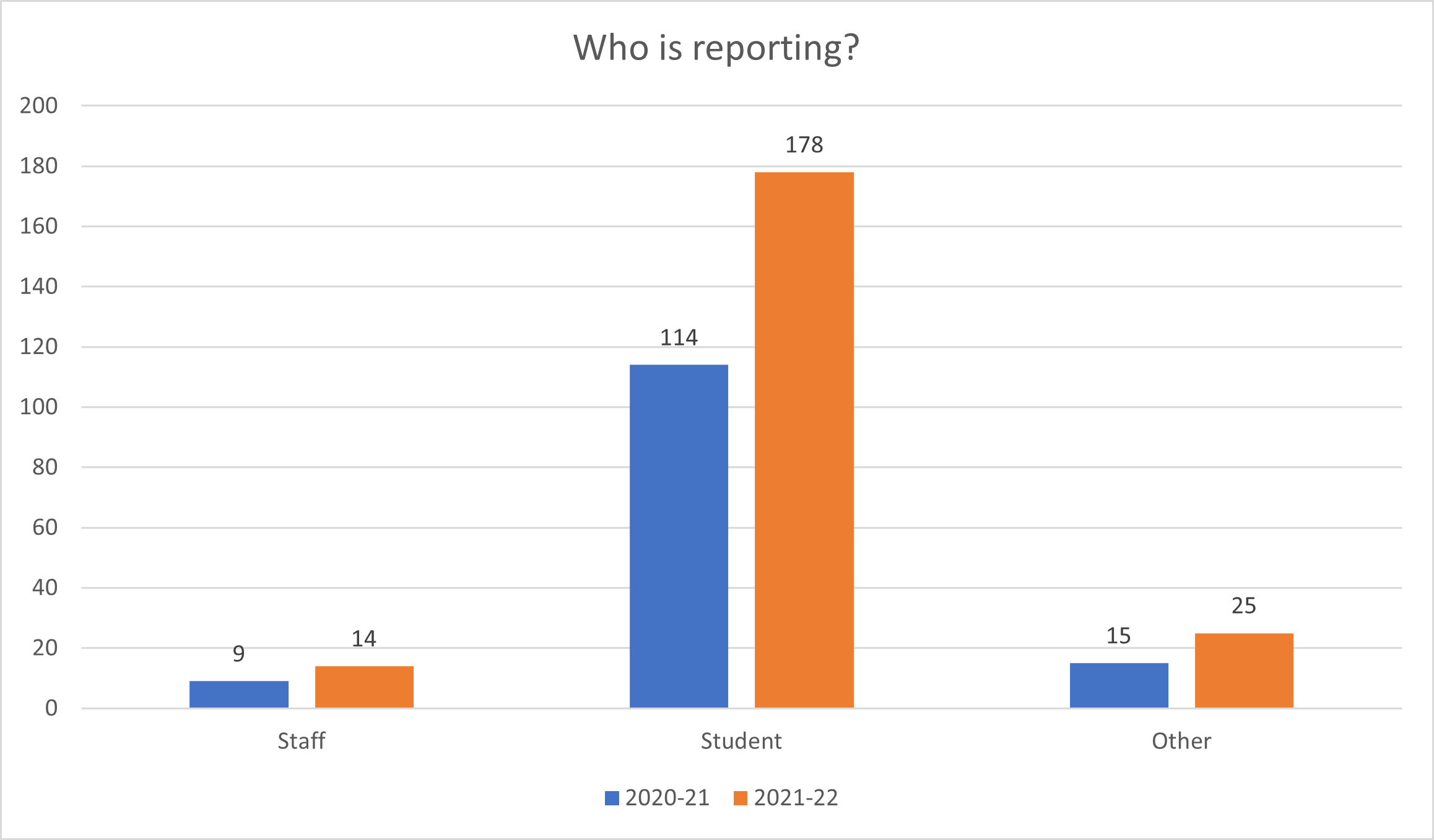
Students submitted most reports in both years. For both academic years, students made up 79% of the University population with (FTE (full time equivalent)) 10,420 students and 2734 staff in 2020-1 and (FTE) 10,729 students and 2801 staff in 2021-2.
What are people reporting?
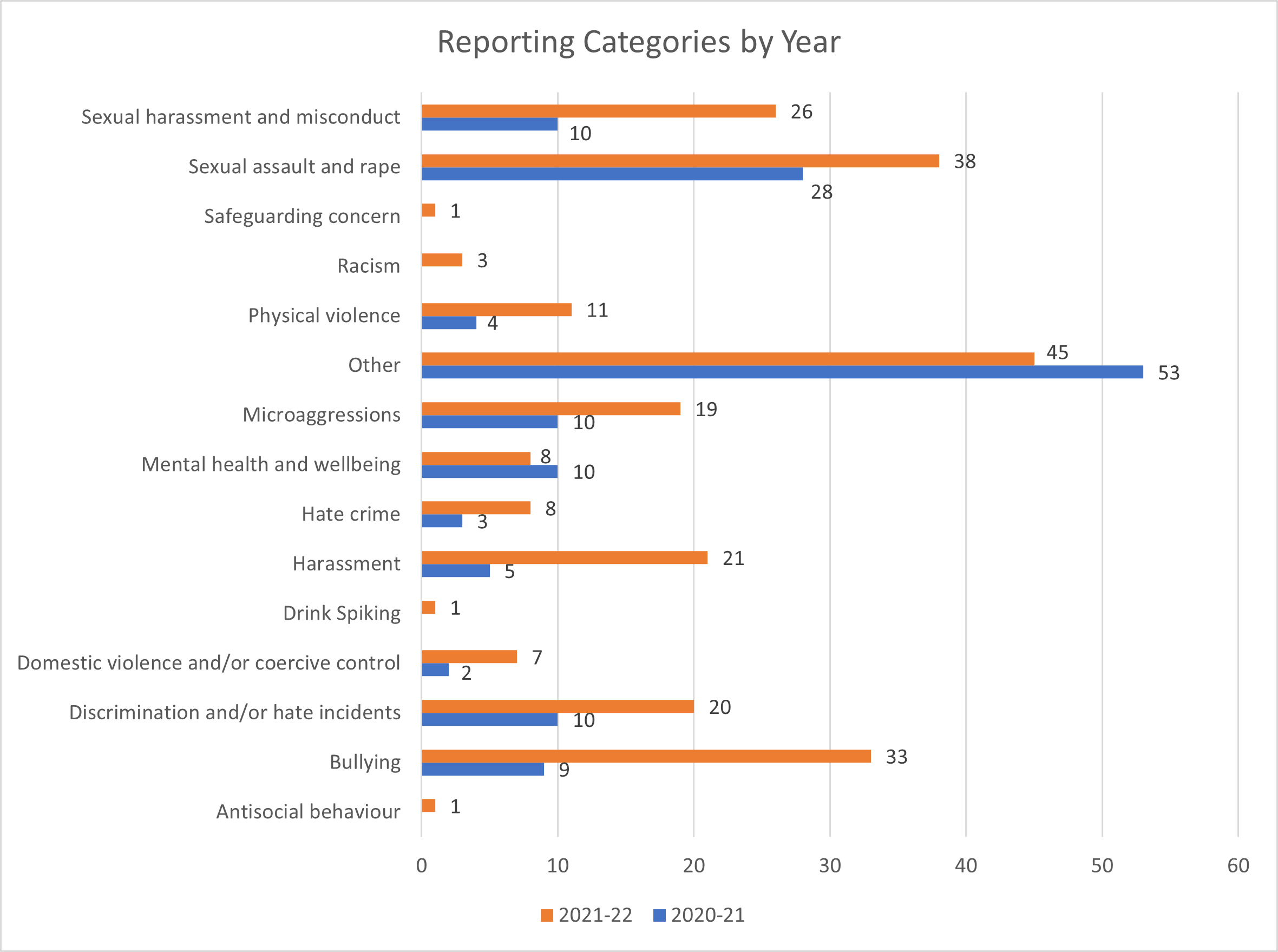
Reporters select a category that best describes the situation about which their report relates. Since the addition of new categories in May and June 2022, the number of reporters opting for ‘Other’ has significantly decreased. Between end of June and end of August ‘Other’ was not chosen by reporters. We believe that the addition of new categories has contributed to this reduction.
How are people reporting?
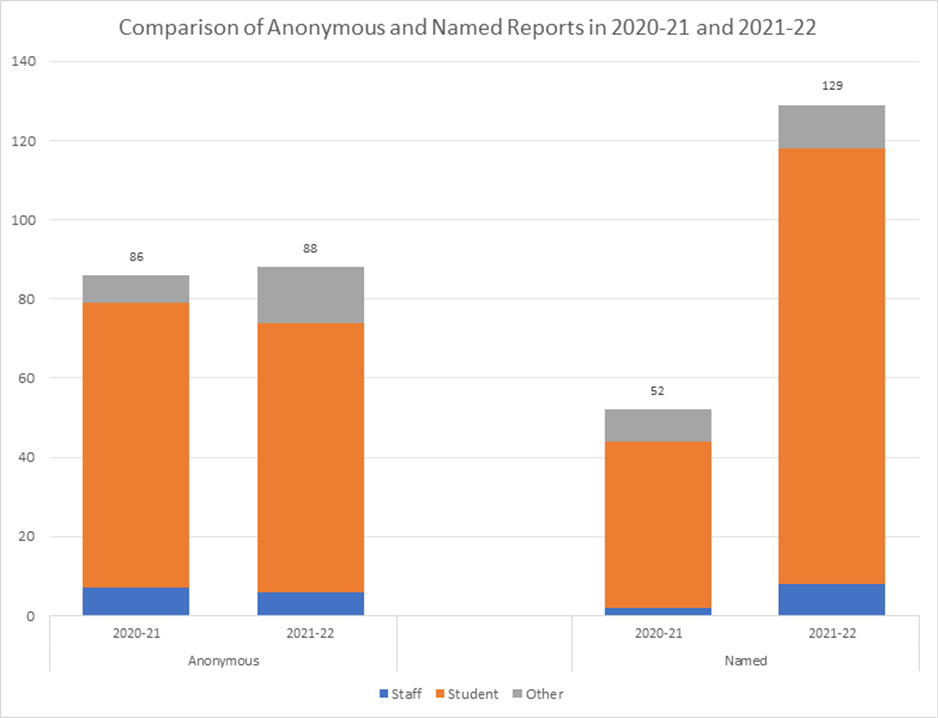
Reporters have the option to report with contact details or anonymously. Named reports have increased overall from 70 for 2020-1 to 101 from the same period in 2021-2 (November to end of August). This may be because the reporter can now choose to switch from reporting anonymously to reporting with contact details without loss of information. It may also be a result of increased trust in the reporting system. Students submitted most reports in both anonymous (77%) and named (85%) reports. For 2020-1, students submitted 84% of anonymous reports and 81% of named reports.
What were the reasons for anonymity?

Reporters can choose one or more of the above options as reasons for anonymity. The second most common response for both years was ‘concern about the repercussions for themselves or others,’ representing 12% of total selections in 2020-1 and 11.6% in 2021-2.
What is the location of incidents?
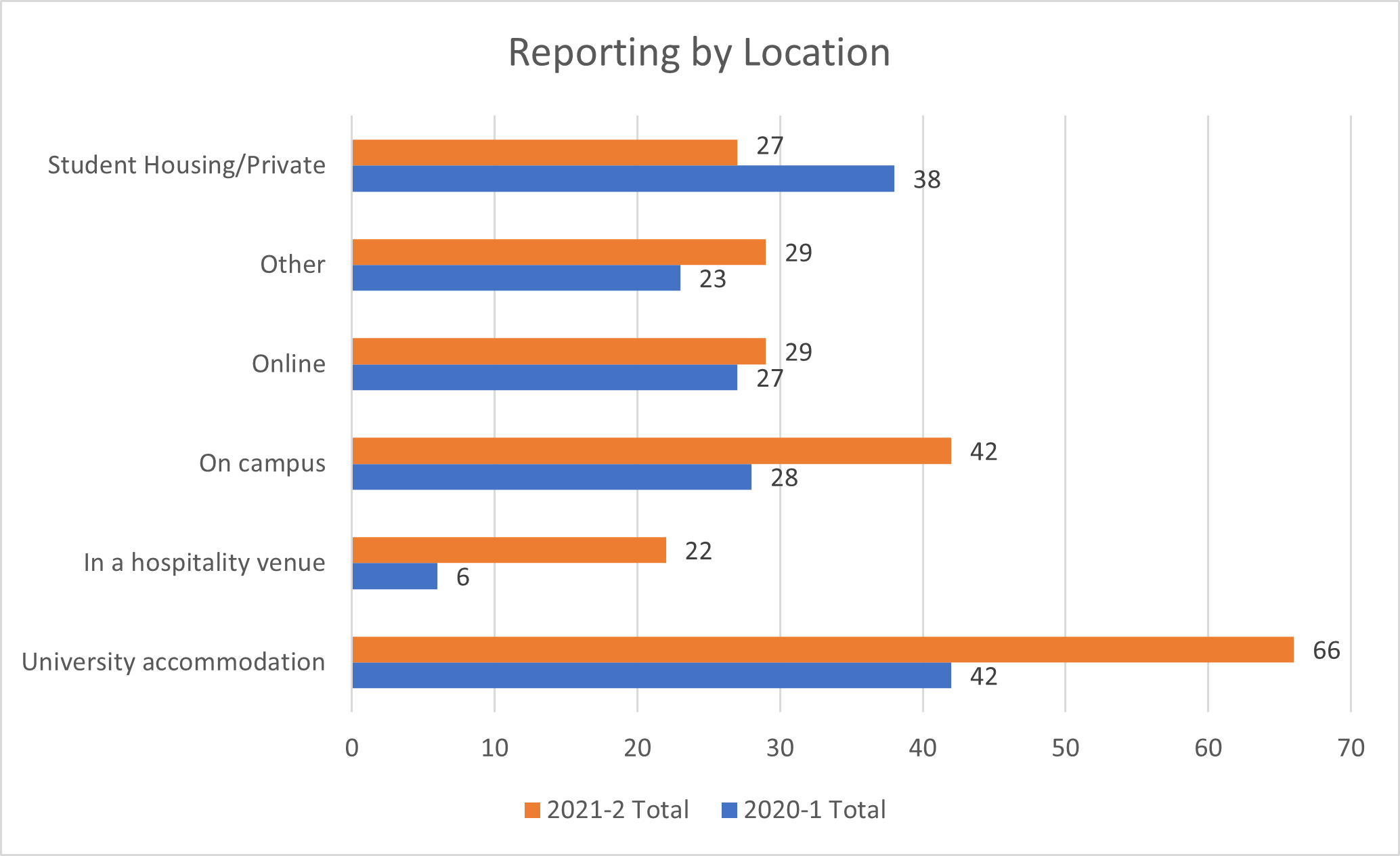
Reporters can choose from the options above to report location. University accommodation is sub-divided into specific halls within the report itself. The biggest proportional increase of incidents occurred ‘In a hospitality venue.’ Reports went from 3.7% (6) in 2020-1 to 10.2% (22) in 2021-2.
As University Accommodation was the most frequently selected location of incident, in both reporting years, Student Services trained the wardennial team in LISTEN training, which is designed to support those who disclose GBV. During the session, supporting people who make other disclosures, such as racism and hate crime/discrimination was also considered as the LISTEN model is applicable to other contexts. Report and Support is widely promoted by staff in residences.
What were the reporting outcomes?
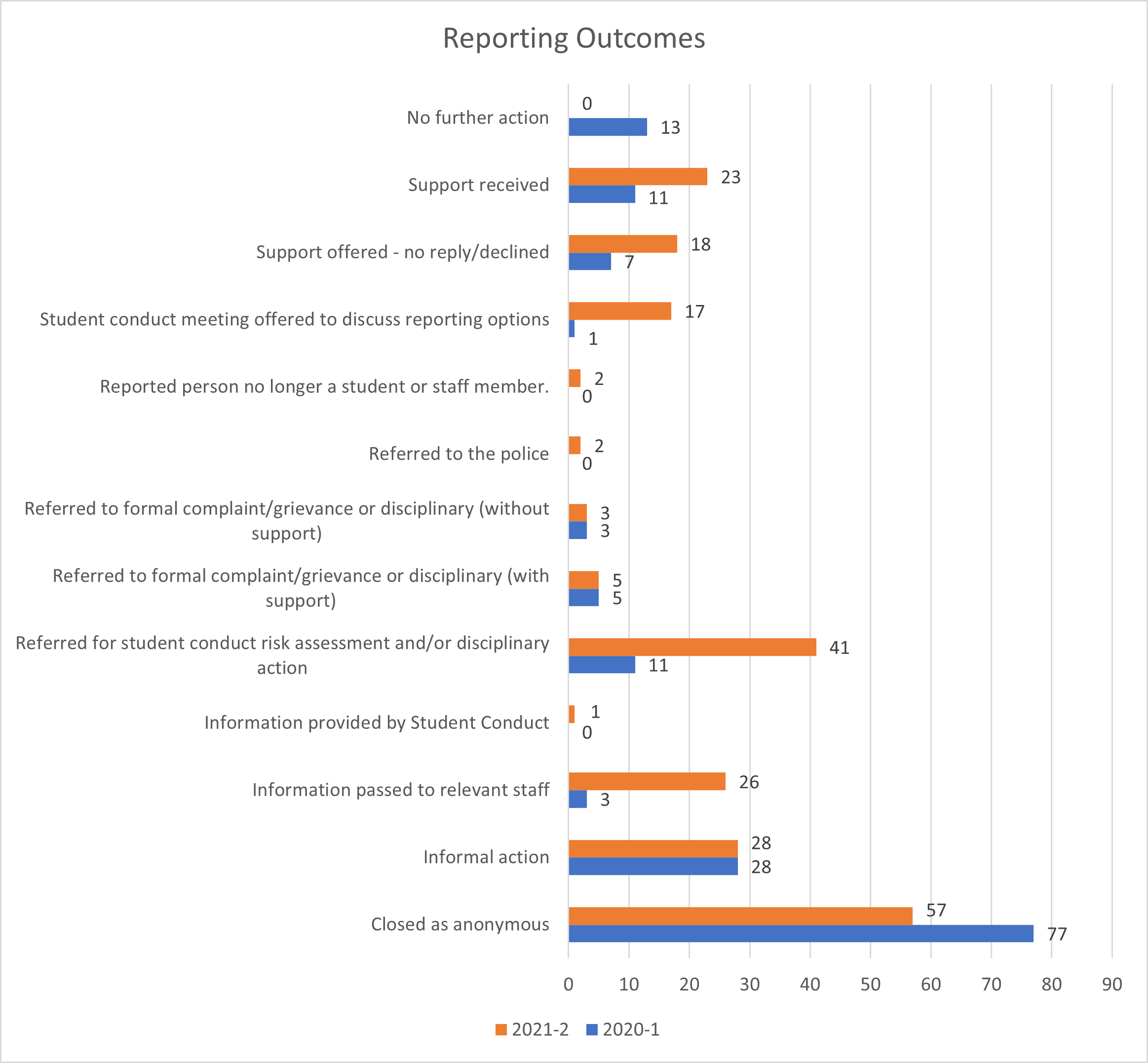
Report outcomes are selected by staff in Student Services, Conduct and HR after receiving the report. Staff can and do contact reporters who give contact details, with information about their options. Responding to anonymous reports is more difficult, sometimes there is insufficient information to act.
The ability to submit and review anonymous reports is a key feature of Report and Support. The comprehensive information available on the support pages of the Report and Support tool is important as an up-to-date central repository of assistance to all. Anonymous reports can sometimes offer insights into potential clusters of negative behaviours and will protect the identity of the reporter.
There has been an increase from 6.9% in 2020-1 to 18.4% in 2021-2 of reports ‘referred for student conduct risk assessment and/or disciplinary action’. Of the named reports, ‘Referred for student conduct risk assessment and/or disciplinary action’ was the largest outcome in 2021-2 with 30.4% or 38 reports. This is an increase from 16.9% (9) of reports in 2020-1.
In listening to reporters and staff dealing with reports, we noted a difference in the understanding of the ‘No further action’ outcome used in the first report. Whilst reporters believed it meant that nothing had been done with the report, staff understood it to mean that after consideration and action, they had done everything they could. To prevent further misunderstanding, we added new categories that reflected the work undertaken, e.g., ‘Student conduct meeting offered to discuss reporting options,’ or we provided the reason staff could no longer progress the matter e.g., ‘Reported person no longer a student or staff member.’ This work resulted in a drop in ‘No further action’ outcomes from 8.2% (13 reports) in 2020-2021 to zero (0) for 2021-2022.
Action plan for 2022 and 2023
We will continue to meet with the Report and Support fora to understand experiences of reports and to maintain an overview of the reporting process. We are keen to understand and remove barriers to reporting and to facilitate effective action where possible. We will monitor definitions to ensure inclusivity. With students and staff in the fora, we identified the following areas for enhancement in 2022-2023.
Providing more targeted support
Explore the option to include Postgraduate and Undergraduate and others, rather than ‘Student’ when choosing relationship with the University. This could potentially enable more targeted support and understanding.
Improving trust in the system
We will continue to review report outcomes to reflect more accurately how Student Services, Student Conduct and Human Resources respond.
Learning from those who have made a report
Develop a way of receiving feedback that widens the feedback base to include both those who have reported and those who have not reported.
Increasing understanding in the student and staff community of the reporting process
By adding another video to those already in the Support pages. This new video will describe the processes after a report has made.
Increasing awareness of Report and Support
By promoting Report and Support as an option for the most reported categories e.g., sexual harassment, misconduct, assault, bullying and microaggressions.
Appendix
Equality monitoring data
Reporters have the option to identify with a particular gender, ethnicity, age, disability, religion and belief and sexual orientation. These data collection points help the University to identify areas for awareness-raising, action and support.
Gender identity
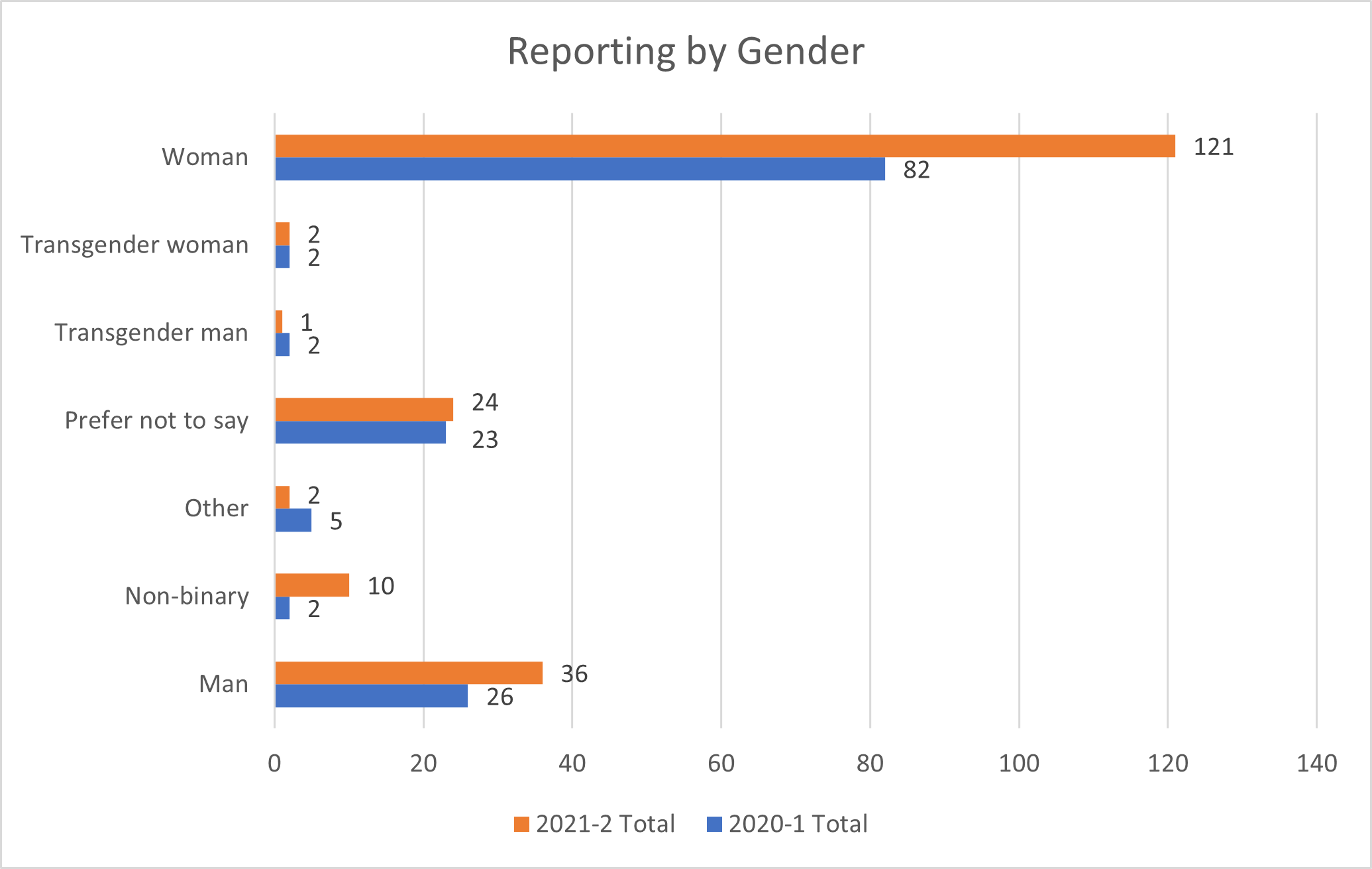
The highest category selected by those identifying as ‘woman’ is ‘other’ with 29 reports making up 22.7% of the total, the second highest was ‘sexual assault and rape’ at 20.3% of selections (15).
Sexual identity
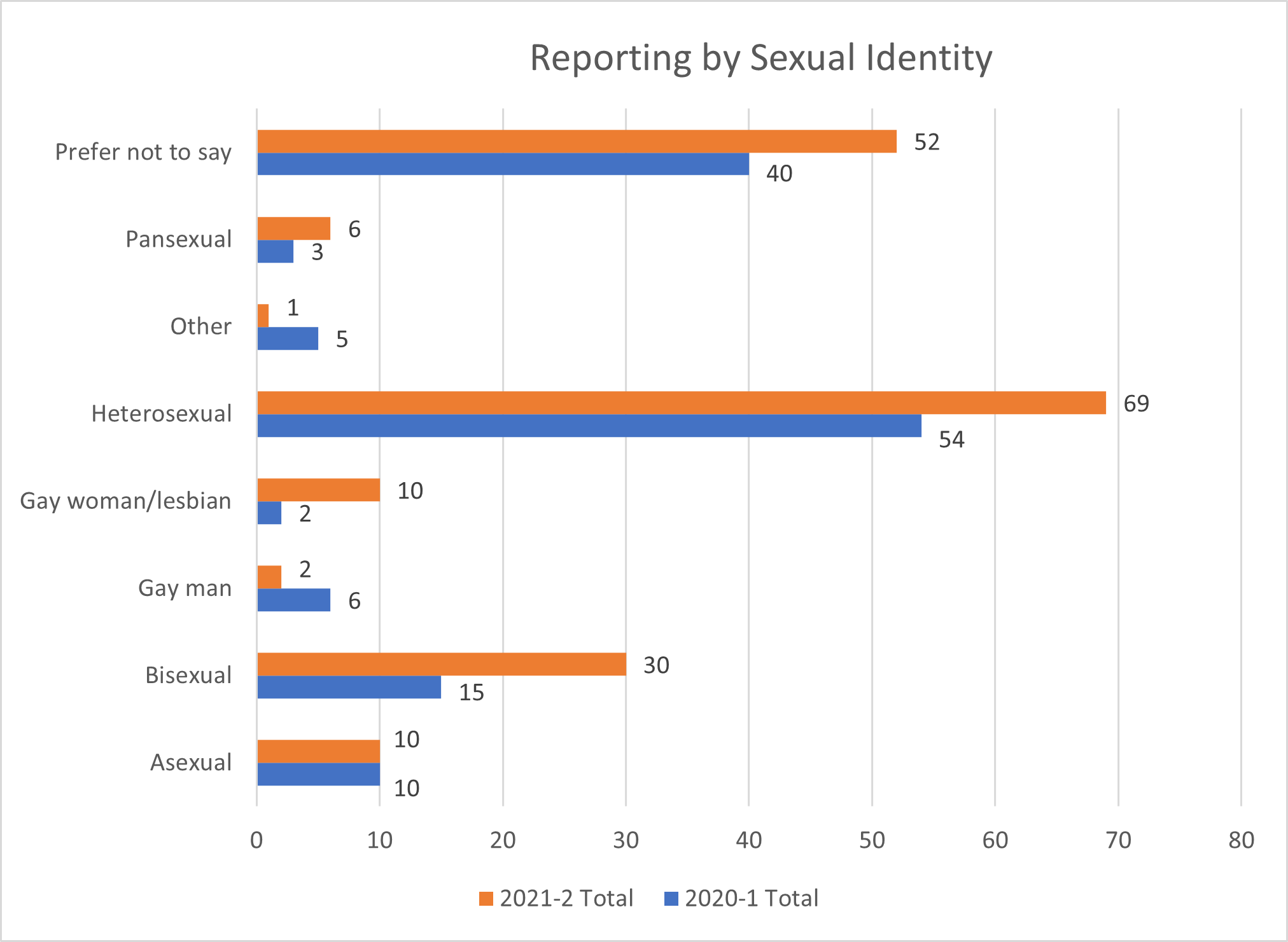
‘Heterosexual’ was the most frequently reported sexual orientation for both years, with 38% in 2021-2, down slightly from 40% in 2020-1. The biggest proportional increase of reports was for those identifying as a ‘gay woman’ going from 1.5% to 5.6%. Reports from people identifying as ‘Bisexual’ increased from 11.1% of reports in 2020-1 to 16.7% in 2021-2.
Ethnicity
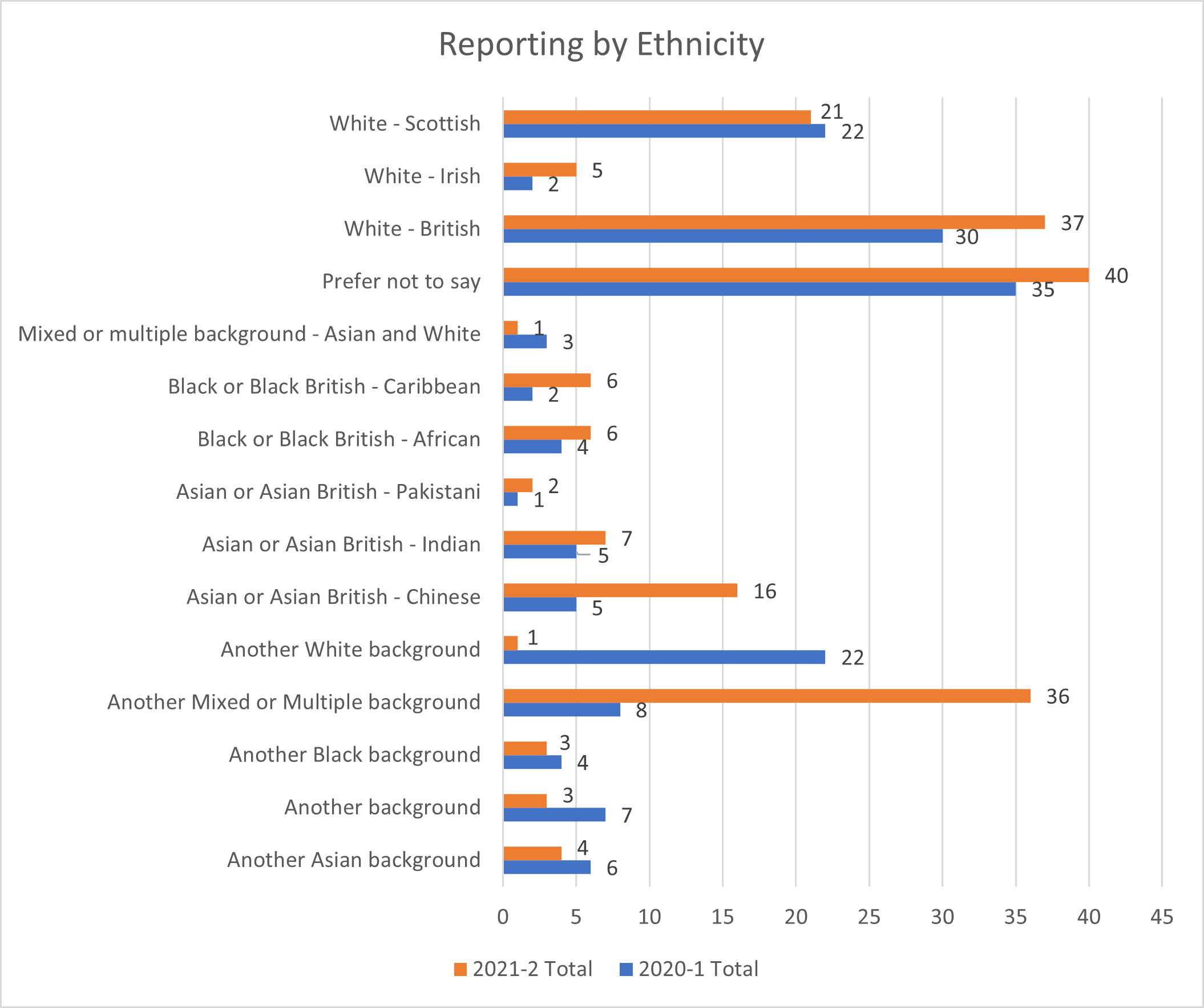
In 2021-2 the largest identified ethnicity was ‘White-British’ with 19.8% (37) of reports in 2021-2 and 19.5% (30) in 2020-1.
Age
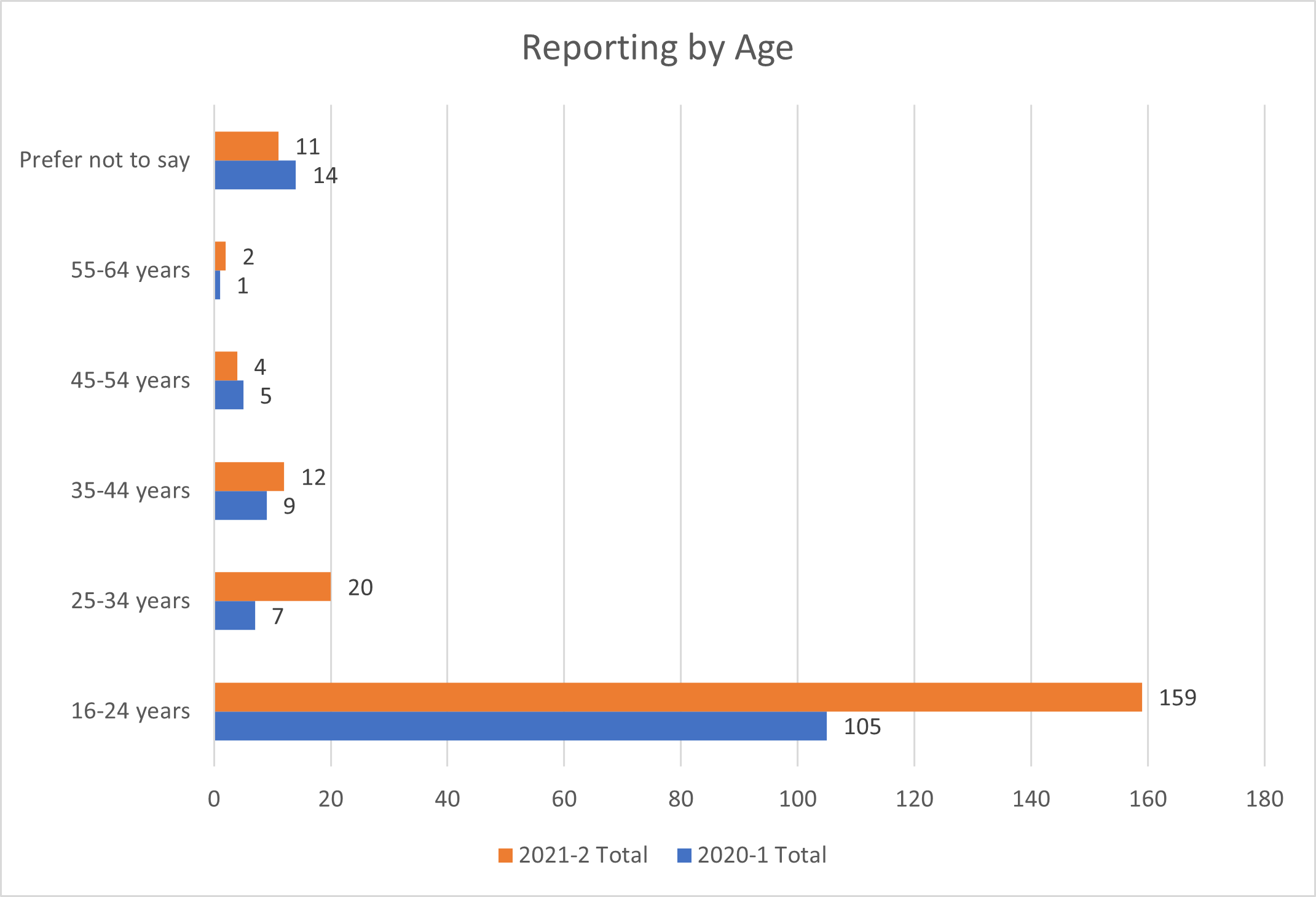
The number of selections for between 16 and 44 years of age, increased from 85.8% (121) to 98.1% (191) reports. Reporting has decreased proportionally for ages 45 and above, from 4.3% (6) to 2.9% (6).
Disability
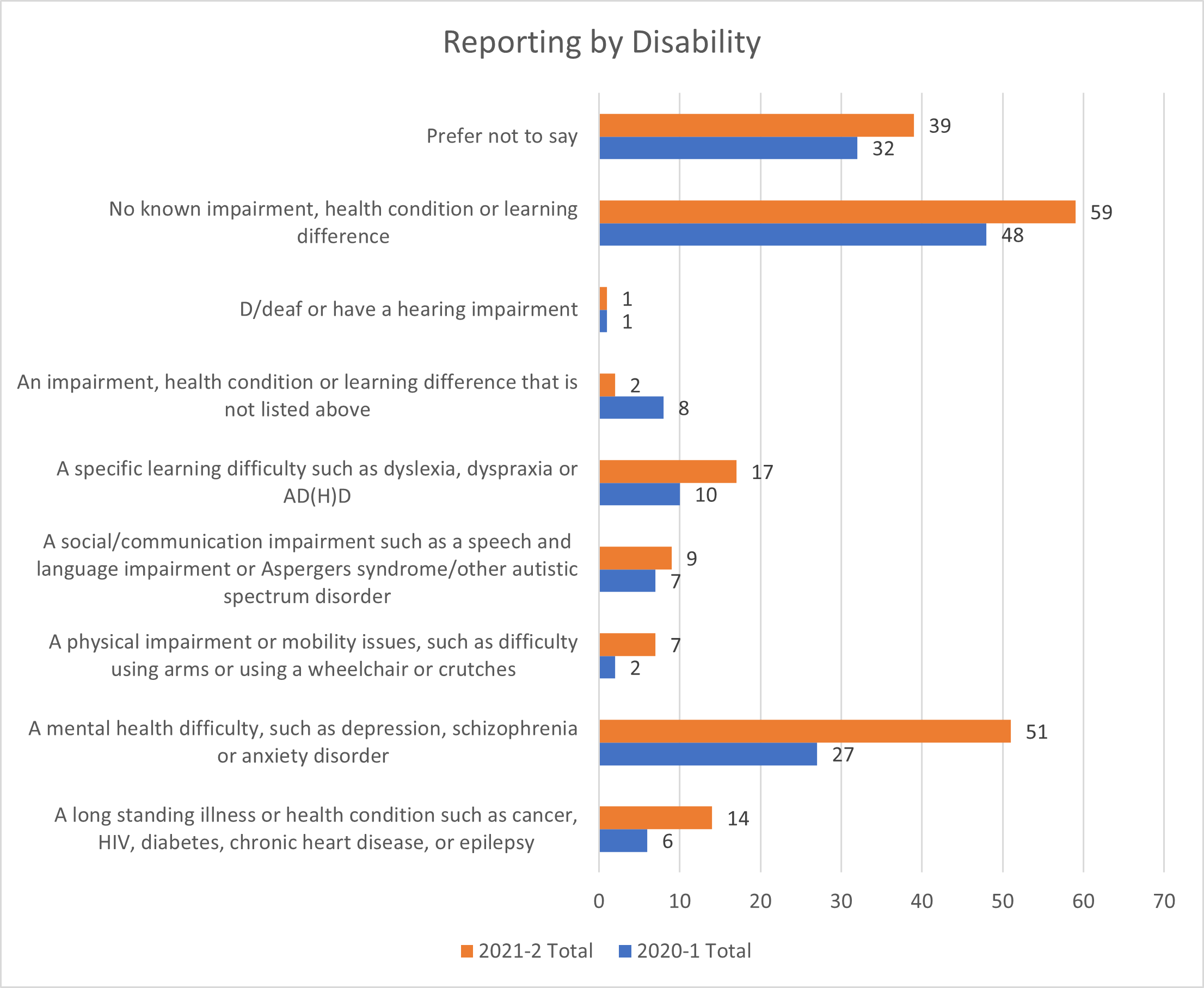
In 2021-2 and 2020-1 the category most chosen was ‘No known impairment, health condition or learning difference’ with 29.6% (59) of selections in 2021-2 and 34.0% in 2020-1.
Religion and belief
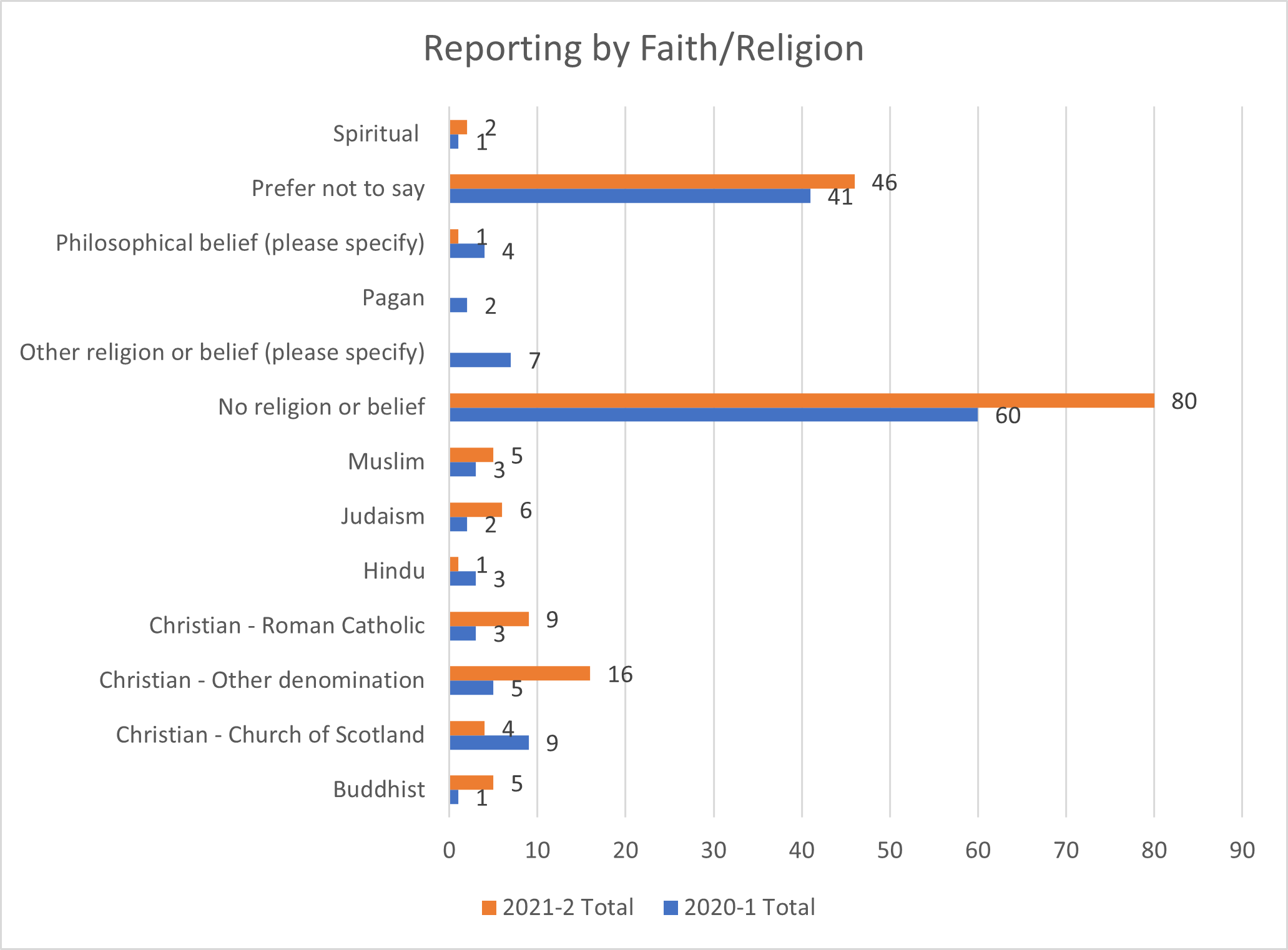
The reports for 2021-2 included the additional options of ‘Other religion or belief’ and ‘Pagan,’ that were not available for 2020-1.
Authors
- Rebecca Swarbrick, Project Officer Mediation and Wellbeing
- Ruth Unsworth, Head of Mediation and Wellbeing
In collaboration with colleagues from Student Services, Student Conduct, Human Resources and attendees of the Fora.
With support and advice from:
- Rebekah Widdowfield, Vice-Principal (People and Diversity)
- Laura Knox, Director of Planning