« back to History, Politics and Philosophy
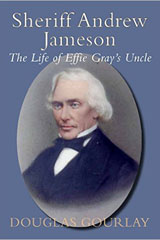
Sheriff Andrew Jameson; the Life of Effie Gray's Uncle
Douglas Gourlay, MA 1949 & BPhil 1954
Born in 1811, the fourth son and sixth child of the sheriff-substitute of Fife at Cupar, Andrew Jameson was educated at Perth Academy before matriculating at the University of St Andrews in 1824. Considerable academic success attended his five years of study there and he was awarded the title of Facile Princeps in 1829. His diaries give a fascinating account of the life of an undergraduate in those years and of his relationships with the academic staff, particularly Dr Thomas Chalmers, a cousin of his mother.
Studying law at Edinburgh University over the next three years, he played a full part in university life and formed an acquaintance with the judge,Lord Cockburn, through their mutual interest in skating.He alo attracted the attention of Douglas Cheape, Professor of Scots Law, who introduced him to other luminaries of the legal profession.His diaries give a full account of his preparations to take the oral examination in civil law.Surprisingly,he experienced considerable difficulty in securing a placement with a legal firm, a requirement for completion of a successful period of training as a lawyer.
To recover from a throat illness, dysphonia, his father managed to secure funds that enabled his son to go to southern Europe for two summers where the warm dry climate brought some improvement.
He went first to S. W. France but then travelled across the south of that country into Italy. Much improved in health he returned to Scotland in 1834 and immediately started preparing to take the rigorous examination for entry into the Faculty of Advocates. Successful, he immediately embarked on his career as an advocate but although he attracted clients, his illness returned. There was no option but to return to southern Europe.
This enabled a remarkable advance in his professional career because having chosen to spend the winter of 1840/41 in Malta,he attracted the notice of no less a person than Sir Henry Bouverie, the governor. Bouverie had for some time tried and failed to find a person suitable to revise the criminal and civil codes of Malta. In Andrew Jameson, he found a man who met the criteria for the task; fluent in Italian, scholarly and qualified in Roman law, the basis of both Maltese and Scots law.
Returning home in 1841, he was interviewed at the Colonial Office and appointed to carry out the task on behalf of H M Government. Distinguished European jurists such as Carl Mittermaier acclaimed his work and on the final unification of Italy in 1870 the Maltese legal codes were adopted in their entirety by that nation.
It was on his way back to Scotland by way of Italy that Andrew Jameson met by chance the great art critic, John Ruskin. The two men immediately found they had common interests and corresponded regularly thereafter. The Ruskin family were well acquainted with the Perth lawyer, George Gray, who had married Andrew Jameson's sister. In 1848 Ruskin married their daughter, Euphemia (Effie), a disastrous union that was dissolved in 1855 in a manner that made it the cause celebre of the decade. Queen Victoria was appalled, even more so when Effie subsequently married Ruskin's friend John (later Sir John) Millais.
Andrew Jameson was appointed sheriff-substitute of the counties of Ayr (1843) and of Edinburgh (1845). He became a prominent figure in the social and legal life of Edinburgh and included among his friends Sir James Young Simpson, the pioneer figure in anaesthetics, Sir Noel Paton, the artist and Sir David Brewster, Principal of Edinburgh University.
In 1865 he was appointed Sheriff of Aberdeenshire, the first sheriff-substitute to have been promoted sheriff.He died in 1870.
Andrew Jameson's first wife died a few years after their marriage in 1844 and his second wife
outlived him. Two sons survived, the elder, another Andrew, was raised to the bench as Lord Ardwall.
Special note. The author is the first to have been given access to the Jameson Archive, a large collection of legal documents relating to a family that have been lawyers in continuous generations since 1740. The book contains letters from John Ruskin and from Effie Gray that have never previously been published and a signed drawing by Ruskin of Mont Viso from Turin, again, never previously published.
ISBN: 978-1-909757-62-2