
› Thickness dependent absorption spectra in conjugated polymers: Morphology or interference?, Applied Physics Letters, Gaudin et al.
› A hybrid organic semiconductor/silicon photodiode for efficient ultraviolet photodetection, Optics Express, Levell et al.
› Comparison of hole mobility in thick and thin films of a conjugated polymer, Organic Electronics, Gambino et al.
› Effects of solution processing and thermal annealing on the phosphorescence of iridium(III) complex-cored dendrimer films, Organic Electronics, Ribierre et al.
› How to recognize lasing, Nature Photonics, I.D.W. Samuel, E.B. Namdas & G.A. Turnbull
..... see more recent publications
› Thickness dependent absorption spectra in conjugated polymers: Morphology or interference?, Applied Physics Letters, Gaudin et al.
› A hybrid organic semiconductor/silicon photodiode for efficient ultraviolet photodetection, Optics Express, Levell et al.
› Comparison of hole mobility in thick and thin films of a conjugated polymer, Organic Electronics, Gambino et al.
› Effects of solution processing and thermal annealing on the phosphorescence of iridium(III) complex-cored dendrimer films, Organic Electronics, Ribierre et al.
› How to recognize lasing, Nature Photonics, I.D.W. Samuel, E.B. Namdas & G.A. Turnbull

Current News • 2013 • 2012 • 2011 • 2010 • 2009 • 2008 • 2007 • 2006 • 2005 • 2004 • 2003 • 2002 • 2001

Schools Lectures on Plastic Lasers
3rd November 2010
Dr Turnbull gave two lectures to school pupils from across Edinburgh at Merchiston Castle School. The lecture "Plastic Lasers from Jelly to Gelignite" discussed the science and history of lasers since their first demonstration 50 years ago and introduced our recent work using plastic lasers to detect explosives.
EPSRC/NSF Chemistry World Network Grant Awarded to Study Solar Cells
1st November 2010
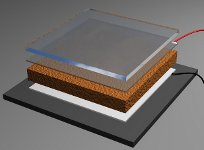
The OSC will join a new international collaboration on organic and hybrid solar cells as a result of a grant awarded jointly by the National Science Foundation of the U.S.A. and the Engineering and Physical Sciences Research Council of the UK. The grant aims to develop new organic solar cell materials links the work of the OSC to that of Prof Vince Rotello at University of Massachusetts, Amherst and Dr Graeme Cooke at the University of Glasgow.
Organic Solar Cell Physics Published in Physical Review Letters
19th October 2010
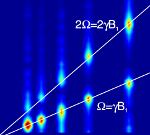
Organic solar cells are of growing importance, and a detailed understanding of their operation is required to improve their efficiency. OSC researchers, working in collaboration with the University of Dundee and the Institut fur Silizium-Photovoltaik at the Helmholtz-Zentrum Berlin in Germany have studied the physics of organic solar cells using sophisticated magnetic resonance techniques to show the presence of doubly charged excitations called biopolarons. The results have just appeared in the prestigious journal, Physical Review Letters.
• View the paper at Physical Review Letters
• Read the paper

Paper Makes Most Downloaded List
4th October 2010
A recent paper from the OSC on ultrafast photophysics is attracting a lot of interest. Last month it was one of the top ten most downloaded articles in the Journal of Physical Chemistry A. The paper studies the light-emission from iridium complexes, which are important for highly efficient displays and lighting.

OSC Science Public Outreach
14th September 2010
The science that we undertake in the OSC is being taken on the road by OSC member Dr Georgios Tsiminis who has added some organic semiconductor research to Psychologist Joanna Brooks of Edinburgh University's brainology tour of schools around the UK, inspiring kids to get involved in science.

Canon Research Fellowship
1st September 2010
Dr Pascal Andre is now a 2010 Research Fellow of the Canon in Europe Foundation. Based at RIKEN he will strengthen scientific interactions between Japan and Europe and reinforce the collaboration between the University of St Andrews and RIKEN. During this Fellowship Dr Andre will be working on the development of textile electronics which could eventually be used to fabricate a variety of built-in electronic devices ranging from displays through to transistor and sensors which, once all the scientific challenges are overcome and the associated physical-chemistry phenomena fully understood would, for instance, be an asset for patient health monitoring and related applications.

SPIE Symposium Presentation
5th August 2010
The research project developed by Dr S. Gambino, S. Chen, Prof. I. D.W. Samuel and Dr Pascal Andre has been presented in San Diego (Ca-USA) at the 2010 SPIE Symposium on Photonic Devices (Organic Light Emitting Materials and Devices XIV). This invited oral presentation has presented the latest findings related to the effects of coated magnetic nanocolloids on the efficiency of hybrid OLEDs.

Presentation at ICSM
4th July 2010
The first results obtained via the International Joint Project awarded in Jan. 2009 by the Royal Society to Dr Pascal Andre (OSC-St Andrews) and Dr Jean-Charles Ribierre (RIKEN-Wako, Japan) have been presented at the 2010 International Conference on Science and Technology of Synthetic Metals (ICSM) held in Kyoto, Japan. The presentation described and discussed charge transport properties in hybrid organic/inorganic bistable memory devices.
Explosive Detection Work Receives Further Coverage
9th June 2010
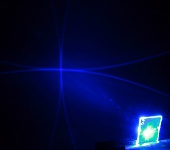
After being featured in New Scientist (see story below) the work in the OSC on using organic lasers to detect explosives has received further attention. The story has been featured by numerous news organisations around the world, including BBC News, Times Online, Die Welt, The Scotsman, The Daily Mail and the Daily Record, amongst others.
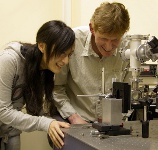 The research focuses on using organic lasers to sense very small quantities of explosive vapours and it is envisaged that this could be used in both battlefield situations and also in domestic environments such as airports. The university press release as well as the paper itself are available to read.

New Scientist Features our Work
4th June 2010
New Scientist magazine has featured our group's work on developing organic laser based sensors to detect explosive vapours. Our recent paper indicates that polyfluorene based lasers enable the efficient detection of materials containing nitroaromatics (such as TNT).

Skin cancer Treatment Launched and Highlighted on Sky, BBC and CBS News
12th March 2010
A wearable light source capable of treating common skin cancers has been launched today at the 2010 meeting of the European Society for Photodynamic Therapy. This breakthrough in skin cancer treatment was developed by Prof. Ifor Samuel and Prof. James Ferguson at Ninewells Hospital, Dundee. The idea started from Ifor's research on organic semiconductors as new light-emitting materials, enabling the light-emitting "sticking plaster" to be made. The new treatment could ultimately be given by general practitioners, removing the need for a hospital visit. More can be read on the Sky News, BBC News, and CBS News.