General | What to buy | Preparation | Electronic Resources | Topic 1 | Topic 2 | Topic 3 | Topic 4 | Model Essays
This is a new paper. The faculty has produced a syllabus, with suggested readings for the nine topics there envisaged, which you can inspect here. Oxford standardly offers you a different philosophical problem every week. Our take on the matter is different. We think it better on all counts if people study just four topics, but study them in some depth. At the moment the four we have chosen are:
Free will, Determinism, Responsibility
Induction
Scepticism and the External World
Personal Identity
If, after doing some background reading, you find that some of the other topics on the faculty list excite your interest more, then perhaps we can accommodate you. But only perhaps. These pages give you our default option.

The Oxford Dictionary of Philosophy, edited by Simon Blackburn.
This excellent book serves as an introduction to Philosophy in its own right. It is wonderfully informative as a tourist guide to the territory, and offers many delightful excursions into bways and backwaters of philosophical trivia. You can preview it here. Use it all the time. Woe befall anyone who uses a term of art in an essay and has not bothered to find out what it means.
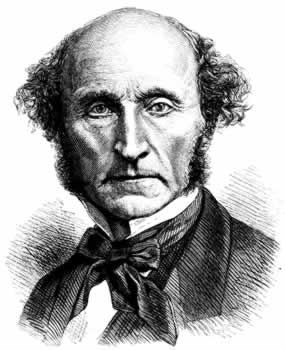
But you might care to invest in one or more of the items presented below under Preparation. And, looking forward, you may well be studying John Stuart Mill's Utilitarianism in Trinity term. Whereupon it will do you no harm to have on your shelves:
We want you to do some preparatory reading for Topic 1, but you should devote as much time as possible to background reading over the Christmas Vacation.
Studying Philosophy is an ongoing dialectical process: Read, Think, Talk Write, Read, Think, Talk Write....
And the more background reading you have done, the more coherent and fruitful the process. One target is Breadth: in Philosophy light dawns slowly over the whole picture, and thus the more parts of the big picture you have visited the better. Another target is Depth: better to read a few books (perhaps more than once through) with understanding than to skim many. There are no rules concerning the right combination of Breadth and Depth. Each individual must work out what best suits them. Select from the lists below, which are in no particular order.
For complete beginners:-
You can preview it, and even buy it online here. So I shall say no more. Simon can do his own promotion.Martin was the Philosopher who first made the subject compelling for me. He was an enormously enthusiastic and energetic overgrown schoolboy, who liked his philosophy to be quickfire, sharply logical, and full of helful metaphors. I found him excellent at painting the big picture. Humane, intellectual and generous, he was a typical Aquarian. I was much saddened when he died on February 27, 1998. I very much like his little book. Truly an Invitation rather than an Introduction. You can read his obituary, and browse through his bibliography here. Many of the articles therein listed are within the grasp of the beginner, so if you like his bright and breezy style, why not check out some more examples?
Nice man, Tom Nagel. Nice Philosopher, too. And he has written some of the best, and most accessible pieces on the contemporary scene. Here is his faculty page at NYU, where you can find a full bibliography, and here is a version of his famous article 'What is it like to be a bat?' Which you will no doubt enjoy. His little introduction to Philosophy is subtitled 'A Very Short Introduction to Philosophy'. Which may recommend it to you.
Not a nice man, this time. Got involved in a mad plot to build an offshore island, as in Waterworld, as a tax-haven for himself and other rich people. Associate and fan of Ayn Rand. And you can guess how it goes on. But those things do not matter, for many past students have told me that this textbook-style introduction helped them no end. So I know in advance that some of you will find it useful. But please, if you can, steal or borrow it, and don't buy it. Otherwise he gets another $5 to use against the interests of the poor and downtrodden.
For those who already have a nodding acquaintance with philosophy, see how a a philosopher takes one leading idea and applies it to a whole range of apparently different isssues:-
If you liked Tom Nagel's Very Short Introduction to Philosophy, you will probably like this one as well. You can preview it here.And some acquaintance with the history of the discipline would not go amiss, either:-
Wrong about so much in detail. But breezy and entertaining, and good with the broad brush.
Electronic Resources
The resources available to you are vast, absolutely vast. I shall point you first at two gateways. If you are new to internetting for philosophy, then your first port of call should be Internet Philosopher, which is maintained by the Humbul Humanities Project here in Oxford. It gives you an excellent tutorial on how to get the best out of the web as a philosophy student. And then you might want to explore the Humbul Humanities Hub itself.
And now some substantial, and very useful sites
Past Masters offers you a huge range of classical texts online.
If you are searching for works by Descartes, don't go to the Oeuvres Complètes, which are in French; but instead click on to the Continental Rationalists, and squirrel on from there. Unless, of course, your French is up to it.
The Stanford Encyclopaedia of Philosophy has a mirror site at Leeds University. Does what it says on the tin.
Philosophy in Cyberspace, hosted by Monash University has much information and many useful links.
Mind gives you the contents of that very journal online. And if you seek other journals online, try
Jstor or
Topic 3: Scepticism and the External World
We shall spend a fortnight on this topic. The first week will be devoted to the classic textual nexus, Descartes' Dream Argument, wherein the man himself presents a powerful argument for scepticism, and offers his defence against it. The second week will be spent looking at modern Brain-in-a-Vat versions of the sceptical argument, and modern defences against it.
If you have not yet seen The Matrix, watch it.
Topic 4: Personal Identity
Forthcoming....
Topic 2: Induction
The so-called Problem of Induction is the central problem in Epistemoplogy. It cuts very deep, and marks the dividing line between the rationalism of Descartes and the naturalism of Hume. There are many ways of approaching this rich area, and those who want to really explore should use the link above, which takes you to a page designed for the Honours School course in Knowledge and Reality. For the first-year course we have pared down the reading, and devised two (complementary approaches): A Day at The Races and The Goodman Paradox.
Topic 1: Free will, Determinism, Responsibility
No doubt about it: this is the problem of the century. Philosophy since the Romantic period has put Agency at the centre of the stage. The age of Insight is over. Philosophers no longer tell a story of us as made in God's image, as spirits of his house, as insightful spectators of the world that He has given us through grace. This is the age of The Agent in the Void, in which we see ourselves us as merely the by-product of natural chemical processes (hence The Void), and as creators of our own world, and hence as creatures most deeply defined by what they do.
Across philosophy you can read it: Mind? Minds are defined by their behaviour. Meaning? Meaning is rooted in human practices. Necessity? A construction of the human mind, a consequence of human choices. And so on, and so forth. Wherever you look, the concept of us as most fundamentally agents is what rules our philosophy.
And the problem? Just as the scientific image left no place for God, nor does it seem to leave any room for agency. And if you add that thought to our self-image as fleshed out by the philosophers of our time, it turns out that we are......nothing.
So this one matters.
We shall (perhaps artificially, but who cares? We can do what we want, can't we?) divide the topic into two parts. First, the pure metaphysical debate, Free Will versus Determinism. And second, Determinism and Responsibility.
Model Essays
This page offers occasional essays - written by your contemporaries - judged to be of sufficient quality to serve as models.
So far we have three.
One on Determinism and Responsibility.
One on Induction
And one on The Goodman Paradox
How to read and write Philosophy
One day I will lay out my own thoughts on the matter. If only because Oxford tutorial essays are a rather specialized philosophical art. But for now I link you to some excellent pages maintained by a nice man at Princeton. Have a good look around his site. His advice is designed for people writing American term papers, which are assessed, and where you have a good deal of time to think about your material and polish your final draft. So you will have to regretfully ignore the excellent advice on taking your time.
How to think about ...
Here you will find avuncular advice on various philosophical matters. So far there are no pages at all, but if people e-mail sensible requests, I will post some.
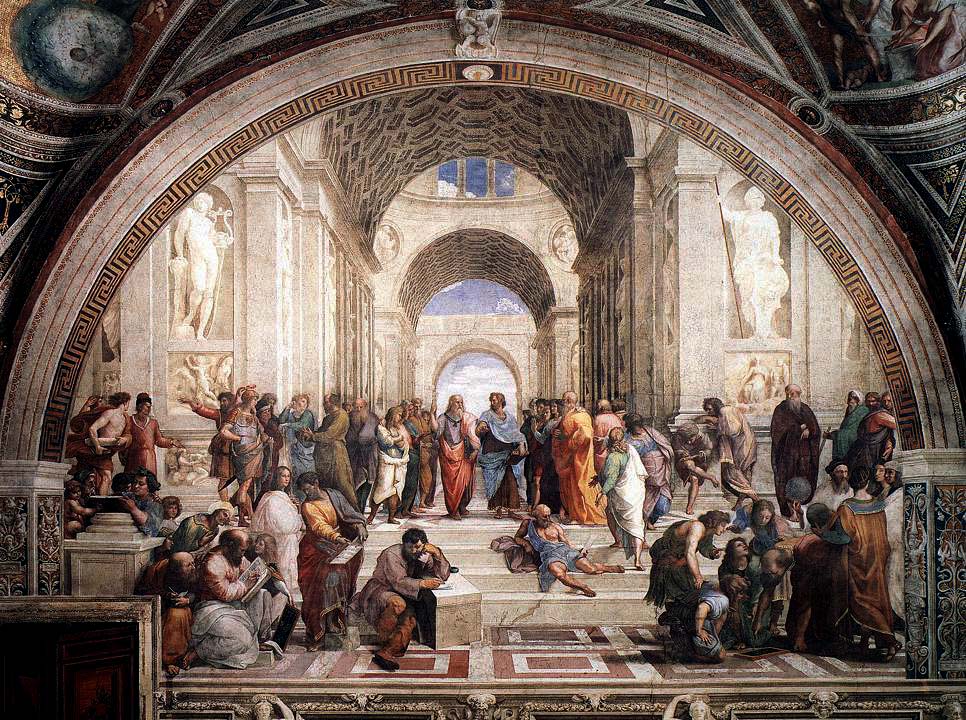
If you have got this far, you are entitled to a philosophical treat. Here it is: Raphael's School of Athens, with Plato and Aristotle centre stage: