Research and Impact Strategy
The IELLI Research and Impact Strategy focuses on enhancing educational delivery and fostering meaningful changes within and beyond IELLI. Its vision is to promote innovation and professional excellence in education, particularly in developing excellent educators, facilitating student success, and fostering diverse learning communities. The strategy is deeply interdisciplinary and interprofessional, aiming to integrate research with practice to improve teaching and learning outcomes.
Research at IELLI is applied and impact-driven, producing both scholarly outputs and educational products like courses and materials. The approach encourages staff and students to engage in research that supports their roles, builds capacity, and strengthens professional networks. Ultimately, the strategy seeks both targeted improvements within IELLI and world-leading contributions to wider educational communities.
Our Vision
To be innovative and professionally excellent in the delivery of educational programmes and activities for diverse audiences, with a core focus on educator and learner development.
Our Objectives
- Develop excellent educators
- Facilitate student success
- Foster diverse learning communities
Our Research and Impact Strategy
Sets out the changes we want to see in and outside of IELLI and how our research and impact activities can contribute to achieving those changes. We will use it to plan, monitor, and evaluate areas of work that are most critical for us to achieve our objectives.
Our Approach
We take an interdisciplinary and interprofessional approach to research and impact. We focus on making a positive change to teaching and learning in IELLI and other learning communities.
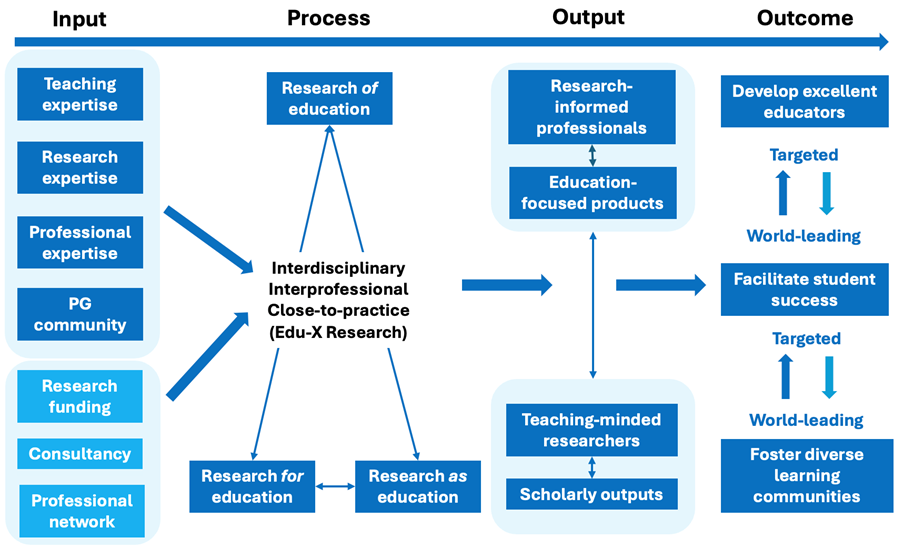
Our strategy is built on a foundation of key inputs: teaching, research, and professional expertise; our vibrant postgraduate community; research funding; consultancy; and an extensive professional network. These inputs drive our interdisciplinary, interprofessional, and practice-oriented research approach (Edu-X research), which encompasses research of education, for education, and as education. This process generates a range of outputs, including research-informed professionals, education-focused products, teaching-minded researchers, and scholarly contributions. Ultimately, these outputs support our intended outcomes: the development of excellent educators, the facilitation of student success, and the cultivation of diverse learning communities.