
› Thickness dependent absorption spectra in conjugated polymers: Morphology or interference?, Applied Physics Letters, Gaudin et al.
› A hybrid organic semiconductor/silicon photodiode for efficient ultraviolet photodetection, Optics Express, Levell et al.
› Comparison of hole mobility in thick and thin films of a conjugated polymer, Organic Electronics, Gambino et al.
› Effects of solution processing and thermal annealing on the phosphorescence of iridium(III) complex-cored dendrimer films, Organic Electronics, Ribierre et al.
› How to recognize lasing, Nature Photonics, I.D.W. Samuel, E.B. Namdas & G.A. Turnbull
..... see more recent publications
› Thickness dependent absorption spectra in conjugated polymers: Morphology or interference?, Applied Physics Letters, Gaudin et al.
› A hybrid organic semiconductor/silicon photodiode for efficient ultraviolet photodetection, Optics Express, Levell et al.
› Comparison of hole mobility in thick and thin films of a conjugated polymer, Organic Electronics, Gambino et al.
› Effects of solution processing and thermal annealing on the phosphorescence of iridium(III) complex-cored dendrimer films, Organic Electronics, Ribierre et al.
› How to recognize lasing, Nature Photonics, I.D.W. Samuel, E.B. Namdas & G.A. Turnbull

Current News • 2013 • 2012 • 2011 • 2010 • 2009 • 2008 • 2007 • 2006 • 2005 • 2004 • 2003 • 2002 • 2001

IKSS 2019
September 2019
Many members of the Organic Semiconductor Centre attended the 24th IKSS summer school in Krutyn, Poland. Congratulations to Dr Kou Yoshida who won the best talk prize for his work on visible light communication (VLC) at 1 gigabits per second using an organic light-emitting diode (OLED). Congratulations also to Dr Sabina Hillebrandt who won the best poster prize for her work developing highly directional and high brightness red OLEDs for treating vision loss in optogenetics.

Optical Probes 2019
July 2019
Members of the Organic Semiconductor Centre recently presented their work at the Optical Probes conference in Vilnius Lithuania. The Optical Probes conference is one of the leading conferences on understanding organic semiconductors, and the team gave five talks and presented a poster. The presentations ranged from fundamental photophysics, through OLED materials design to organic solar cells and lasers. Pictured are Prof Ifor Samuel, Dr Arvydas Ruseckas, Dr Paloma dos Santos, Dr Rajamalli Pachai and Dr Tomas Matulaitis.

Science Discovery Day, St Andrews
9th March 2019
Science Discovery Day on the 9th of March in the School of Physics and Astronomy was a great chance to show off our work to the public and inspire local childrens’ love of Physics. We made solar cells, raced solar-powered cars, and took the chance to talk to people about the exciting research happening every day in the building. Guests of all ages took part in making their own dye sensitive solar cells, using a raspberry juice dye to absorb light and produce electricity. 6 year-old Eva loved learning about solar power ‘Using raspberry juice to make electricity was really awesome and I loved racing the solar powered cars off the edge of the table with my little sister!’ Photo; Eva (aged 6) learning how to make a raspberry dye operated solar panel.

Celebrating EU Researchers' Night, Scottish Parliament
7th March 2019
Members of the OSC visited the Scottish Parliament to showcase their work in organic solar cells, organic light-emitting diodes (OLEDs) and explosives sensing on the 7th of March. The exhibition was divided into “making light”, “making electricity” and “applications”. The team took the opportunity to highlight how our science research enables new applications in health, energy, explosives sensing and displays to attending MSPs, Ministers, and other guests, as well as the crucial networks across the EU that have helped facilitate this work. The work was showcased in the beautiful Garden Lobby in the Parliament building, and the opportunity to speak to policy makers was invaluable. Photo; Foreground - Ben Macpherson, Minister for Europe, Migration and International Development and Prof Ifor Samuel, discussing skin cancer treatment using OLEDs developed at St Andrews. Background - Researcher Jonathon Harwell sets up a demonstration

Frontiers in Organic Optoelectronics Symposium
20th November 2018
The Organic Semiconductor Centre hosted a symposium on Frontiers in Organic Optoelectronics as part of our EPSRC-JSPS core to core grant which links our centre to leading centres at Kyoto and Kyushu Universities, as well as the Universities of Regensburg, Queensland, Mons and Sorbonne. The photograph shows the speakers and organisers of the symposium. We were particularly pleased to welcome Professor Hironori Kaji from Kyoto University and Professor Yoichi Tsuchiya from Kyushu University and four members of their research groups.

Scotland-Japan Symposium, Organic Electronics: Lighting Up the Future
3rd May 2018
Members of the OSC are organising the first Scotland-Japan bilateral symposium on organic optoelectronics to be held at the Royal Society of Edinburgh (RSE), with the support of the Japan Society for the Promotion of Science and the RSE. Talks and posters at this meeting will highlight advances in organic optoelectronics displays, lighting, communications, and lasing. Following the event, the OSC will welcome distinguished Japanese visitors for lab tours and further collaboration on the 4th of May.

OSC brings Superman's laser vision a step closer to reality!
May 2018
Superman’s ability to shoot laser beams from his eyes has come a step closer to reality, with discoveries made by a research team at the University of St Andrews. Lasers on the eye – ocular lasers – may now be possible with the development of an ultra-thin membrane laser using organic semiconductors. They could be harnessed for new applications in security, biophotonics and photomedicine. More information about the membrane lasers can be found here.

OSC Bee4exp field trials in Croatia
April 2018
Dr Ross Gillanders and James Glackin returned to Croatia to continue work with collaborators from the University of Zadar, HCR-CTRO and the University of Banja Luka for field trials developing the use of honeybees in the detection of landmines.

OSC Research Fellow wins best poster at PVSAT-14
April 2018
OSC member Dr Lethy K. Jagadamma's poster "Ultrathin NiO as efficient hole extraction layers for hybrid perovskite solar cells" won a poster prize at PVSAT-14. This conference was held at Imperial College London, with the purpose of bringing together people from all aspects of the solar power industry to discuss current photovoltaic research and its possible application around the world. Lethy’s work shows how the efficiency of perovskite solar cells can be improved by introducing a charge selective nickel oxide layer. She is a Marie-Curie Fellow at the OSC.

Bee4exp project website launched
March 2018
Building on work done during the TIRAMISU project, the NATO SPS funded Bee4exp project aims to develop innovative methods and technologies for landmine detection using honeybees. Explosive sensors and sample collection methods being developed by the OSC are being used in this project to test for the prescence of trace amounts of explosives collected by bees when foraging in mine contaminated areas. More information about the project can be found here.

New class of polymer laser published in ACS Nano, highlighted in phys.org
8th February 2018
Working together with Thomas Krauss in York and Kishan Dholakia in St Andrews, OSC professors Ifor Samuel and Graham Turnbull have created a new class of polymer laser. This research has been published in ACS Nano and was highlighed by phys.org.

OSC Hosts ERPOS2017
18th July 2017
Conference season continues for the Organic Semiconductor Centre with the hosting of ERPOS2017, with 129 participants from 5 continents! A jam-packed schedule featured a talks from world leading scientists working on topics ranging from OLEDs to solar cells and the use of organic light emitting materials in biophotonics. Other highlights included a whisky tasting, visit to the historic Glamis castle plus a gala dinner and celidh held at College Hall.

OSC Hosts APCC2017
10th July 2017
The organic semiconductor centre hosted APCC2017, a pre-conference to the International Symposium on the Photophysics and Photochemistry of Coordination Compounds.

OSC student wins best poster at LOPEC2017
March 2017
OSC student Oskar Blaszczyk's poster "Effects of solvent vapour annealing on OPVs" won the best student poster prize at LOPEC2017, presented by Prof Takao Someya. The conference, held in Munich is a leading trade fair and conference in organic and printed electronics which aims to bring together academic and industrial research in the field.

Artist in residence to give talk at the Byre theatre
10th March 2017
OSC artist in residence, Nedyalka Panova is to give a talk on her work with the group on Tuesday 14th March. More information and tickets for the event can be found here.

OSC members attend science discovery day
4th March 2017
Members of the OSC met with the public to show off and discuss the work done in the group at the School of Physics and Astronomy's annual science discovery day. Highlights included `Synchronised Swinging', a demonstration of the work done in the hybrid polaratonics project and a showcase of how organic semiconductors are used to find landmines.

OSC work presented at the Brazil MRS meeting
3rd October 2016
Professor Ifor Samuel gave a plenary lecture at the XV Brazilian MRS meeting in Campinas, São Paulo. The talk showcased the applications of organic light emitting materials from medicine to minefields, through the group’s work with OLEDs for skin cancer treatment, organic semiconductor lasers for humanitarian demining and the use of organic semiconductors
in visible light communication.
More information about the Brazilian MRS can be found here.

OSC research showcased at the Explorathon
30th September 2016
Members of the OSC exhibited the group's work to the public at the St Andrews Explorathon in the Byre theatre, an event celebrating European researcher's night. The public were able to meet with group members and discuss the group's work, from landmine detection supported by the TIRAMISU project, to solar cells, OLEDS, medical applications of organic semiconductors, and the EXCITON project to name a few.

OSC field trials in Croatia
24th September 2016
Dr Ross Gillanders and James Glackin returned to Croatia to continue work with collaborators from the Universities of Zadar and Zagreb for field trials of an organic semiconductor based landmine detector, which also uses colonies of honeybees in the process of humanitarian demining. This project began under the FP7 TIRAMISU project and has continued under an EPSRC impact accelerator grant.

"Incredible" Landmine detection work featured in the media
9th September 2016
The OSC's work developing explosives sensors for landmine detection has been included in Buzzfeed's "Did You Know The EU Funds All This Incredible Research In Scotland?", promoting Explorathon 2016.
Members of the OSC will be presenting the group's work on landmine sensors in St Andrews on Friday 30th September as part of the Explorathon event. More details can be found here.

OSC work presented at SPIE Optics and Photonics 2016
1st September 2016
Professor Ifor Samuel gave a plenary lecture at SPIE Optics and Photonics, one of the world's largest photonics meetings held in San Diego on the 28 August - 1 September 2016. His talk showed how the remarkable combination of properties of organic semiconductors enable new applications
in healthcare, energy, sensing and communications.

OSC members attend HOPV16
2nd July 2016
Dr Arvydas Ruseckas, Dr Lethy Krishnan Jagadamma and Jonathon Harwell attended the International Conference on Hybrid and Organic Photovoltaics in Swansea, Wales.

OSC goes to ICSM
2nd July 2016
Prof Ifor Samuel, Stuart Thomson and Francisco Tenopala Carmona attended the 40th ICSM conference held this year in Guangzhou, China. ICSM is one of the longest running conferences covering organic semiconductors and one of the top events to show and discuss the latest developments in the field, from fundamental science to applications of organic electroncis.

OSC Members Graduate
1st July 2016
Congratulations to Andrew Matheson, Paulina Morawska, Euan Shaw, James Stevenson, Olena Kulyk, and Scott Pearson who graduated after completing their PhDs. Congratulations to Andrew, Paulina, Euan, James, Olena and Scott, and all the best for the future!

Prof. Samuel wins RSC Chemical Dynamics Award
25th May 2016
Professor Ifor Samuel has won the Chemical Dynamics Award from the Royal Society of Chemistry for 2016.
The RSC Chemical Dynamics Award is for outstanding innovative research on the dynamics of molecules, including spectroscopy, kinetics or molecular interactions in the gas, liquid or solid phase.
Prof Samuel said: “I am delighted to receive this prestigious award because of the recognition it brings to my work to understand fundamental photophysical processes in organic semiconductors.”
Congratulations Ifor!

OSC Members attend mine action 2016
1st May 2016
Dr Ross Gillanders, Nedyalka Panova, and James Glackin from the Organic Semiconductor Centre attended the Mine Action conference in Biograd-na-Moru in Croatia. The conference has attendees from a wide range of humanitarian demining backgrounds, from academics to the deminers on the ground via policy makers and industry leaders. The conference had demonstrations of state-of-the-art ground- and water-based demining vehicles, and the delegation visited a working mine-field (under incredibly strict supervision…) After the conference ended Ross and James managed to squeeze in some field trialling with our collaborators from Zadar University and their bees.

Stephen Gethins MP visits the Organic Semiconductor Centre
8th April 2016
As part of a visit to the School of Physics & Astronomy on the 8th of April by Stephen Gethins MP, the wide-ranging research conducted by the Organic Semiconductor Centre was demonstrated. Prof Samuel gave an overview of research to understand these remarkable materials and their many applications including solar cells, skin cancer treatment, displays and lighting, structured light and visible light communications. Dr Gillanders demonstrated the landmine detection prototype developed under the TIRAMISU programme, which Mr Gethins, a member of the Foreign Affairs Committee, described as “ground-breaking”.

Artist in Residence joins the group
14th March 2016
The OSC is very excited to welcome Nedyalka Panova, an artist in residence, to the group. Nedyalka is visual artist working on the interface between art and science, and is particularly interested in advanced materials: their applications and methods for fabrications on nanoscale.
You can follow Nedyalka's progress at her blog: Arssciencia.
Aurora sighted over St Andrews
7th March 2016
A strong solar storm combined with cloudless sky on a crisp clear night, gave St Andrews a spectacular show on Sunday night. The photo below shows the aurora over the St Andrews castle.


OSC work featured on Journal of Materials Chemistry A cover
18th January 2016
Recent work performed in the group on quantum dot sensitized solar cells has been published in the RSC Journal of Materials Chemistry A which focusses on materials for energy and sustainability. This research has been widely recognised and selected for the journal front cover.
Our work improved electron hole transfer in inverted quantum dot solar cells using non-toxic quantum dots. Inverted solar cells fabricated with various QDs demonstrate excellent power conversion efficiencies of up to 1.25%, which is 4 times higher than the best values for previous inverted QD sensitized cells.

Busy time for the OSC
18th December 2015
The past few weeks have been a busy time for the OSC with four of our students- Andrew Matheson, James Stevenson, Olena Kulyk and Scott Pearson passing their vivas.
Congratulations to Andrew, James, Olena and Scott, and all the best for the future!

OSC goes to MRS
4th December 2015
OSC members Mithun Chowdhury, Shinto Varghese and Tariq Sajjad presented their work at the MRS fall meeting in Boston, Massachusetts.

OSC Illuminated
4th December 2015
Members of the Organic Semiconductor Centre attended Illuminations, the Scottish closing ceremony for the International Year of Light at Heriot-Watt University. The event included exhibits of how light is used and studied in both industry and academia, along with a display of science club projects by schoolchildren from the surrounding area. Other highlights of the event included a talk on the history of the understanding of light, "A Brief History of Light: what the medieval world knew about optics” given by BBC science broadcaster Professor Jim Al-Khalili, and a light show. The group demonstrated to the public the wide range of uses for organic semiconductors, ranging from cancer therapy to explosives detection and how light can be used to track single molecules. This event marked the end of an exciting year of outreach events for the group, which included the International Year of Light launch event, Photopoetry, National Science Week and the Shine event.

OSC Shines
9th November 2015
Members of the Organic Semiconductor Centre presented their work to the public at the Shine event at the Byre Theatre. Shine was an exciting event linking physics, astronomy, music and art as part of the International Year of Light. A lecture on light's wave-particle duality, “Waves and particles- light's confusing nature” introduced the Scottish premier of Matthew Hindson's “Light is both a particle and a wave” performed by the St Andrews New Musical Ensemble. We showed uses of light ranging from detecting explosives to treating skin cancer, with demonstrations to suit all ages.
Holweck prize awarded in St Andrews
16th September 2015
The distinguished French scientist, Isabelle Ledoux-Rak selected St Andrews as the place to receive the Holweck prize. The Holweck prize is awarded jointly by the Institute of Physics and the French Physical Society and the recipient gives a lecture. Prof Ledoux-Rak described her exciting work on organic nonlinear optics and sensing.

Pictured to the right are Prof. Ifor Samuel, Dr Frances Saunders (president of the IOP), Prof. Isabelle Ledoux-Rak and Dr Alain Fontain (president of the French Physics Society). Photo by Wendy Clark.

Structured light meeting at the Burn
8th September 2015
OSC Researchers spent a productive three days meeting at the Burn, discussing applications of structured light for imaging, sensing and therapeutics. This meeting brought together over 30 researchers working on the EPSRC Structured Light Programme Grant from the University of St Andrews and University of York.
OSC students graduate
24th June 2015
Today, two former OSC students, Dr Alex Ward and Dr Calvyn Howells graduated after competing their PhDs. Since completing his PhD, Dr Ward founded Razorbill Instruments, a start-up company to commercialise a technology developed in the School of Physics and Astronomy.
Also in PhD completion, last week Bernd Ebenhoch passed his PhD viva.
Congratulations to Alex, Calvyn and Bernd.

Professor Graham Turnbull promoted
19th June 2015
Graham Turnbull has been promoted to a personal chair. This recognises Prof Turnbull's research in organic semiconductor lasers for applications in LED lighting for high-speed data communication and explosives detection.
Congratulations Graham!
World leading researchers visit centre
18th June 2015
Two of the world’s leading Organic Semiconductor researchers visit the Centre this week. Prof Soo Young Park (Seoul National University) presented his group's work on luminescent organic semiconductors. Prof Serdar Sariciftci
(Johannes Kepler University of Linz) shared progress in organic electronics, including advances in using organic semiconductors for energy generation with solar and catalytic techniques.
Prof Samuel receives Research Excellence Award
22nd May 2015
The work of Prof Ifor Samuel in collaboration with Dr Sally Ibbotson and Prof James Ferguson at Ninewells Hospital has been recognised by an award. Their work on ambulatory PDT was given the "Clinical PDT research excellence award" by the International Photodynamic Association at their 15th World Conference for research in the field of Photodynamic Therapy.

New clean room opened
21st May 2015
Today, the new cleanroom and ultra-low vibration lab were opened by Angela Constance, Cabinet Secretary for Education and Lifelong Learning. The opening was celebrated with presentations from leaders in the field, Prof. Klaus Kern (Max Planck Institute), Prof. J C Seamus Davis (Cornell) and Prof. Jeremy Baumberg (Cambridge).
The group is looking forward to moving into our new facilities and advancing our research on lasers and optoelectronics materials.

OSC BSc student wins best project prize
20th May 2015
BSc student, Karina Sutija, has won the BSc project prize for her work with the group. Karina studied how the structure and properties of polymer films can be affected by solvent vapours. Congratulations Karina!

OSC helps inspire photo poetry collaboration
23rd February 2015
As part of the 2015 International Year of Light celebrations, the University of St Andrews commissioned Light Box, a collaboration between poet Robert Crawford and photographer Norman McBeath. As well as celebrating light, Light Box also features members of the organic semiconductor centre, who contributed aspects of the pieces presented in Light Box. The launch of Light Box at the Royal Society of Edinburgh also saw collaborative poetry between postgraduate students and members of the OSC.
Light Box is available to view online for free.

OSC Members help launch the International Year for Light
23rd February 2015
2015 has been proclaimed the International Year of Light, to illuminate the revolutionary power of light-based technologies to the public. Members of the Organic Semiconductor Centre helped the Scottish launch of International Year for Light at the Royal Society of Edinburgh.

The group presented a range of exhibits, illustrating different areas of our research. The organic solar cell team (Pictured above left), taught the basics of organic solar cells. Their interactive exhibit fabricated dye sensitised solar cells using juice from raspberries as the photosensitiser.

The TIRAMISU project shared their advances in detecting landmines with light emitting polymers sensitive to explosives. Light was shone on superfast Li-Fi technology in collaboration with the University of Edinburgh. Light joined in the hunt to track single molecules (pictured left) and illuminate the biomedical potential of light (pictured above right).

Spotlight on Visible Light Communication
12th February 2015
Recent work performed in the group on visible light communication with organic polymers has been published in ACS Photonics. This development has been widely recognised and reported on by Chemical & Engineering News.
Led by Prof Ifor Samuel and Dr Graham Turnbull, the group have demonstrated photoluminescent polymers with lifetimes of less than 1 nanosecond, allowing rapid switching. This rapid switching allowed a proof-of-principle device to send data at 350 Mbps, 35 times faster than achieved with convectional LED phosphors. This advance could allow “smart” room lights to carry data at higher speeds than available with Wi-Fi.

OSO Members present at Photonics West in San Francisco
10th February 2015
Members of the Organic Semiconductor Centre are giving six presentations at Photonics West, the world's largest photonics meeting, in San Francisco this week. Research student Olena Kulyk is giving two talks: one on a wearable organic optoelectronic muscle contractions sensor and another talk on photodynamic therapy of skin cancer. Ifor Samuel is giving two invited talks – one on the first quantitative measurements of the coherence of organic light-emitting diodes and lasers, and the other on visible light communications. Shuyu Zhang is giving a talk on organic LEDs and solar cells in visible light communication, whilst Andrew Matheson is presenting a poster on his work on the photophysics of organic solar cells.

Wearable Sensors for Medicine
20th December 2014
Recent work done in the group on wearable organic optoelectronic sensors for biomedical applications has been published in Advanced Materials. This paper has been widely recognised and highlighted by Nature and several other scientific/public reports. Led by Prof Ifor Samuel and Dr Ashu Bansal, the team have demonstrated organic optoelectronic devices as a new class of wearable sensors for medicine and sport. They anticipate that the results will be of significant interest to researchers and industries across the biomedical, sports, clinical medicine and plastic electronics communities. The discovery could establish the era of low cost disposable wearable optical sensors. The paper is available on open access and can be read here.

Find a Better Way to demine
28th November 2014
Dr Graham Turnbull and Dr Ross Gillanders from the School of Physics and Astronomy joined Manchester United legend Sir Bobby Charlton earlier this month on a visit to a minefield in Croatia.
They were part of a delegation, organised by Sir Bobby's charity Find a Better Way, of UK scientists who are looking for new ways to improve the detection of landmines for humanitarian de-mining. The visit was hosted by the Croatian Mine Action Centre in the Zadar province of Croatia. The researchers visited a test minefield where equipment is validated and gained first-hand insight to the work on an active demining site and current detection techniques.
 The St Andrews researchers are currently developing explosive vapour sensors within the European project TIRAMISU (Toolbox Implementation for the Removal of Antipersonnel Mines, Submunitions and Unexploded Ordnance). They plan to use this technology both for technical surveys of suspected mine fields, and in support of metal detectors to discriminate between landmines and other buried metal objects. During 2015 the team will field test the technology in collaboration with other TIRAMISU partners from Italy, Croatia and Portugal.

Prof. Heinz Baessler examines Alex Ward's viva
21st November 2014
The Organic Semiconductor was pleased to welcome Prof. Heinz Baessler, one of the world’s leading researchers on charge and exciton transport in conjugated polymers. He was visiting as PhD examiner for Alex Ward who passed his PhD. Alex has won a Scottish Enterprise/Royal Society of Edinburgh Enterprise Fellowship to set up a company to commercialise a technology developed in the School of Physics and Astronomy. Congratulations Alex!

Solar Cell Meeting at the Burn
12th June 2014
The recent Solar Cell Meeting at The Burn brought together over 30 researchers from five groups from the universities of St Andrews, Strathclyde, Glasgow and Dundee. Led by the OSC, the three-day meeting allowed chemists and physicists to discuss their work on organic solar cells, to better understand the challenges we face individually and as a community. The meeting offered the opportunity to get a different perspective on our work, and to form closer ties with collaborators.

Visit from Prof. Chihaya Adachi
6th January 2014
One of the world’s leading OLED researchers, Prof. Chihaya Adachi, recently visited the OSC to discuss his pioneering work on OLED materials. He gave a talk on his work on next-generation materials which utilise a new light-emitting mechanism called thermally activated delayed fluorescence (TADF). This new class of materials have internal quantum efficiencies of nearly 100%, without requiring expensive rare-earth metals..

Heterometallic Ion Pairs
16th January 2014
Dr Eli Zysman-Colan’s recent paper entitled "Exploring Energy Transfer in Luminescent Heterometallic Ruthenium-Iridium Ion Pairs" in Dalton Transactions has just been published. It is the first reported example of a three component heterometallic ion pair assembly.
The paper can be read here.

Work published in Nature Communications
16th January 2014
Recent work done in the group on the most efficient organic photovoltaic polymer/fullerene blend has been published in Nature Communications.
Lead by Gordon Hedley, this work looks at the effect of the solvent additive 1,8-diiodooctane (DIO) on the photophysics and morphology of the highly efficient PTB7/PC71BM solar cell system, which has power conversation efficiencies of over 9%. The work was a collaborative effort, incorporating ultrafast photophysics and exciton diffusion measurements done in the group with photoconductive AFM measurements and organic synthesis done in the University of Glasgow.
The paper is available on open access and can be read here.

Prof. Samuel awarded Wolfson Research Merit Award
13th January 2014
Prof. Ifor Samuel has been awarded a Royal Society Wolfson Research Merit Award, running until 2018. Jointly funded by The Wolfson Foundation and the Royal Society, the award is for retaining “respected scientists of outstanding achievement and potential” in the UK.
Congratulations to Ifor for this prestigious award.
Further items from past years can be found in the news archive:
2013 • 2012 • 2011 • 2010 • 2009 • 2008 • 2007 • 2006 • 2005 • 2004 • 2003 • 2002 • 2001
Below are a selection of highlights from the past few years:
Explosive Detection Work Receives Further Coverage
9th June 2010
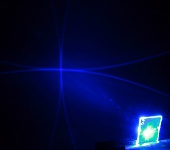
After being featured in New Scientist the work in the OSC on using organic lasers to detect explosives has received further attention. The story has been featured by numerous news organisations around the world, including BBC News, Times Online, Die Welt, The Scotsman, The Daily Mail and the Daily Record, amongst others.
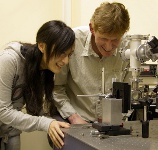 The research focuses on using organic lasers to sense very small quantities of explosive vapours and it is envisaged that this could be used in both battlefield situations and also in domestic environments such as airports. The university press release as well as the paper itself are available to read.

Skin cancer Treatment Launched and Highlighted on Sky, BBC and CBS News
12th March 2010
A wearable light source capable of treating common skin cancers has been launched today at the 2010 meeting of the European Society for Photodynamic Therapy. This breakthrough in skin cancer treatment was developed by Prof. Ifor Samuel and Prof. James Ferguson at Ninewells Hospital, Dundee. The idea started from Ifor's research on organic semiconductors as new light-emitting materials, enabling the light-emitting "sticking plaster" to be made. The new treatment could ultimately be given by general practitioners, removing the need for a hospital visit. More can be read on the Sky News, BBC News, and CBS News.

Nature Photonics Paper Published
1st October 2009
The Nature Photonics article discussing how to recognise a laser is published. More publications can be found here.

Organic Semiconductor Centre Wins Printed Electronics Award
4th December 2008
The Organic Semiconductor Centre has been awarded the Printed Electronics Academic R&D award for its innovative work, which includes advances in lasers, semiconductors and the treatment of cancer. Prof. Ifor Samuel collected the award at the ceremony held in San Jose, California. Read the press release

Prof. Samuel Wins Ben Sturgeon Award
15th September 2008
The Society for Information Display has awarded Prof. Ifor Samuel with their Ben Sturgeon Award in recognition of research achievements in the displays area. Prof Samuel and his team have been developing the use of electrically conducting polymers (plastics) that emit light, and which can be used in flexible displays. Read the press release

LED-pumped Polymer Laser Developed
6th May 2008
Ying Yang, a research student working with Dr Graham Turnbull and Professor Ifor Samuel has recently demonstrated an LED-pumped polymer laser. This development opens the way for a new generation of low cost tunable visible lasers. The work has been highlighted in a News and Views piece in Nature [1] and by optics.org and will be presented by Miss Yang in a talk at the prestigious International Conference on the Science and Technology of Synthetic Metals in Brazil in July. The published paper, was one of the top twenty downloaded articles on Applied Physics Letters.
• Read the press release
• View the Research Highlight
• Read the paper
• Find out more about our work on organic lasers