If we carry out a more detailed analysis we find that the actual output voltage will be
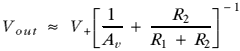
which

Now the 'actual' gain of a normal op-amp is in the range 100000 to 1000000 (or more!) hence provided we choose resistors which only 'ask' for gains of, say, up to a few hundred we find that the actual op-amp gain doesn't matter very much. For most practical purposes the gain of the op-amp feedback circuit is determined by the choice of the resistors. This has some important advantages.
- Firstly, we don't need to know the op-amp's 'real' gain since we can set the gain of the circuit with the resistors we choose.
- Secondly, it doesn't matter that when we pick two op-amps out of a box they may not have (and in fact, almost certainly won't have) the same values of gain. If we use the same resistors, we'll get almost exactly the same gain, no matter what individual op-amp we pick.
- Finally, many amplifiers have a gain which isn't constant. It tends to vary with temperature, signal frequency, signal level, etc, etc. These effects all tend to distort the signal when we try to amplify it. By using a feedback arrangement we ensure that it is the resistors which control the gain, not how well the op-amp is feeling today! Hence feedback tends to suppress unwanted signal distortions.
In the above example we've seen how the feedback network can be used to control the amplifier's behaviour and ensure that the system's gain is determined just by the chosen resistor values. We can now extend this use of feedback to the power amplifier introduced in part 9.
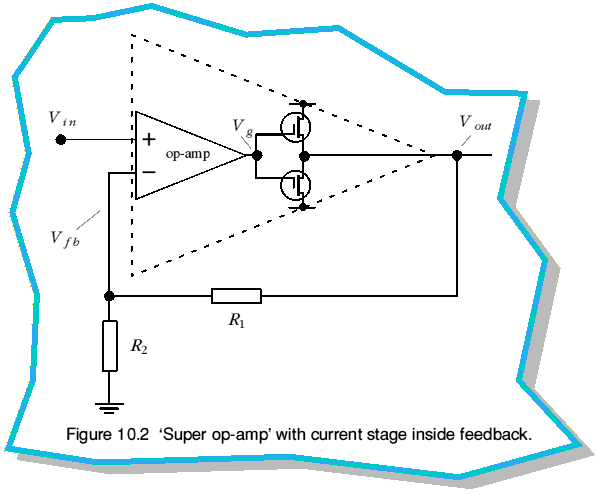
Figure 10.2 illustrates this power amplifier once again. Looking at this we can see that the output current stage is inside‘ the feedback loop of amplifier & feedback resistors. As a result, we can consider the current stage just as if they were hidden inside the op-amp, boosting it's inherent ability to produce current for the load. The op-amp & FET combination makes a sort of super op-amp‘ inside the dotted triangle.
We can then use exactly the same arguments as before to show that the system's output voltage will always be times the input signal. The feedback network and op-amp act to control the current stage FETs & make them output the current needed to obtain the required output voltage. In effect, op-amp & feedback are a control system to make the current stage do exactly what's required.
Summary.
You should now know that an operational amplifier (or op-amp) amplifies the difference between the two input voltages presented to its inverting and non-inverting input pins. That the gain of a good op-amp is very large - so large that, for most purposes, we can pretend it's infinite. That this means the op-amp requires virtually no input signal current. That the op-amp 'wants' to have the same voltage on its two inputs.
You should also know that a feedback network can be used to control the overall voltage gain of an op-amp/feedback system. That, using a pair of feedback resistors as illustrated in figure 10.1, we can set the system's voltage gain. That this means we can reduce the effects of those amplifier imperfections which tend to distort the signal being amplified. You should also understand how feedback can be used to allow an op-amp to control the output from a current stage or other power amplifier and ensure accurate output.


 Content and pages maintained by: Jim Lesurf (jcgl@st-and.ac.uk)
using HTMLEdit2 on a StrongARM powered RISCOS machine.
University of St. Andrews, St Andrews, Fife KY16 9SS, Scotland.