
being 8 hours of cinema devoted to the exploration of the Wars over 'IF'
Tuesdays 12 noon - 1pm in Lecture Room 23, Balliol, throughout Michaelmas Term 2009
Introduction | The Programme | Reading | E-mail us | Stop Press
This lecture course is designed to be accessible to complete beginners. Indeed, it is designed to be partly designed by said beginners. Each week we hitch-hike to a different destination, and the choice of destination will be down to you. The hope is to inspire you to think a little more deeply about English 'if' than the standard Logic course demands. So all that you need to do is sit back and enjoy the roller-coaster. But there is much to be discovered, and you might want a little more than that. In which case the facilities offered to Others will be of use to you too.....
There will be only a modest amount of didactic teaching in the lectures themselves. So for you, the weekly sessions are meant to provide a structure for your thinking. Beyond that, we offer detailed reading, and the chance to interact with The Merivale Society by sending in requests and questions.
So the lectures, and the website which manages them, will be interactive in two ways. First, the various destinations in the Hitch-hiker's Guide will be selected by the audience. And second, we guarantee to answer any questions you may have about 'if', and we guarantee to resolve any problems you may have.
See The Programme for details
...will unfold as term progresses, depending upon audience response and audience demand. There is a default programme available, but only the first four weeks are now fixed in stone. In Week 1 I took you back to an iconic moment in our history - 22 November, 1963 - to acquaint you with the original ....
There you were introduced to The Oswald Sentences, met The Widdy Wonder, and kindly allowed me a counterblast against her shibboleths concerning English Grammar. You learned the first, and founding, lessons of that discipline: that Truth is not a property of Sentences, but of the Messages they encode, and that it is The Message which determines The Sentence, and not the other way around.
In Week 2 we hitch-hiked back to April 1895, and took a train ride from Paddington to Bodmin along with two dubious characters who will be our guides for many weeks, to investigate
The Mystery of Modus Ponens
We did not solve said mystery, not its companion paradox, the Tortoise Regress. But with Holmes' help we assembled all the clues. Which means you have a chance to resolve it yourselves, before we publish the solution later in term. We ended with a genuine cliff-hanger, because it was now time to take one of the great train-rides of the world. In Week 3 we embarked at Grand Central Station, New York, to ride
The 20th Century Limited
to La Salle Street Sation in Chicago. We had our first look at Oswald sentences [B] and [C]. More importantly, we played poker and learned about Gibbardian stand-offs. And persuaded ourselves that the messages encoded by [B] and [C]
(i) cannot have truth values, because different thinkers, reasoning from different premises, could quite reasonably arrive at opposite verdicts;
(ii) the only difference in either verdict or reasoning was tense;
(iii) the reasoning was inductive, requiring the exercise of the aculty of imagination, and not deductive;
(iv) the reasonin was not performed within the message - as with Oswald [A], but lay behind the message as justification for the verdict.
And in Week 4 we hitch-hiked off to a Greek Island, to observe
The Battle of Salamis
and to learn from Aristotle himself how to think about the future. Namely that:
[1] The Future has a different Logic to Present and Past. From which it follows that
[2] Messages about the Future do not have Truth-Values, and that
[3] 'Will'and 'Will not' are not related as contradictories but merely contraries.
Nest week is a week off from the hard intellectual style so far, because this time I want to speak to yur emotions, as I invite you to join me at
The Defining Moment of the 20th Century
As always, there will be no need to take notes. Every week, one hour after the lecture, I shall post:
Just click on the appropriate week:
Week 1 | Week 2 | Week 3 | Week 4 | Week 5 | Week 6 | Week 7 | Week 8
Captain Merivale Writes pops up in a separate window, and will post answers to any questions you may have. E-mail us
Requests from us means exactly what it says on the tin.
Reading lists, for those who wish more intellectual detail, will be published each week after the lectures. Just click on the appropriate link below.
Week 1 | Week 2 | Week 3 | Week 4 | Week 5 | Week 6 | Week 7 | Week 8
If you liked my diatribe against the Widdy Wonder, you can find more of the same venom in chapter 12 of
The Language Instinct, by Steven Pinker, Penguin 1995.
And while you are there, you can learn more about English and its grammar from chapters 1,4 and 5. Hell, why not read the whole book? And if you are unsure of the basic vocabulary of the toiling grammarian, there is a nice resource, The Internet Grammar of English.
Some of you might like to have just a little more on the phenomenon of Ambiguity, Here is a set of (very condensed notes) that we hand out to young logicians at Balliol. If you would like something more closely tailored to the lecture course, e-mail us and we will produce.
Some of you might like to actually read "The Adventure of Silver Blaze", complete with the original illustrations by Sidney Paget in The Strand magazine. And others may wish to flesh out my sketchy account by reading "What The Tortoise Said to Achilles", published in Mind 4, No. 14 (April 1895): 278-280. There are hundreds of articles which attempt to solve the Tortoise Regress, as it is known. You could google some, and see what you think. Some get close to our preferred simple solution, but we have not seen one that really gets there. If you come across one in your squirrelling, please let us know. We will reveal our solution in full detail later in term. Before then you have a chance to work it out for yourselves. We have given you all the clues.
If you would like to see Carroll's Tortoise idea deployed to a quite different end, you might like to read Simon Blackburn putting the boot in to Rational Choice Theory. His nice little whimsy is "Practical Tortoise Raising", published in Mind, New Series, Vol. 104, No. 416 (Oct., 1995), pp. 695-711.
Henry Gondorff was our poker player. But in the literature he is known as Sly Pete, Alan Gibbard's creature. You may wish to read an article by Our Revered Leader which discusses the Sly Pete case. The entire opus is available here. And the article you want is called 'Jackson Classifying Conditionals'.
We recommend nohing particuar this week. But you are welcome to peruse the opus of Our Revered Leader, given last week. And you might care to actually read De Interpretatione 9, made available through the links in the Programme for Week 4.
Most encouraging. Thank you very much. More than 90% of you are already right about the Oswald Sentences. And the few dissenting voices were dissenting for reasons which will very soon bring them back onside. Not one dissenting voice was articulating the reasons of the opposition. Indeed, one of you - let us call her Miss New Zealand - put her finger so accurately on the major logical difference between the message encoded in [A] and the messages encoded in [B] and [C]. [A], she said, encodes a piece of deductive reasoning, premised on the obvious ground that someone shot Kennedy. And [B] and [C] do not. Exactly so. We are delighted. I shall contact Emanuel Goldstein himself, and pass on the good news.
The rest of term will be devoted to articulating the thought you all must have been having. Meanwhile, you might care to refresh your memory of the slides. Or you might like to reacquaint yourselves with the original Nightmare on Elm Street. Or perhaps to rehearse the details of my counterblast to The Widdy Wonder, perhaps pausing to check out The Widdy Web, maybe even glimming the Widdeo Video.
For the true ghouls amongst you, here is The Zapruder Film.
And for hardy souls there is also a little reading.
And for the dissenters, we very much hope that you continue to attend and articulate your dissent. For this will tell us where we need to focus our attention.
Reading for Week 1 | Back to main programme | Back to main menu
Well, that was hard work, wasn't it? Here are the slides. And here is a web page containing everything I have to say about compound messages. Just click on compounds, and read whatever you like. There is much avuncular advice on formalising English messages into Propositional Calculus. And there is also some reading. Further notes on the lecture will be posted when we return to the topic of Oswald Sentence [A] later in term..
Reading for Week 2 | Back to main programme | Back to main menu
Well, that was interesting for us, at least. Your responses to the Poker experiments encourage the thought that we are on the right lines. More about fantasy next week, when we visit Salamis. Meanwhile, here are the slides. And there is also some serious reading.
Reading for Week 3 | Back to main programme | Back to main menu
Ah! Salamis at last. Here are the slides, and here is your one-way tourist ticket to Salamis, complete with day-trips to see Aristotle, De Interpretatione and The Persians.
Reading for Week 4 | Back to main programme | Back to main menu
Reading for Week 5 | Back to main programme | Back to main menu
Reading for Week 6 | Back to main programme | Back to main menu
Reading for Week 7 | Back to main programme | Back to main menu
Reading for Week 8 | Back to main programme | Back to main menu
So far, only one:
We agree with John Langshaw Austin that the empirical study of English grammar, of how messages are articulated in English sentences, is crucial to the semantic enterprise. And we have an argument. That any semantic proposal is committed to some or other grammatical dogma, for whatever the proposed semantic account of a given message, there must be an answer to the question.
How does English encode this message in the output sentence?
It is routine for philosophers and logicians to dismiss grammar as irrelevant, but we are unaware of any decent argument for that cavalier approach. Indeed, we cannot even find anything worthy of a response. The best we have so far are two:
[1] The Apostate in private correspondence:
"I just don't see why grammar should be so much in the driving seat".
True, no doubt. He just doesn't see it. Thank you for sharing.
[2] Hugh Mellor quoting Frank Ramsey with approval:
....as Ramsey said of the subject-predicate distinction, ‘The task on which we are engaged is not merely one of English grammar; we are not school children analysing sentences ... but are interested not so much in sentences themselves as in what they mean.' So what matters here is not the grammar of English ‘If'-sentences but what we use those sentences to express.
D.H. Mellor, 'How to Believe a Conditional', Journal of Philosophy 90 (1993) p. 240, quoting Ramsey, Foundations, edited D.H. Mellor (London: Routledge, 1978) at p. 13..
We refer our Honourable Friend to the answer we gave a moment ago. Establishing what sentences mean is the very business of the grammarian. A grammatical analysis of a sentence lays out how what it is found to mean is articulated in its assemblage of words, and so shows how what is meant is structured, and out of what components. The very first questions the semanticist confronts.
So our question is:
Back to main programme | Back to main menu
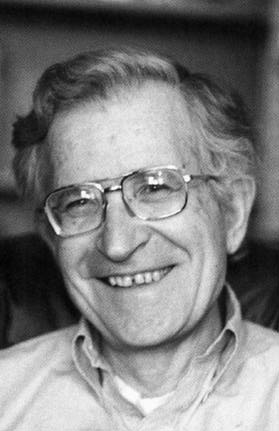
The notes and other ancillaries are only posted after the lectures. But while you are here, why not meet a philosopher? Today, Noam Chomsky has a message for you. Just let your mouse drift over his picture.
Back to main programme | Back to main menu
Back to main programme | Back to main menu