ELVIS
ELVIS Project Overview
Microchip Laser Research Group

 .
.
The Q-switched laser developed at St Andrews for
the ELVIS Project. The brass tubes at the left hold the lenses
that collimate and focus the pump lght. The gain crystal is in the
left hand mirror mount, and the mirror is visible on the right hand
mount. In between is the electro-optic deflector. The deflector,
which was developed and fabricated at Leysop, is shown in the picture
below.

The application of the ELVIS laser required active Q-switching to
produce pulses in the nanosecond range. This leads to a demand for a
short laser, and a concomitantly short and low loss Q-switch. The
quadrupole electro-optic deflector was chosen for this. The
quadrupole deflector works by using an electrode geometry that
provides a linear variation in transverse electric field with
distance up the active aperture. When the drive voltage is applied
(~900 V), the refractive index gradient that is produced leads to a
deflection of the laser beam that passes through the device. The
deflector acts much like a prism in this regard. When the voltage is
removed, the beam can pass straight through. The deflection is
sufficient to prevent laser oscillation, and so the device can act as
a Q-switch. There is no need for additional polarisers, and the
deflection is effectively independent of temperature. This means that
the Q-switch is compact, low loss, and relatively insensitive to
environmental parameters.
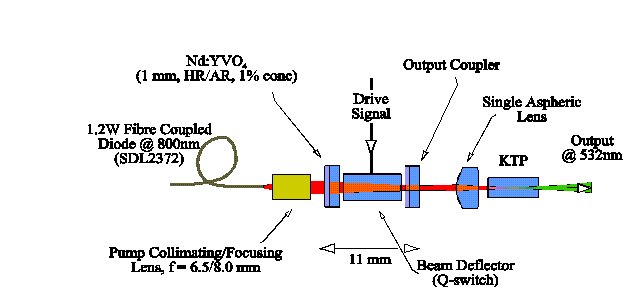
This novel Q-switch was used in a short laser cavity, as shown
schematically above. This consisted of a 1mm thick slice of 1%-doped
Nd:YVO4, which was pumped with 1.2 W from a fibre-coupled
diode laser. The 50% output coupler was placed close to the end of
the deflector, which resulted in a cavity of length approximately 12
mm. At a repetition rate of 2 kHz, when pumped with 1.2 W, this laser
produced pulses of ~1.3 ns full width half maximum and peak power 14
kW. At 20 kHz the pulses were 1.5 ns long and of 6.8 kW peak power.
These infra-red pulses were then passed through a KTP crystal outside
the cavity. At 20 kHz this resulted in a 42% conversion efficiency to
the green, generating 1.1 ns pulses of 3.9 kW peak power. The timing
jitter was better than 0.5 ns, and the amplitude jitter was better
than 8%. These characteristics made this laser appropriate for the
imaging applications of the ELVIS
system.
This work was supported in part by the DTI through
the LINK project ELVIS. The project collaborators are GEC Marconi
Ltd, Elforlight Ltd, Leysop Ltd, Tritech International Ltd, and the
University of St Andrews. Support was also provided through EPSRC
grants GR/K14766 and GR/L27345.
For more information please contact one of
Bruce Sinclair, School of Physics and Astronomy, University of St
Andrews, St Andrews, Fife, Scotland, KY16 9SS,
email b.d.sinclair@st-andrews.ac.uk
OR
Dr Leslie Laycock, GEC Marconi Research Centre, Great Baddow,
England,
email leslie.laycock@gecm.com