School of Physics and Astronomy at St Andrews


Dr Graham Friel working on the ELVIS pulsed laser.
School of Physics and Astronomy at St Andrews
Dr Graham Friel working on the ELVIS pulsed laser.
A pulsed microchip laser is at the heart of an exciting new underwater imaging system called ELVIS (Enhanced Laser Vision System). The laser will be mounted in a remotely-operated miniature submarine, and the pulses of green light will be used to map out the state of pipelines in the North Sea, or to search for underwater mines to dispose of them.
Seawater around our coasts scatters light strongly, which means that remote video inspection of pipelines is difficult, and can be carried out only from a very close range. At longer distances sonar is used. The use of light pulses in a manner similar to radar or sonar can allow a high resolution depth-scaled image to be obtained from some distance. A problem of optical ranging, however, is backscatter from suspended particles in the water. This is overcome by using a wavelength of relatively low attentuation, and a detection system which does not "see" the backscattered light from most of the water volume between the laser and the object being probed. By looking at the reflected light as a function of time, the light scattered by the "dirty" seawater can be distinguished from the light reflected from the object being examined. If the pulses from the rapidly pulsing laser are scanned into different directions, a fully three dimensional picture can be built up. A picture showing the proposed deployment method is shown below (image courtesy of Marconi Electronic Systems).

The Marconi Electronic Systems Remotely-Operated-Vehicle, into which it is intended that ELVIS technology will be mounted. Picture courtesy of, and copyright, Marconi Electronic Systems.
The ELVIS (Enhanced Laser Vision Systems) consortium was funded by a DTI/EPSRC Photonics LINK scheme, and consisted of the following collaborators:-
|
Lead site, with interest in exploitation of results in their products. |
|
|
Leysop |
Electro-optic specialists |
|
Laser engineering and development |
|
|
Market research and positioning |
|
|
University of St Andrews |
Laser research |
At the heart of this system is an ultra-compact pulsed solid-state laser developed at St Andrews and engineered by Elforlight. Details of one relevant design were recently published [G.J. Friel, R.S. Conroy, A.J. Kemp, B.D. Sinclair, J.M. Ley:, Q-switching of a diode-pumped Nd:YVO4 laser using a quadrupole electro-optic deflector, Appl Phys B 67 (1998) 2, 267-270]. An evaluation of the required laser source showed that we needed to generate green pulses about 1 ns long with a few microjoules of energy, at a repetition rate of 20 kHz. As this laser was required to be compatible with an existing small underwater vehicle, there were also stringent demands on the size and efficiency of the laser. This, combined with economic considerations, was a major challenge. However, with the use of a novel electro-optic Q-switch developed by Leysop, we achieved the design goals, as detailed in a section on the scientific details of the laser system. These features allow the generation of a short (<1.4 ns) intense pulses at 1.06 micrometres. The high intensities of these pulses allow the efficient generation of their second harmonic by single-pass frequency doubling in the nonlinear material KTP. As well as its application in the imager, we were also successful in applying this novel pulsed source to the generation of longer wavelengths through the use of an intra-cavity optical parametric oscillator [R S Conroy, C F Rae, G J Friel, M H Dunn, B D Sinclair, J M Ley , Compact low-threshold Q-switched intracavity optical parametric oscillator, Optics Letters 23, (1998), 1348].
Report on pulsed laser on the Alpha Galileo Website.
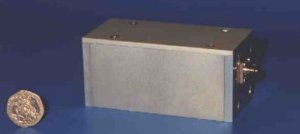
The picture shows an engineered prototype of the Q-switched
laser.
Specifications of a related laser
marketed by Elforlight (after connection click on lasers then
SPOT)
GEC took responsibility for the systems design and engineering of the vision system into which the laser is mounted. The entire assembly of laser, scanner, and detection system was designed to be compact and robust, and ready for use in adverse conditions. GEC and Tritech provided valued input in terms of the necessary specifications for the vision system for defence and commercial markets respectively.
At St Andrews we also worked on single-frequency frequency-chirped continuous-wave green lasers, as these could also be used in an imaging system (and many other applications). Again, we successfully developed a miniature, simple, and efficient laser system to meet the ELVIS specifications. Studies of the fundamental physics of operation of miniature diode-pumped microchip lasers were also carried out. These have given us important new understanding of the mechanisms defining the width of the output laser beam, and have explained a self-Q-switching effect that we observed under particular conditions.
For more information please contact one of the following:
For the laser science
Bruce Sinclair, School of Physics and Astronomy, University of St
Andrews, St Andrews, Fife, Scotland, KY16 9SS,
email b.d.sinclair@st-andrews.ac.uk
OR
For commercial and applications interest
Dr Leslie Laycock, GEC Marconi Research Centre, Great
Baddow, England,
email leslie.laycock@gecm.com
The work at St Andrews was supported by a grant from EPSRC number GR/L23345 entitled ELVIS - Enhanced laser vision systems - microchip lasers. The principal investigator was Dr Bruce Sinclair, and the researcher employed by the grant was Dr Graham Friel. PhD students Alan Kemp and Tanya Lake also contributed to the work.