
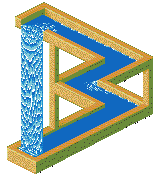
Every time you allow an electron to move (i.e. allow itself to be pulled) on to an object at a potential +V, you liberate an energy eV. So why can't you go on doing
this steadily, forever? Why isn't this a perpetual motion machine capable of providing us with an endless supply of energy?
The answer comes from what we had to do to give the charged object a potential in the first place. To give it a positive charge we had to remove some of
its electrons
Consider an object which starts of being neutral. We then remove, say, 1000 electrons to give it a positive electric potential, V. Then we
release a free electron and it is pulled onto the object. When it lands it releases an amount of energy, eV.
The object now only has 999 electrons missing, and its potential is reduced to 0.999×V.
When we try dropping another electron on to the object it is not pulled quite as strongly, and when it lands it releases and energy of 0.999×eV. It
also reduces the charge a little more to 0.998×V.
Each time we drop an electron on to a positively charged object we give it a new electron and reduce its positive potential. This has two effects. It lowers
the amount of energy released when subsequent electrons arrive, and it moves the onject back toward being electrically neutral. Once we have replaced
all of the 1000 electrons that we originally removed the object is neutral again. It then will not attract any more electrons, nor will they release any
energy when they arrive.
A simliar arguement applies to an object which has been negatively charged by giving it, say, 500 electrons. In this case, each time we allow an electron
to 'escape' from the negatively charged body it will be pushed away, giving it some released kinetic energy. However, as each electron escapes it
reduces the number of extra electrons held by the object. This reduces the object's negative potential making it push away any newly released electrons
less strongly.
The energy available from 'dropping' electrons on to a positively charged object (or liberating them from a negatively charged one) is finite.
It depends on how big the potential for the object is - i.e. on the number of electrons 'missing' or 'extra'. Once we have used
this up, the object is the electrostatic equivalent of a flat battery.
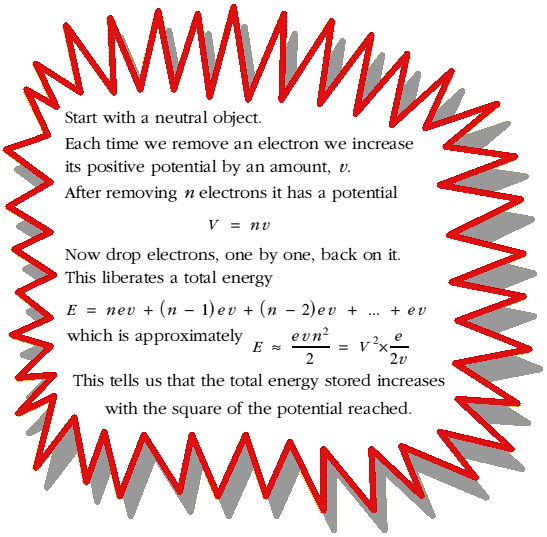 To charge up an object with this energy in the first place we have to destroy its neutrality by removing (or adding) electrons. This means we have
to drag electrons against the force produced by the object that we are charging. For example, we have to pull electrons away from a positively charged object
as we give it more positive charge. This means that we have to do some work - provide some energy - which is liberated when we reverse the process and
allow electrons back on to the positively charged object.
The energy released when we neutralise or discharge the object is exactly equal to the amount we put in when we gave it the potential,
hence we cannot get anything out for free!
To charge up an object with this energy in the first place we have to destroy its neutrality by removing (or adding) electrons. This means we have
to drag electrons against the force produced by the object that we are charging. For example, we have to pull electrons away from a positively charged object
as we give it more positive charge. This means that we have to do some work - provide some energy - which is liberated when we reverse the process and
allow electrons back on to the positively charged object.
The energy released when we neutralise or discharge the object is exactly equal to the amount we put in when we gave it the potential,
hence we cannot get anything out for free!
The change in the potential of an object when we add or subtract an electron will depend on the object's size and shape, and what it is made of. The value linking the change in charge to the change in potential is called the capacitance of the object. Hence the electronic devices which make use of this effect are called capacitors.
Electronics homepage
Course contents
 Content and pages maintained by: Jim Lesurf (jcgl@st-and.ac.uk)