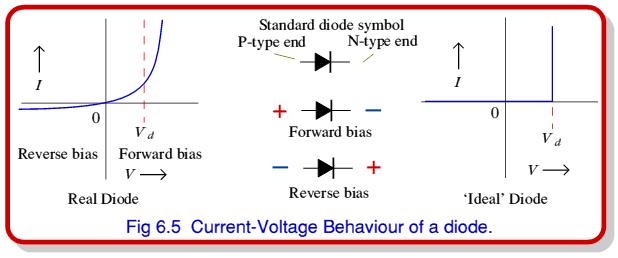
The diode's electrical behaviour can be seen in the ‘real diode’ graph illustrated in figure 6.5. The polarity of applied voltage which produces virtually no current is called Reverse bias. On the basis of the explanation given above we might expect no current to flow when the diode is reverse biassed. In reality, the energies of the electrons & holes in the diode aren't all the same. A small number will have enough energy to overcome the barrier. As a result, there will be a tiny current through the diode when we apply reverse bias. However, this current is usually so small we can forget about it.
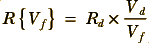
The polarity which produces a significant current is called Forward bias. When we raise the forward bias voltage we reduce the diode's energy barrier. This essentially reduces the diode's resistance. We might therefore expect it's effective resistance to vary approximately  . i.e. we can say that the diode's effective resistance at a given forward voltage will obey an equation like
where  is the actual diode's resistance when we apply a forward voltage equal to
  . From the definition of resistance we can say that
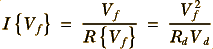
  . Combining this with equation 3 we can expect that the resulting current will be
The interesting result of the above argument is that it predicts that the current in a forward biassed diode varies with the square of the voltage. Diode's don't obey Ohm's Law! A more accurate analysis of the physics of a diode shows that the IV curve isn't a square-law but an exponential relationship of the general form
where the values of  depend upon the diode. This is the sort of formula you'll see quoted in most textbooks (especially physics ones rather than engineering books). In fact, the actual IV relationship of a real diode will depend on the details of how it was made. It's rarely exactly either a square-law or an exponential, but for many practical purposes assuming square-law behaviour quite OK. This square law approximation simplifies things in many situations.
For some purposes we can simplify the diode's behaviour even more & pretend it's IV behaviour is like the ‘ideal’ diode curve shown in figure 6.5. Here we assume that no current flows unless we attempt to apply a voltage  . The diode then conducts as much current as we like without a higher voltage ‘drop’ across the diode. Most modern diodes are made of silicon. For this semiconductor material,
  Volts. Hence, to a first approximation we can say a diode only conducts when the forward voltage is half a volt. From the viewpoint of a solid-state physicist, this model of the diode is hopelessly over-simplified. We should really remember that a forward biassed diode always passes some current, but this current is small unless the applied voltage is around half a volt. Despite that, it's good enough to explain how lots of the circuits which use diodes work!
 Content and pages maintained by: Jim Lesurf (jcgl@st-and.ac.uk)
using
TechWriter Pro and HTMLEdit on a StrongARM powered RISCOS machine.
University of St. Andrews, St Andrews, Fife KY16 9SS, Scotland.