
Now, when measuring the signal's mean power with a resistor & thermometer we don't always know anything about the signal pattern — i.e. we don't always know if it's d.c., a sinewave, or more complicated. All we know are a power and a resistance. A given measured average power, P, could be produced by any signal pattern whose average squared voltage was 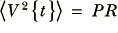 . The three signals (d.c., sinewave, & complicated) shown in figure 4.1 can now all be said to have the same ‘size’ if they produce the same amount of power — i.e. when


Hence this technique of measuring a mean power gives us a way to compare the sizes of signals without having to worry about the details of their variations.
From equation 7 we can now define a voltage,  , calculated from the measured power


i.e.


This quantity,  , can be used to represent the size of the signal's voltage no matter what the signal pattern is. The rms stands for root mean square and indicates that it is a value which depends upon the square root of the time average (mean) of the voltage squared. Root mean square voltages (and other quantities, like currents) are a convenient way to represent the signal size since we don't have to bother with the signal's shape. As a result rms voltages and current values are widely used to indicate the sizes of signals. In effect, when we say a given signal has an rms voltage level,
  , we're actually saying that it carries the same power as a steady d.c. voltage of
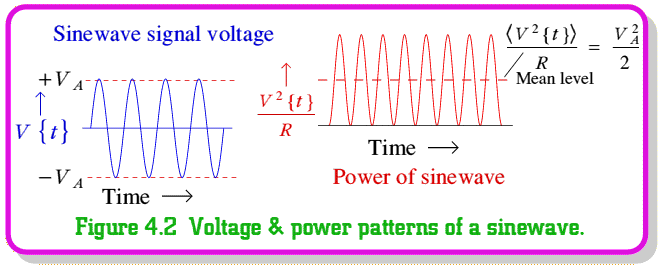
  volts. For a sinewave we can expect that
 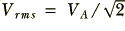 . Since we've already found that
  we can use an oscilloscope to determine a sinewave's rms voltage by noting the peak-to-peak voltage an using

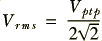
Note, however, that equation 10 is only correct for sinewaves.
Waves like squarewaves or trianglewaves have different  ratios. Some
waveforms — e.g. the complicated one shown in figure 4.1c on the
previous page — don't even have a unique peak-to-peak value!
ratios. Some
waveforms — e.g. the complicated one shown in figure 4.1c on the
previous page — don't even have a unique peak-to-peak value!


 Content and pages maintained by: Jim Lesurf (jcgl@st-and.ac.uk)
using
TechWriter Pro and HTMLEdit on a StrongARM powered RISCOS machine.
University of St. Andrews, St Andrews, Fife KY16 9SS, Scotland.