FETi can be prevented from spiking by injecting negative current. However, when this is done, the FlTi motorneurons still produce high-frequency spikes just as in the normal motor programme.
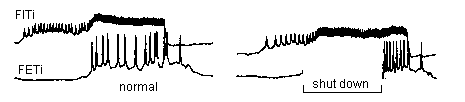
There may be some subtle difference in FlTi spike pattern, but clearly the FETi-FlTi connexion is not needed for the main features of the motor programme to be expressed.
The extensor muscle can be prevented from developing any tension by cutting the axon of FETi with a laser. When this is done a "fictive" motor programme is produced, which looks similar in most respects to the normal programme, but which does not produce any leg extension.

One difference is apparent - the FlTi trigger inhibition is not so "sharp" in the fictive motor programme produced with no extensor muscle tension, as in the normal programme. Other than that, the programme is once again more-or-less normal
The same game can be played with the M neuron as is descibed for FETi above - it can be prevented from spiking by injecting negative current. When this is done, the motor programme still shows the trigger termination of the FlTi activity, but, just like in the fictive motor programme, it is not so sharp as in the normal programme.