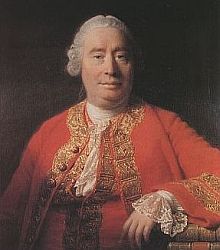
Section X of Hume's Enquiry Concerning Human Understanding is entitled Of Miracles, and it is one of the finest philosophical essays ever written. A model of elementary intellectual hygiene. It is set against a particular historical background: senior clergy and others in the self-styled Rationalist Movement are arguing that the question of God's existence can be settled on straightforward empirical principles. More precisely, they are arguing that there are two sources of compelling scientific evidence for the existence of the Christian God: miracles and design. Hume tackles the propriety of belief in miracles in Section X of the Enquiry, and demolishes the Design Argument in Section XI.
David Hume
An Enquiry Concerning Human Understanding, 3rd edition, ed. Selby-Bigge , revised P.H. Nidditch. Be sure to consult this precise edition - others may not contain the Appendix on Miracles.
Richard Swinburne
C.D. BroadThe Concept of a Miracle , MacMillan , London 1970 Miracles , Collier MacMillan , London 1989. Swinburne has aslo edited a collection of articles: Miracles , Collier MacMillan , London 1989.
‘Hume's Theory of the Credibility of Miracles', Proceedings of the Aristotelian Society , 1916
J.L.Mackie
The Miracle of Theism , Clarendon Press, Oxford 1989
Advice
As always, read the primary source first. If you don't, you are forever doomed to see it through someone else's spectacles. Which would be an especial shame here, given the quality of the piece. So: read it through as an essay. Then go over it again most carefully, this time as a philosopher searching for the precise details of its arguments. Then think about it. Then check out the Appendix on Miracles. Again, most carefully. (Some editions of the Enquiry do not contain the Appendix, or give it only as a long footnote. Be sure to find it).
Your next task is to sort out the precise nature of Hume's argument concerning the legitimacy of belief in miracles. Many commentators have misunderstood. Mackie is not one of them, so you can get some help from chapter 1 of his book.
Then work out the opposition. Swinburne's shabby little book, The Concept of a Miracle contains many anti-Hume manoeuvres. Try and work out how Hume would deal with them.
Charlie Dunbar Broad's article accuses Hume of proving too much. According to Broad, the upshot of Hume's position is that we should never believe in striking and unexpected events, and that this would make the progress of science impossible. Again, try to work out how Hume would respond.
The Swinburne collection, Miracles , reprints the Hume and the Mackie , and also contains other articles, which you are welcome to read in search of illumination, but I do not recommend any of them strongly.
Choose your own title for your essay. If you would prefer me to impose one, here it is:
If the stars wheeled in their courses to spell out ‘I A-M T-H-E L-O-R-D T-H-Y G-O-D', could it be rational to remain an atheist?
-oOo-