TUSLIP
Day of Physics Schedule |
Participants should try to arrive between 9.45 and 10.15. Please report to the
TUSLIP table just inside the main entrance of the School of Physics and Astronomy on the
North Haugh site of the University of St Andrews.
Those who have pre-booked experiments should register on one master sheet,
while those who have yet to choose their experiment should sign up for one
of the experiments that is still available. Travel
Suggestions
| TIMETABLE -
currently subject to change. 10.10 - 12.05 Laboratory work in our first and
second year laboratories.
12.05 - 13.00 "Real" lecture from our first year Waves and Optics
course, Dr Bruce Sinclair, University of St Andrews
13.00 - 13.40 Lunch in main concourse. This is an opportunity
for pupils to meet each other, students from Dundee and St
Andrews, and staff from the two sites.
Visitors are asked to bring their own packed lunches.
13.45 - 14.00
Physics in action -
"Acoustic Tweezers and the Real Sonic
Screwdriver?" Dr Mike MacDonald, University of Dundee.
14.00 - 14.05 Comments on
physics study at university from a former pupil of Kirkcaldy High
School, fourth year student and recent School Student President Claire
Motion.
14.05 - 14.20 Interlude: physics demonstrations and discussions
with current students
14.20 – 14.40
Careers using Physics - Dr David McGloin, University
of Dundee
14.40 - 14.55 Low temperature physics, members of the Scottish Doctoral
Training Centre in Condensed Matter Physics
14.55 – 15.10
Astronomy in action - Professor Moira Jardine, University of St
Andrews
|
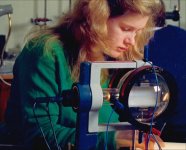 Work
in the teaching laboratories will be conducted in pairs (sometimes threes),
and in most cases there will be several students tackling the same topic.
There is a range of experiments available, each of which we hope visitors
can complete within 100 minutes. These are mostly adapted
from experiments that our students undertake. Many are relevant to
work that visitors will be doing in Advanced Higher Physics.
Our staff and students will be on hand to guide, offer assistance, and to
comment on achievements. They will also be happy to answer any queries of a
more general nature. The experiments are taken from the lab work that our
first and second year students do. Generally, those tackling the first year
experiments will receive more verbal
instructions on what to do, and those tackling the experiments in
later labs will be
expected to work more from the printed sheets. In both cases though, our staff and
students are there to help - please use them! We will provide a sheet entitled "Experiment Record",
but please bring your own pen, pencil, ruler, and calculator. Where both members of a pair are from
one school, please would they use this one sheet between them to record details as
requested (if the two experimenters are from different schools, then please use one sheet
each). Please ask our demonstrators to comment on this sheet and your results before
leaving the labs. These experimental studies may be
useful for part of your AH studies; please discuss with your teachers in
advance. Work
in the teaching laboratories will be conducted in pairs (sometimes threes),
and in most cases there will be several students tackling the same topic.
There is a range of experiments available, each of which we hope visitors
can complete within 100 minutes. These are mostly adapted
from experiments that our students undertake. Many are relevant to
work that visitors will be doing in Advanced Higher Physics.
Our staff and students will be on hand to guide, offer assistance, and to
comment on achievements. They will also be happy to answer any queries of a
more general nature. The experiments are taken from the lab work that our
first and second year students do. Generally, those tackling the first year
experiments will receive more verbal
instructions on what to do, and those tackling the experiments in
later labs will be
expected to work more from the printed sheets. In both cases though, our staff and
students are there to help - please use them! We will provide a sheet entitled "Experiment Record",
but please bring your own pen, pencil, ruler, and calculator. Where both members of a pair are from
one school, please would they use this one sheet between them to record details as
requested (if the two experimenters are from different schools, then please use one sheet
each). Please ask our demonstrators to comment on this sheet and your results before
leaving the labs. These experimental studies may be
useful for part of your AH studies; please discuss with your teachers in
advance.
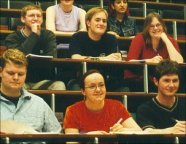 At 12.05
visitors will join a first year lecture on waves and optics. We have been asked by
teachers to let their pupils experience a conventional lecture. It is a lecture from part
way through the 16-lecture course. We hope most of it will be comprehensible to our
visitors. We have specifically been asked to give a "real" lecture, rather than
a gee-whiz-wow special set of demonstrations - some of which are included later in the
programme. We have sometimes been able to let TUSLIP visitors join a scheduled first year
lecture, but timetabling this year did not permit this. However, the lecture that is being
given to you is one that Dr Bruce Sinclair will be giving in a few weeks later to our
first year class. The waves and optics course is one of three that together make up one
module in the first year at St Andrews. A total of six modules are usually taken in this
year. Visitors are encouraged to try to take notes from this lecture in the same way that
our students would, so please bring pen and paper. We expect our students to take notes from the lecture, possibly
supplement these notes with information from text books, and certainly annotate further
when going over them later the same day. Subsequent working on tutorial questions allows a
good practice of the physics involved. At 12.05
visitors will join a first year lecture on waves and optics. We have been asked by
teachers to let their pupils experience a conventional lecture. It is a lecture from part
way through the 16-lecture course. We hope most of it will be comprehensible to our
visitors. We have specifically been asked to give a "real" lecture, rather than
a gee-whiz-wow special set of demonstrations - some of which are included later in the
programme. We have sometimes been able to let TUSLIP visitors join a scheduled first year
lecture, but timetabling this year did not permit this. However, the lecture that is being
given to you is one that Dr Bruce Sinclair will be giving in a few weeks later to our
first year class. The waves and optics course is one of three that together make up one
module in the first year at St Andrews. A total of six modules are usually taken in this
year. Visitors are encouraged to try to take notes from this lecture in the same way that
our students would, so please bring pen and paper. We expect our students to take notes from the lecture, possibly
supplement these notes with information from text books, and certainly annotate further
when going over them later the same day. Subsequent working on tutorial questions allows a
good practice of the physics involved.
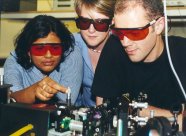 After the lecture visitors should make their way to the
main concourse for lunch. Visitors are asked to bring
their own packed lunch with them. Some
limited refreshments will be available for
purchase from the vending machines. Staff and students will be present for you to ask them
any queries that you may have about being a physicist. After the lecture visitors should make their way to the
main concourse for lunch. Visitors are asked to bring
their own packed lunch with them. Some
limited refreshments will be available for
purchase from the vending machines. Staff and students will be present for you to ask them
any queries that you may have about being a physicist.
The afternoon gives the opportunity for sixth year
pupils to interact with current students, to hear about career opportunities
using physics, and to hear short presentations, some with demonstrations, on
aspects of phyiscs and astronomy.
Return to TUSLIP Day of Physics Home Page
|