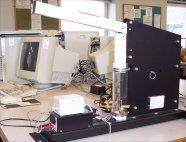
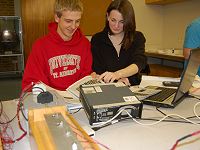
This level one experiment looks at the centripetal force, and how the centripetal force
needed to keep a mass travelling on a circle depends on the rotation rate and the radius
of the circle. It uses the PASCO rotational motion kit shown alongside. The
experiment ties in well with our mechanics courses at levels one and two. These
ideas are important for all circular motion, from planets to fairground rides to
centrifuges. We understand that a similar experiment is
part of the Advanced Higher syllabus.
It takes energy to raise the temperature of a liquid, but it also takes energy to
change the state of a liquid at its boiling temperature into a gas. This level one
experiment uses an electrical heater in a flask of liquid nitrogen to determine this
latent heat of vaporisation. This experiment is relevant to our level one structure
of matter course. The relatively large latent heat of liquid nitrogen allows us to
use it as a good coolant. The latent heat of water is important, for example,
in steam power, cooling rates of people, and atmospheric physics.
The ratio e/m for the electron is relatively easy to measure. A beam of electrons
travelling in an evacuated vessel is subjected to forces due to applied electric and
magnetic fields. By analysing the motion and using the two fields to counteract the
effects of each other, we are able to determine e/m. This experiment is relevant to
our first year structure of matter course. The properties of the electron are needed
for the design of a range of electronic devices, and many other aspects of science and
technology.
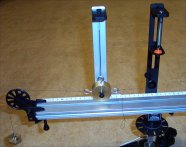
A stretched string will resonate at a set of well defined frequencies, corresponding to an integer number of half-wavelengths being present over the length of the string. A sensor similar to that used on an electric guitar is used to detect the motion of the string and this is analysed by a dedicated data collection and analysis programme on a computer. This is another level one experiment, tied in closely to the first year waves and optics lecture course. Standing waves and other resonances pervade science, ranging from the obvious guitar strings to the behaviour of electrons in atoms.
This is based on one of our level one astronomy practicals. Photographic images
of a star field are examined to classify the different types of galaxy. Observation
of the universe around us is our prime means for obtaining a better understanding of the
way that stars and planets are born, live, and die.
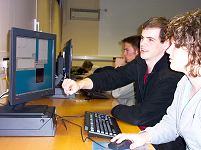
A simulation of an observatory allows students to see the moons of
Jupiter move around their planet. Observations then allow a
calculation of the periods of rotation, which can be combined with ideas of
circular motion to determine various properties of this astronomical system.
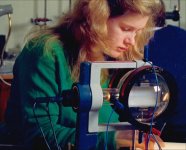
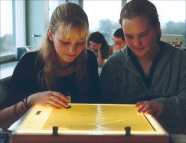
Light can be considered as a wave made up of electric and magnetic fields. The direction of the electric field is the direction of polarisation. Most light sources are randomly polarised, but light can be polarised by "Polaroid" filters and other means. Polarisation is important in a number of natural and man-made effects. This level two experiment explores the transmission of polarised light through polarisers, means of changing the polarisation of light, and the use of polarised light to determine stress in plastics and the concentration of a sugar solution. The experiment allows people to "see" the reality of vector components.
Lasers are now widely used in communications, medicine, data storage, and industry, and
are discussed in a number of our lecture courses at level one (lasers) and level two
(photonics), as well as at later levels. This level two experiment allows the
investigation of the propagation of laser light (much of which is underpinned by
diffraction), and means by which the wavelength of the laser light can be measured.
We have become accustomed to the use of zoom lenses in video photography to change the size of an image. This experiment starts off looking at the imaging properties of a single converging lens, then examines the way that three lenses can be used to create a simple zoom lens system which provides an image with variable magnification in the same location.
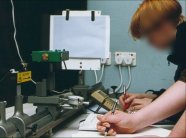
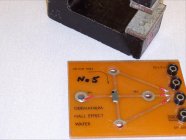
When an electric current flows through a semiconductor it may appear to be due to the motion of electrons in one direction or holes in the other. One way to determine which is the main charge carrier is to apply a magnetic field perpendicular to the current direction. This then sets up a voltage across the sample, the direction of which is dependent on the type of charge carrier. This experiment is based on a level two investigation, and is a link to some of the techniques that can be used to probe the physics of materials.
Hot bodies can lose energy by convection, conduction, and radiation. The amount of energy radiated as heat is expected to depend on the fourth power of the absolute temperature of the body (Stefan's law). This predicted dependence is tested for the filament of a torch bulb. Understanding of energy transfer by radiation is fundamental to our theories of stellar formation and burning, as well as various aspects of thermal engineering on a domestic and industrial level. Introduction to Radioactivity Radioactive sources are used in a well defined
environment. The stopping powers of various materials are measured,
and the counting statistics are explored. For a fixed mass of gas we expect the pressure, volume, and temperature to be related by PV/T being a constant. Some aspects of this relation are tested using a test rig interrogated by a computerised sensor system, using PASCO equipment. This investigation is based on a level two experiment. |
 R
R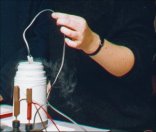
 Jupiter's
Moons
Jupiter's
Moons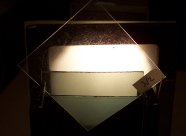

 Electrons in
semiconductors (
Electrons in
semiconductors (