MICROCHIP LASERS - a brief overview, October 1999
Bruce Sinclair, University of St
Andrews
 Microchip lasers
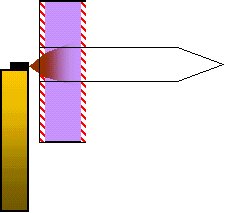
are perhaps the ultimate in miniaturisation of diode-pumped solid-state lasers. A thin
etalon of gain material (shown left in purple) has dielectric coatings applied to its
plane surfaces, and a diode laser (shown black with red beam) provides a strongly
localised pump source. The pump also produces thermal and gain related effects that
provide cavity stability mechanisms, allowing the production of a high quality TEM00 beam.
As first demonstrated a decade ago in Nd containing gain materials by Dixon and by
Zayhowski and Mooradian, the short length of these devices allows the generation of
single-frequency radiation in a readily mass produced laser. Scientists at Milan extended this concept into
telecoms applications by using Er-Yb:glass as
the gain material to generate tens of milliwatts of high-purity radiation at 1.5 mm.
Microchip lasers
are perhaps the ultimate in miniaturisation of diode-pumped solid-state lasers. A thin
etalon of gain material (shown left in purple) has dielectric coatings applied to its
plane surfaces, and a diode laser (shown black with red beam) provides a strongly
localised pump source. The pump also produces thermal and gain related effects that
provide cavity stability mechanisms, allowing the production of a high quality TEM00 beam.
As first demonstrated a decade ago in Nd containing gain materials by Dixon and by
Zayhowski and Mooradian, the short length of these devices allows the generation of
single-frequency radiation in a readily mass produced laser. Scientists at Milan extended this concept into
telecoms applications by using Er-Yb:glass as
the gain material to generate tens of milliwatts of high-purity radiation at 1.5 mm.
The functionality of the microchip laser concept can be increased, while still
maintaining its inherent simplicity and robustness, through the use of a
"sandwich" of the gain etalon with another material. This additional material
can take the form of a frequency-doubling crystal to shift the output of Nd devices into
the visible, an electro-optic material to allow for frequency tuning, or a saturable
absorber to permit passive Q-switching.
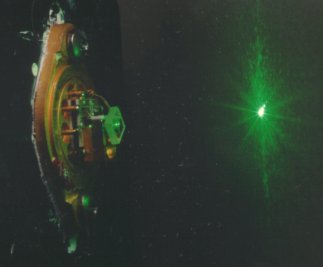 Work at St Andrews and at Hamburg
has explored intracavity frequency-doubled Nd lasers and produced tens to hundreds of
milliwatts of cw red, green, and blue light. The short cavities had low loss and a small
beam waists. This allowed the generation of significant circulating IR fields, and thus
efficient second harmonic generation. The short cavity lengths also contributed to reduced
intermodal coupling, and hence could remove the intensity instability known as "green
noise". This type of technology was marketed by Uniphase,
amongst others, as a replacement for air-cooled argon ion lasers in the reprographics and
biomedical industries, for example.
Work at St Andrews and at Hamburg
has explored intracavity frequency-doubled Nd lasers and produced tens to hundreds of
milliwatts of cw red, green, and blue light. The short cavities had low loss and a small
beam waists. This allowed the generation of significant circulating IR fields, and thus
efficient second harmonic generation. The short cavity lengths also contributed to reduced
intermodal coupling, and hence could remove the intensity instability known as "green
noise". This type of technology was marketed by Uniphase,
amongst others, as a replacement for air-cooled argon ion lasers in the reprographics and
biomedical industries, for example.
Zayhowski at Lincoln Labs led the way in the
development of passively Q-switched lasers. He sandwiches a slices of Nd:YAG with a slice
of the saturable absorber Cr:YAG to produce cavities about 1mm long. When pumped with one
watt from a fibre-coupled diode these devices produce pulses as short as 218 ps, pulse
energies as high as 14 mJ, time-averaged powers of up to 120
mW, with pulse repetition rates between 8 and 15 kHz. He has also demonstrated
quarter-millijoule output devices pumped with 10 W fibre-coupled diode laser arrays. The
high peak powers and near-ideal spectral and spatial output of all these devices makes
single-pass frequency conversion of their output rather efficient. One-watt pumped
microchip lasers have produced 7 mJ of green and 1.5 mJ of 266 nm at pulse repetition rates around 10 kHz. These short
pulses allow for compact LIDAR systems with 1 mm depth resolution, and the high
intensities are useful for laser-induced breakdown spectroscopy. They have also been used
to drive efficient optical parametric oscillators and amplifiers.
In Europe LETI-CEA
with Nanolase have successfully developed passively
Q-switched Nd:YAG lasers using a saturable absorber epitaxially grown on to the Nd:YAG
gain material, though in some systems Nanolase utilise a conventional slice of Cr:YAG.
These high-specification and relatively low-cost lasers are marketed for applications in
micro-fluorescence, ranging, and spectroscopy, amongst others. Devices operating at 1.55 mm and 1.06 mm have potential for use in
collision avoidance systems in cars. Again the ability to generate harmonic wavelengths
efficiently is important for many applications. Keller's group in Zurich has taken passive
Q-switching to a new record, producing 37 ps pulses at 1.06 mm
using a semiconductor saturable absorber, and have also used their SESAM technology at
telecom wavelengths.
There remains much interest in the physics of microchip lasers, both in terms of how
they work, and in their use for experiments in quantum optics.
Microchip lasers have found their own distinctive role. Their robust and readily
mass-produced structures are very attractive. Couple this with their single-frequency cw
performance, or their excellence at generating sub-nanosecond pulses, and one sees that
they are well suited for many applications.
Return to University of St Andrews Microchip Laser Group's Home Page