Research Framework

A Neuroethological approach to cognitve neuroscience

Neuroethology can be viewed as the study of behaviour as a function of responses of neurones and interactions between the neural responses that lead to the observed behaviour. The aim is to build models that explain behaviour based on the observed neural properties.

The complexities of animal behaviour - including that of humans - is incredibly complex and varied. The approach adopted in my laboratory has therefore been to combine a variety of methods to try and elucidate some likely candidates for particular aspects of our behaviour:

(1) The starting point is always the "natural" behaviour.
(2) What neural mechanisms might underlie the behaviour?
(3) How well do the postulated neural mechanisms explain the behaviour?

My primary research questions involve visually driven behaviour:

What visual features in an image are extracted that allow recognition? What happens to behaviour if we change certain features?
Why some features, not others? How sensitive are we to changes in features?
How are these features combined into a coherent whole? Is perception of some features dependent on percieving others?
What behavioural phenomena can be explained from the processing? What are the simplest models needed to explain the behaviour?
What constraints do observed neuronal properties place on models of behaviour? What are the relationships between behavioural phenomena?
How should we interprete neuronal activity? What does neuronal activity tell us about behavioural phenomena?

The framework for conducting the research:

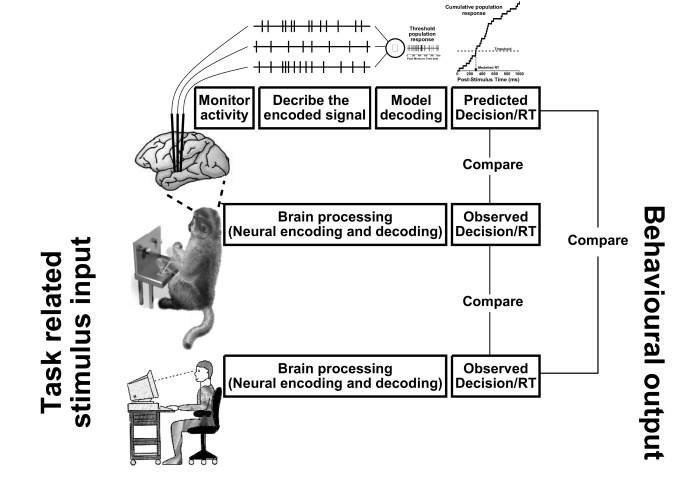
Schematic framework underlying the research. In its simplest form, information processing in the brain consists of a (possibly large) number of stages, each involving the encoded information carried by neuronal activity being decoded by the neurones receiving those signals. Indicators of visual perceptual efficiency can be obtained by providing subjects with visual stimuli while monitoring output measures of decisions (what the stimulus is) and the time it takes the subject to make that decision (recognition reaction time, RT). Behavioural studies are performed in both human and macaque to compare the perceptual efficiency of these two primates. Data from neurophysiological recordings of neuronal activity obtained while the macaque is performing perceptual tasks are used to describe relationships between the input stimulus and the neuronal activity (neuronal encoding) and to infer relationships between the neuronal activity and behavioural output of both human and macaque (neuronal decoding).

   Email with suggestions/bug reports: mike